
Common Mistakes People Make Choosing Travel Dates for Price
Most choosing travel dates for price mistakes come from looking at one number, the fare, instead of the whole trip. Moving your dates by a day or two can shift not just the flight but hotel rates, minimum-stay rules, and whether you arrive during a local holiday.
Here’s where people usually go wrong.
Only flexing the flight
Flight searches make it easy to see which days are cheapest, so people pick the lowest fare and book the rest around it. But the cheapest flight day can land you in a city on a Friday night when hotel prices jump, or force an extra night that wipes out the saving. Price the flight and the stay together for each date option before you decide.
The same applies to how you get there. A cheaper fare that lands at midnight may mean an expensive taxi, or a night near the airport you hadn’t budgeted for.
Ignoring school holidays and local events
Demand drives prices, and school holidays are one of the biggest drivers. They differ by country and even by region, so a week that’s quiet where you live can be peak season where you’re going. Many governments publish their dates; the UK’s official school term and holiday dates page is one example, and it’s worth checking the equivalent for your destination too.
Local festivals, trade fairs, and sports events have a similar effect on hotels. A quick search for events in your target week can explain why one set of dates costs far more than the next.
Assuming the day of the week is a rule
You’ll hear that certain weekdays are always cheapest to fly. Sometimes midweek flights are less busy, but airline pricing changes constantly and varies by route. Treat any fixed rule as a hint, not a guarantee, and check the actual prices for your route across a spread of dates.
Forgetting the cost of time
Saving money by flying out on a day that eats a vacation day, or taking an early departure that needs a hotel the night before, isn’t always a saving. The same goes for long connections picked purely for price. Our guide to mistakes people make booking connecting flights covers how much layover time is reasonable, and the extra hours have a cost even when the ticket is cheaper.
Locking in too early on a cheap fare
The lowest fare classes are often the least flexible. If you book the cheapest possible date before your plans are settled, a change fee can cost more than you saved. Budget carriers are especially strict here; common mistakes people make booking budget airlines explains where those fees hide.
Choosing travel dates for price mistakes: not comparing a full window
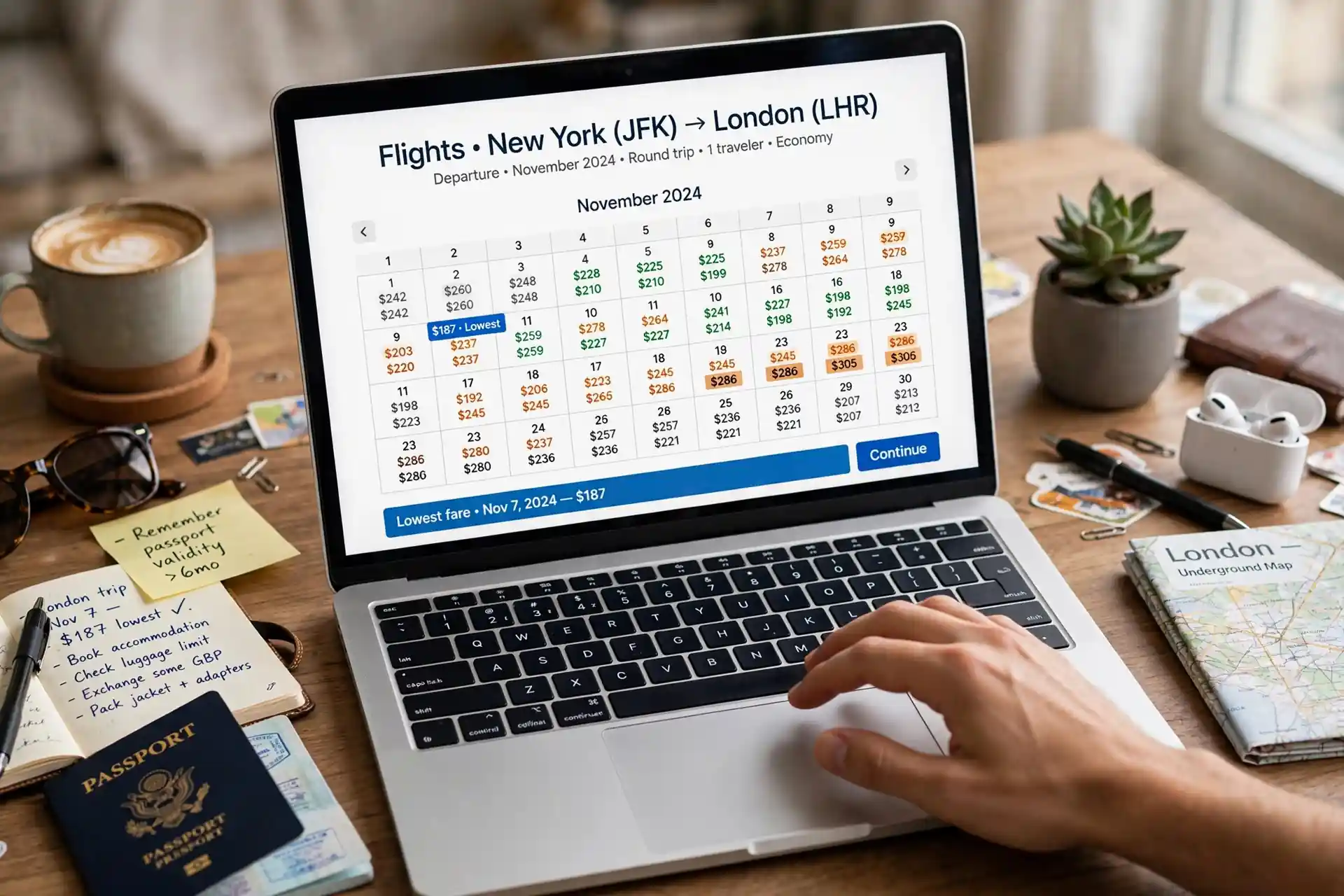
Instead of checking your ideal dates and a day either side, look at a calendar or flexible-date view covering a few weeks. Patterns become obvious quickly, such as prices rising sharply at the start of a holiday period and dropping once it ends.
Then write down the total for each serious option: flight, bags, accommodation, and ground transport. The cheapest line is often not the date with the cheapest fare.
Prices move fast. If a total looks good and the dates work, book it rather than waiting for a drop that may not come.
The Price Patterns Nobody Tells You About
Travel prices follow patterns that are remarkably consistent once you see them, and most travelers choose dates in direct opposition to those patterns. The fundamental dynamic is supply and demand applied to perishable inventory. An unsold hotel room tonight is revenue lost forever, so prices collapse when demand is low and spike when it is high. Your job is to position your travel in the low demand windows without sacrificing the experience.
The biggest pattern is the shoulder season effect. Every destination has peak periods when weather, holidays, and school schedules align to maximize crowds, and shoulder periods just before and after when conditions remain good but crowds thin. The Mediterranean in late September offers warm seas and empty beaches at half the August price. Japan in late November has stunning autumn color without the spring cherry blossom premiums. Research your specific destination’s shoulder windows rather than defaulting to the obvious months. This single decision often saves more than all other travel hacks combined. It also connects directly to daily budget planning, since accommodation is the largest variable cost.
Day of Week Dynamics
For flights, Tuesday and Wednesday departures are consistently cheapest on most routes, while Friday and Sunday command premiums. This is not a myth but a reflection of business versus leisure demand patterns. For hotels, the pattern inverts by location type. Business district hotels drop prices on weekends when corporate travelers leave. Leisure destinations spike on weekends. A downtown hotel in a financial district can cost half as much on Saturday as Tuesday. Match your booking to the location’s demand rhythm.
Holiday Traps and Event Spikes
School holidays, national holidays, and major local events create price spikes that dwarf normal seasonal variation. Traveling during spring break, Christmas week, or a city’s major festival means paying two to three times the normal rate for flights and hotels. Sometimes the event is the point of the trip, and the premium is justified. More often, travelers stumble into these periods accidentally because they chose dates for personal convenience without checking the destination calendar.
Always check three things before locking dates: the destination’s public holiday calendar, major events and festivals, and school holiday periods for the origin countries of most visitors. A quick search for the city’s events calendar takes five minutes and can save hundreds. The corollary is that the week after a major holiday often offers the year’s lowest prices, as demand craters while availability remains high.
The Booking Window Sweet Spot
Booking too early and too late both cost money. For international flights, the optimal window is typically two to five months ahead. Domestic flights do best one to three months out. Hotels vary more, but four to eight weeks ahead usually captures good rates with remaining selection. Booking a year ahead rarely helps because revenue management systems have not yet started discounting. Booking last minute sometimes yields deals but more often yields scarcity pricing, especially for popular routes.
Use price tracking tools to learn your route’s patterns rather than guessing. Set alerts and watch for two weeks before booking to understand the normal range. When the price drops into the lower portion of that range, book. Waiting for the absolute bottom is a fool’s game that usually ends with prices rising while you hesitate.
Flexibility as a Money Saving Tool
Date flexibility is the most powerful pricing tool available to leisure travelers. Shifting a trip by even three days can change flight costs dramatically. Use flexible date search features that show prices across a month. Consider nearby airports, which can differ by hundreds on international routes. A slightly less convenient airport with a cheap train connection often wins on total cost.
Length flexibility matters too. Sometimes extending a trip lowers the average daily cost enough to offset the extra days, because weekly hotel rates and longer rental car periods carry discounts. Conversely, the marginal seventh day of a trip sometimes costs more in accommodation than it delivers in experience. Evaluate the per day economics rather than assuming longer is proportionally more expensive. For structuring the trip once dates are set, building a complete itinerary turns good dates into a good trip. More travel planning guides are at Factblaze.
Frequently Asked Questions
What is the cheapest month to travel internationally?
It depends on the destination, but late January through March, excluding holidays, is broadly the cheapest period for most Northern Hemisphere destinations. September and early October offer shoulder season value in Europe and North America. Always research your specific destination rather than relying on general rules.
Do flight prices really go up if I search repeatedly?
The evidence for personalized price increases based on search history is weak. What actually happens is that prices fluctuate naturally and people notice increases more than decreases. Use incognito mode if it gives peace of mind, but focus energy on date flexibility and booking windows, which have proven impact.
Is it cheaper to travel on the holiday itself?
Often yes. Flights on Thanksgiving Day, Christmas Day, or New Year’s Day are frequently cheaper than surrounding days because most people want to be already arrived. If you do not mind traveling on the holiday, the savings can be substantial.
How far ahead should I book hotels?
Four to eight weeks for most trips. For peak season at popular destinations, two to three months. For major events, as soon as you commit to going. Hotel prices are more stable than flights, so the penalty for booking early is smaller, but last minute deals do exist in low demand periods.
Are package deals cheaper than booking separately?
Sometimes, particularly for resort destinations where operators negotiate bulk rates. But compare carefully. Packages bundle convenience with opacity, making it hard to see what each component costs. Price the flight and hotel separately first, then compare against the package total.
Conclusion
Choosing travel dates well means understanding demand patterns: shoulder seasons over peaks, midweek over weekends for flights, business districts on weekends, and avoidance of holiday and event spikes. Combine this with sensible booking windows and genuine date flexibility, and the savings compound across every component of the trip. The travelers paying the least are rarely the most frugal. They are the ones who chose their dates with the market in mind. For historical fare data and trend analysis, Expedia’s travel trend reports publish useful seasonal pricing insights.