Common Mistakes People Make Packing Electronics for a Trip
The costliest packing electronics for travel mistakes are putting spare lithium batteries or power banks in checked luggage, bringing one cable for everything, and discovering a device can’t charge until you’re already there. Each is easy to fix before you zip the bag. Here’s where people usually go wrong.
Packing electronics for travel mistakes start with power banks
Spare lithium batteries, including power banks and loose camera batteries, generally have to travel in your carry-on, not your checked bag. If one overheats in the cabin, crew can deal with it; in the hold, nobody can. Airlines will pull a bag or confiscate a battery if they find one where it shouldn’t be.
Capacity matters too. As of September 2026, the FAA’s guidance allows most spare lithium-ion batteries up to 100 watt-hours in carry-on bags, with larger ones up to 160 watt-hours needing airline approval. The FAA’s PackSafe pages list the current rules for U.S. flights, and other countries and individual airlines can be stricter, so check with your carrier too. The capacity is printed on the battery itself; if it’s worn off, you may not be allowed to fly with it.
Protect the terminals as well. Keep loose batteries in their original packaging, a battery case, or with tape over the contacts, so they can’t short against keys or coins.
Bringing one cable and hoping for the best
Cables are the item people most often forget or lose. A single cable that charges your phone, earbuds, and watch in turn means someone always waits. Pack one per device you use daily, plus a spare for the one you’d miss most.
A compact charger with several ports cuts down on bulk and on how many sockets you need. Hotel rooms rarely have outlets where you want them, so this matters more than it seems.
Skipping the voltage check
The wrong plug is a nuisance. The wrong voltage can ruin a device. Most phone and laptop chargers handle a wide range, but hair tools and some older gadgets don’t. Our guide on choosing a travel adapter that works everywhere explains how to read the label before you go.
Packing it all where you can’t reach it
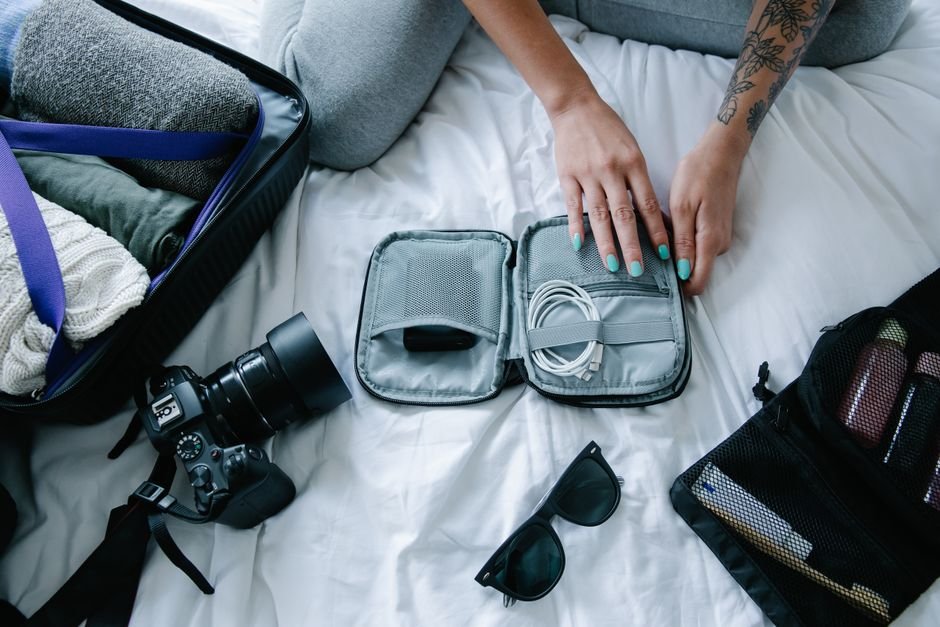
Electronics that go through airport screening in a jumble slow you down and invite a bag search. Keep laptops and larger devices somewhere you can pull them out quickly if screening requires it, and group cables and chargers in one organizer rather than scattering them through the bag.
A few habits help:
- Charge everything the night before, including the power bank.
- Take a photo of your gear so you can check nothing is left behind at each stop.
- Pack a short extension lead or a multi-port charger for rooms with one outlet.
- Download entertainment and maps in advance so you’re not relying on spotty Wi-Fi.
Liquids and electronics usually get screened separately, so it’s worth pairing this with packing a toiletry bag that meets carry-on rules.
Next step: pick up your power bank, find the watt-hour rating, and confirm it can fly with you before you leave.