
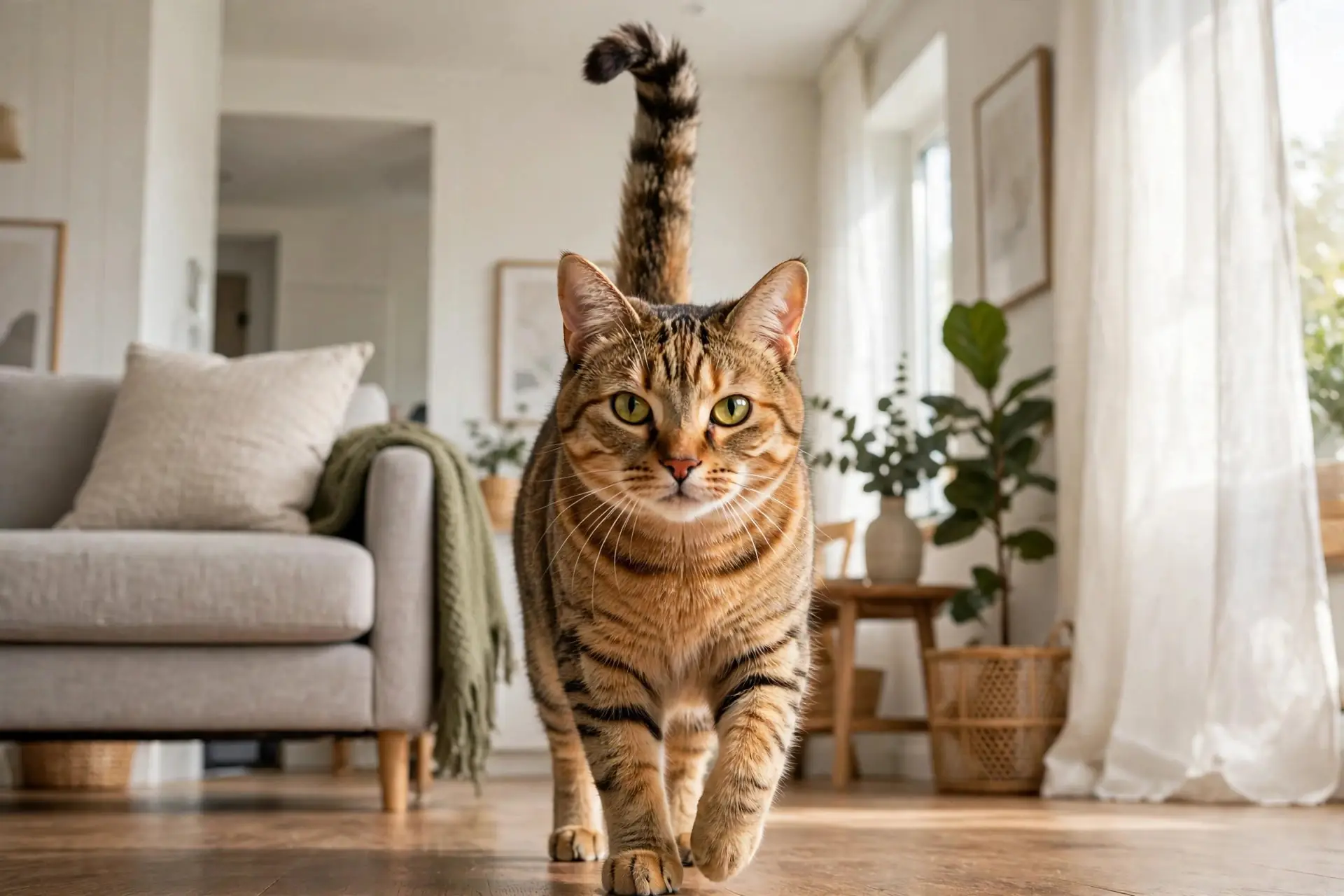
How to Read a Cat’s Tail Position
A cat’s tail is one of the clearest windows into its mood, often clearer than its face, which barely moves by comparison. Learning a handful of positions tells you far more about what’s about to happen than guessing from expression alone.
The Friendly Signals
A tail held straight up with a slight curl or question-mark hook at the tip is a greeting, usually meaning your cat is confident and glad to see you. A slow wrap of the tail around your leg, or around another cat during a calm moment, is closer to a hug than a random brush — it’s a deliberate, affectionate gesture, not an accident of walking past you. A gently swaying tail tip while a cat watches something with interest, rather than lashing, usually means curiosity rather than agitation.
The Warning Signals
A puffed-up tail, wider than usual along its whole length, means a cat feels threatened or startled and is trying to look bigger than it is. A low or tucked tail signals anxiety or a sense of being unsafe in the moment. The one people misread most often is a tail that thumps or lashes back and forth while the rest of the body looks relaxed or even still — that thumping is overstimulation building toward a swat or a bite, not calm at all, and it’s usually the last clear warning before contact happens.
Context Changes the Meaning
The same tail position can mean different things depending on what else is happening. A twitching tail tip during play is normal focus and excitement; the same twitch while a cat is being held or petted somewhere it doesn’t want to be touched is a request to stop. The same principle that applies to reading a dog’s stiff posture before a bite applies here — no single signal tells the whole story on its own, so read the tail alongside the ears, pupils, and overall body tension rather than in isolation.
When It’s Worth Paying Closer Attention
A cat that suddenly starts puffing its tail around a specific person, animal, or room it used to walk through calmly is telling you something changed in how safe that situation feels to it. It’s worth noting when that shift happens and what was different at the time, even if there’s no obvious cause yet, since the pattern often becomes clear only in hindsight.
The Cornell Feline Health Center publishes further reading on feline body language if you want to go deeper than tail position alone.
Start by ignoring your cat’s face for a week and watching the tail instead. It’s a more honest narrator than you’d expect.
Cats are famously hard to read, but their tails are surprisingly honest. A cat’s tail is an extension of its spine, packed with nerves and muscles, and it broadcasts emotional state in real time — often more accurately than facial expressions do. Once you learn the vocabulary, you’ll catch moods your cat’s face never would have revealed.
The Upright Tail: Confidence and Friendliness
A tail held straight up is one of the clearest positive signals a cat gives. It generally means the cat feels confident, content, and open to interaction — this is the tail position cats use when greeting a favored human or approaching a friendly cat. A slight curve at the tip, like the top of a question mark, softens it further into an invitation: this cat would like attention, please.
Watch for the quiver. A tail held high with a slight trembling or vibration at the tip often appears when a cat is especially excited to see you — many owners notice it at feeding time. It’s a sign of strong positive arousal. (One exception: an unneutered male may quiver his upright tail while spraying, which is territorial marking, not affection. Context tells you which one you’re seeing.)
The Low Tail: Caution and Anxiety
A tail carried low — drooping toward the ground or tucked loosely under the body — usually signals worry, submission, or unease. The cat isn’t relaxed; something in the environment has it on guard. New surroundings, unfamiliar people, or a recent scare all produce this posture.
A tightly tucked tail, pressed hard against the belly, is the stronger version: fear. A cat holding its tail like this wants to be left alone. Give it space, reduce noise and movement around it, and let it come out on its own terms. Chasing or cornering a cat in this state is how scratches happen — not from malice, but from panic.
The Tucked Tail Versus Relaxed Low Carriage
Not every low tail means fear. Some cats, especially certain breeds, naturally carry their tails lower when relaxed. The difference is in the body: a fearful cat’s tucked tail comes with crouching, flattened ears, and dilated pupils. A relaxed cat’s low tail comes with soft eyes, neutral ears, and loose posture. Read the whole cat, not just the tail.
The Puffed Tail: Frightened, Not Angry
The classic Halloween-cat silhouette — tail fluffed out to twice its normal width — is the clearest fear signal in the feline repertoire. The cat is making itself look bigger because it feels threatened. The upright puffed tail means a startled cat that hasn’t decided whether to flee or stand its ground; a puffed tail held low or tucked means a terrified cat leaning toward flight.
What looks like aggression here is usually defensive. The cat wants the threat to go away, not a fight. The worst thing you can do is escalate — loud noises, fast movements, or forcing contact. Remove the trigger if you can, or just back off and let the adrenaline fade. The puffiness usually subsides within minutes once the cat feels safe.
The Swishing and Thumping Tail
Tail movement matters as much as position. A slow, lazy sway — the tail drifting side to side while the cat lounges — is usually contentment or mild interest. The cat is relaxed and just thinking. A faster, sharper swish, especially while you’re petting the cat, is a rising-irritation meter. Many owners learn this one the hard way: the cat seemed fine, then bit. The tail had been warning for a minute.
Hard thumping — the tail slapping against the floor or furniture — is a stronger statement: frustrated, annoyed, or overstimulated. If you’re petting a cat whose tail has started thumping, stop. You’ve found the limit, and the cat is telling you plainly. This is where understanding what a cat’s purring actually communicates helps too, because a purr during thumping can mean the cat is self-soothing its irritation, not enjoying the petting.
The Twitching Tail Tip
A tail tip that flicks or twitches while the rest of the tail stays still is a small signal with a big range of meanings. During play or hunting — stalking a toy, watching a bird — it’s focused excitement. During petting, it can be the first hint of overstimulation. While sleeping, it may just be dream activity. Context, again, is everything: same twitch, three different stories.
The Wrapped Tail: Self-Soothing
A cat sitting with its tail curled neatly around its paws is usually calm and composed — the feline equivalent of sitting with hands folded. A sleeping cat that wraps its tail over its nose is conserving warmth and blocking light, a practical comfort behavior.
But a cat that wraps its tail tightly around its own body while awake, especially in an unfamiliar place, may be self-soothing anxiety — hugging itself, essentially. Combined with crouching or hiding, it suggests the cat needs time and quiet, not handling.
Reading Tail Signals Together With the Rest of the Cat
The tail is the headline, not the whole article. A high tail with relaxed ears and slow blinks is pure contentment; a high tail with flattened ears and a stare is a different message entirely. Cats also use whisker position, pupil size, and body posture to complete the picture. When the signals agree, you can trust your read. When they conflict — purring plus a thumping tail, for example — trust the more urgent signal.
Learning this vocabulary pays off most with subtle changes. A cat whose tail carriage has shifted over days or weeks — a formerly high-tail cat now carrying it low — may be telling you about pain or illness rather than mood. Behavioral changes that persist are worth a vet visit; the tail is often the first thing to show it. And small friendly signals matter too: what a cat’s slow blink means pairs beautifully with an upright tail as a sign of genuine trust.
Frequently Asked Questions
What does it mean when a cat’s tail is straight up?
Generally confidence and friendliness — the cat feels good and is open to interaction. A slight hook at the tip makes it even more inviting.
Why does my cat’s tail puff up?
Fear. The cat is trying to look larger to a perceived threat. It’s defensive, not offensive — back off and let the cat calm down rather than escalating the situation.
What does tail thumping mean?
Irritation or frustration, especially during petting. The cat is nearing its limit. Stop what you’re doing and give it space before the warning becomes a bite or scratch.
Can a cat’s tail position indicate illness?
A persistent change in normal tail carriage can reflect pain or discomfort, especially combined with hiding, appetite changes, or lethargy. If the change lasts more than a day or two, Cornell University’s College of Veterinary Medicine resources suggest consulting your veterinarian rather than guessing.
Do all cats use their tails the same way?
The broad signals are consistent across domestic cats, but individual and breed differences exist — some breeds naturally carry tails lower, and some cats are simply more expressive. Learn your own cat’s baseline first.
Conclusion
A cat’s tail is a real-time mood display, and learning to read it turns guesswork into understanding. Upright means confident, low means cautious, puffed means frightened, thumping means stop. Combine the tail with ears, eyes, and posture, and your cat becomes remarkably legible. For more on feline behavior, explore Factblaze — and the next time your cat greets you with a quivering upright tail, you’ll know exactly what it’s saying.