What a Cat’s Slow Blink Actually Means
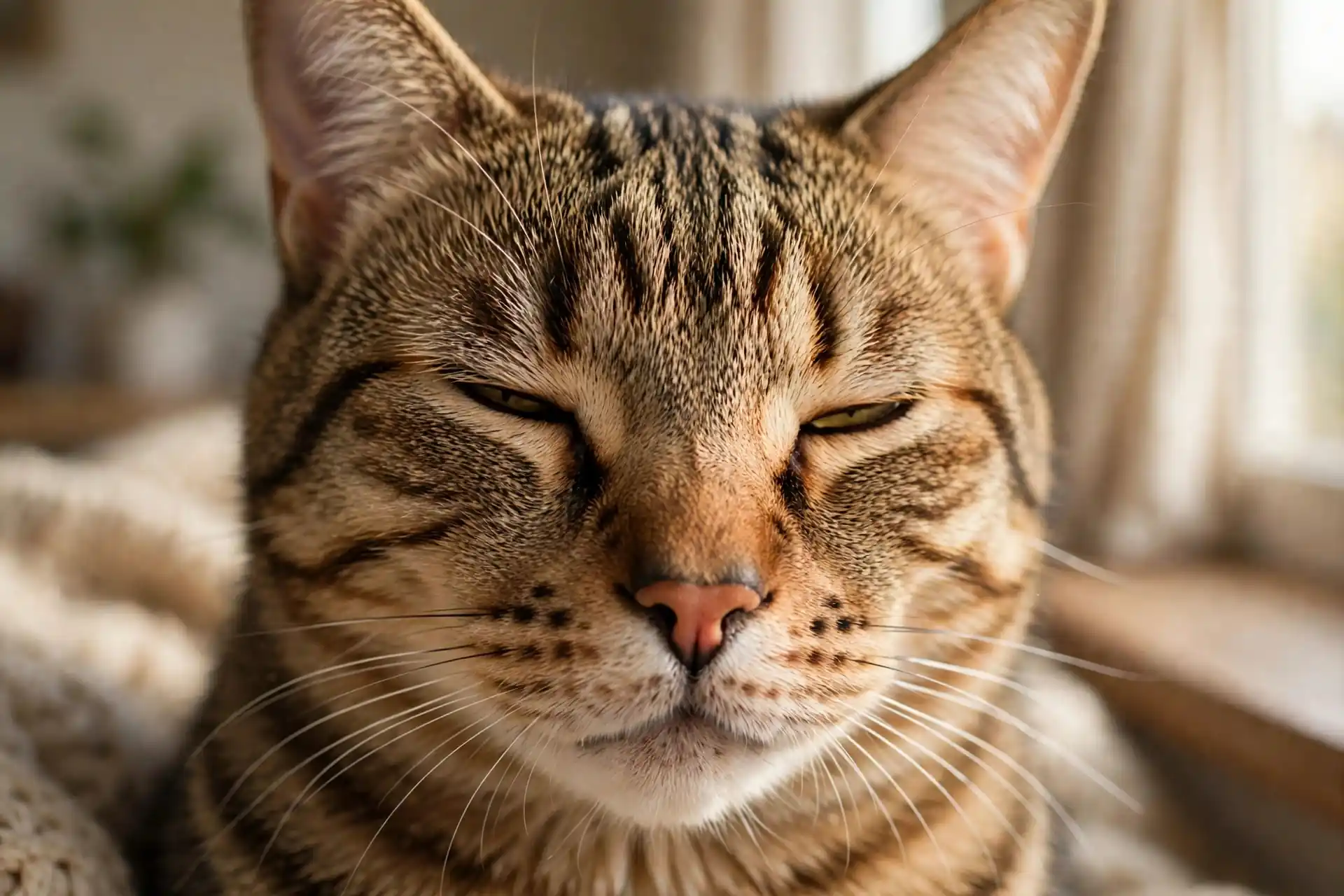
A cat’s slow blink is a relaxed, friendly signal that it trusts you. When a cat looks your way, lowers its eyelids halfway or fully, and holds them there for a beat before opening again, it’s telling you it feels safe and doesn’t see you as a threat.
People sometimes call it a “cat kiss,” which oversells it a little but captures the spirit. Most people wondering what does a cat’s slow blink mean have noticed it aimed straight at them, often from across the room, and the explanation comes down to how cats use their eyes.
Why a slow blink signals trust
In cat body language, a hard, unbroken stare is a challenge. Cats that are sizing each other up lock eyes and hold them. Closing the eyes in front of another animal is the opposite: it gives up the ability to watch for danger for a moment, which a cat only does when it feels at ease.
Research supports what owners have long suspected. A 2020 study by researchers at the universities of Sussex and Portsmouth, published in Scientific Reports, found that cats were more likely to narrow their eyes back at people who slow blinked at them, and more likely to approach an unfamiliar person who had done so.
What does a cat’s slow blink mean in different settings
From a cat lounging across the room, it’s contentment and a low-key hello.
From a new or shy cat, it’s a tentative sign it’s warming up to you. Let it set the pace.
Between two cats in a tense moment, it can be a way of easing things down, a signal that it isn’t looking for a fight.
Squinting that doesn’t open back up is a different matter. A cat that keeps one or both eyes half-closed, has watery or cloudy eyes or discharge, or paws at its face may have an eye problem or be hurting. That needs a vet, and quickly if the eye looks red or swollen or the cat won’t open it, because eye conditions can worsen fast. The other signs a cat is in pain are worth knowing too.
How to slow blink back
You can return the gesture, and many cats respond:
- Settle at a comfortable distance, side-on if the cat is shy.
- Soften your face and look toward the cat without staring hard.
- Narrow your eyes slowly, close them for a second or two, then open them gently.
- Glance slightly away and wait.
If the cat blinks back, looks away calmly, or wanders over, it’s working. If not, don’t push. Some cats are simply less expressive with their eyes, and a cat that stays relaxed near you is saying much the same thing.
It’s a useful tool with nervous cats in shelters or new homes, since it lets you communicate without reaching toward them. Read it alongside the rest of the body; a cat’s tail position helps you tell a relaxed cat from one that’s just holding still. For more on feline behavior and health, the Cornell Feline Health Center is a reliable place to read further.
So next time your cat blinks at you from the sofa, blink back slowly. It costs nothing, and it’s one of the few conversations you can have in their language.
What the Slow Blink Actually Communicates
A cat’s slow blink, the deliberate half closing and reopening of the eyes held for a beat, is one of the most reliably interpreted signals in feline communication. Researchers call it the slow blink sequence, and studies have confirmed what cat owners long suspected: it is an affiliative signal, a gesture of trust and relaxed social intent. When a cat slow blinks at you, it is doing the feline equivalent of a warm smile.
The mechanism makes evolutionary sense. Direct staring in cats is a threat signal. Deliberately breaking eye contact through a slow blink is the opposite: a voluntary vulnerability display. A cat that closes its eyes in your presence is demonstrating that it does not perceive you as a threat requiring visual monitoring. This is why the slow blink feels so meaningful when it happens. It is a small act of trust from an animal whose survival instincts are built around caution. Understanding this unlocks better interaction with cats generally, alongside reading tail positions for the rest of the emotional picture.
The Science Behind the Blink
Controlled studies have shown that cats respond positively to humans who slow blink at them. In experiments, cats were more likely to approach a stranger who had slow blinked, and more likely to return the blink, compared to a neutral expression control. The cats also showed more relaxed behaviors following the exchange. This is remarkable because it demonstrates two way communication across species using a signal that humans can deliberately produce. You can literally learn to speak a phrase of cat.
The practical technique is simple. Relax your face, half close your eyes slowly as if in a drowsy relaxed state, hold briefly, then open slowly. Do not stare first. The blink works as a response to soft attention, not as an opening move in a staring contest. Many owners report their cats beginning to slow blink back within days of consistent practice, which is the beginning of a genuine communication loop.
When Cats Do Not Slow Blink
The absence of slow blinking is not necessarily a problem. Some cats are simply less expressive with their eyes, communicating more through body posture, tail, and proximity. Kittens and young cats may not have developed the full social repertoire yet. Cats in stressful environments, new homes, shelters, or multi cat tension, suppress affiliative signals generally, and the slow blink returns as they settle.
What matters more than the specific signal is the overall pattern of relaxed behavior: soft body posture, slow movements, choosing to be near you, kneading, purring during contact. The slow blink is one dialect in a larger language. Do not fixate on it to the exclusion of everything else the cat is telling you. And never force eye contact to elicit a blink. Staring at a cat to make it blink is exactly backwards, creating the threat signal the blink is meant to dissolve.
Slow Blinks Between Cats
Cats use slow blinks with each other as well, particularly in established positive relationships. bonded pairs exchange slow blinks during rest. A new cat offering slow blinks to a resident cat is a promising sign for the relationship. Conversely, the hard stare with dilated pupils and no blinking is the prelude to confrontation. Watching blink patterns between household cats gives early insight into how their social negotiation is progressing, which is invaluable during introductions of new pets to multi cat homes.
Building Trust Through Blinking
For shy or newly adopted cats, the slow blink is a practical trust building tool. Sit quietly in the same room without approaching. When the cat glances at you, offer a slow blink and then look gently away. You are communicating safety in the cat’s own language while respecting its space. Repeat over days. Many fearful cats begin approaching the slow blinking human before they approach anyone else, because the signal has been consistently safe.
Combine blinking with other trust signals: predictable routines, food offered without strings, play sessions that let the cat control the intensity, and respect for hiding spots. Trust builds through accumulated safe experiences, and the slow blink is one reliable brick in that foundation. It costs nothing, requires no equipment, and works across the species barrier in a way few communication tools do. More feline behavior insights are at Factblaze.
Frequently Asked Questions
Do cats slow blink at other animals?
Primarily at cats and humans. The signal seems tuned to social partners the cat recognizes as interactive. Cats may slow blink at calm dogs they are bonded with, but the research has focused on cat to cat and cat to human exchanges, where the pattern is well documented.
What if my cat never slow blinks at me?
It does not mean your cat does not trust you. Some cats show affection through proximity, kneading, head butting, or following you room to room instead. The slow blink is one signal among many. If your cat is relaxed around you by every other measure, the relationship is fine.
Can I slow blink at a strange cat?
Yes, and it is one of the safer ways to greet an unfamiliar cat. Approach calmly, crouch to seem smaller, avoid direct staring, and offer a slow blink. If the cat returns it or relaxes, you may offer a hand to sniff. If the cat tenses or moves away, respect that answer.
Is the slow blink the same as squinting in pain?
No, and the distinction matters. A relaxed slow blink involves the whole face softening. Pain squinting is often one sided, accompanied by tension, tearing, or pawing at the eye. If squinting appears suddenly with other signs of discomfort, see a vet rather than interpreting it as affection.
Do all cats understand human slow blinks?
The research suggests most do, even cats with limited human socialization, though well socialized cats respond more readily. Kittens learn it through interaction. The signal appears to tap into deeply conserved feline social behavior rather than requiring specific training.
Conclusion
The slow blink is a genuine cross species signal: a deliberate vulnerability display meaning safety and affiliation, confirmed by research and reproducible by anyone willing to learn it. Use it to greet cats, build trust with shy ones, and deepen the quiet communication you already share with your own. In a relationship built largely on respecting boundaries, the slow blink is the moment the cat tells you the boundaries are working. For more on feline cognition and communication, the American Association of Feline Practitioners offers science based resources for cat owners.
Related Articles
- What a Cat’s Kneading Behavior Means
- How to Tell If a Cat Is Actually in Pain
- What a Cat’s Purring Actually Communicates
More pet guides worth reading
- How to tell if two cats are playing or fighting
- What makes a scratching post something a cat will use
- What whisker fatigue actually is
- What a cat’s purring actually communicates
- How to tell if a cat is actually in pain
- Choosing the right carrier for a nervous cat
- How to introduce a new pet to a multi-cat household
- Why cats knead