What Seasonal Color Palettes Mean for Building a Wardrobe
A seasonal color palette wardrobe starts by sorting colors into four groups — spring, summer, autumn, winter — based on how warm or cool, and how bright or muted, they read against your skin and hair. The point isn’t to follow a strict system; it’s to stop buying the same colors that never quite work and start buying pieces you reach for instead.
Each group in a seasonal color palette wardrobe leans on a few shared qualities rather than a fixed list of shades.
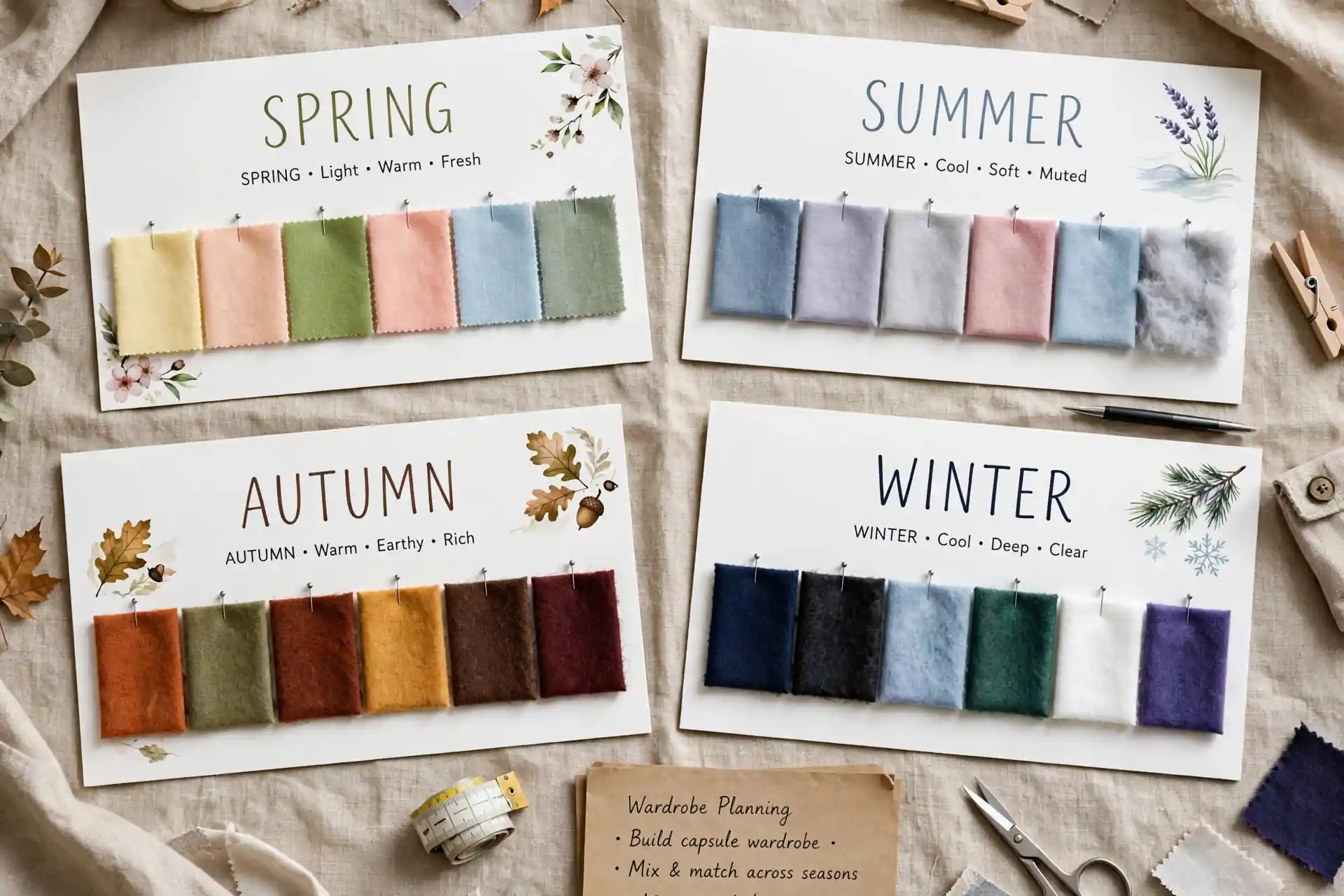
- Spring: warm, clear, bright — coral, warm yellow, grass green
- Summer: cool, soft, muted — dusty blue, lavender, rose
- Autumn: warm, muted, deep — rust, olive, mustard
- Winter: cool, clear, high-contrast — true red, black, icy blue
You don’t need a professional draping session to get useful information out of this. Hold a warm gold and a cool silver fabric up under your chin in natural light and look at your skin, not the fabric — one will make you look rested, the other slightly tired. Do it again with a muted olive and a bright true red. Most people land clearly on the warm or cool side within a few comparisons, even if they can’t name which of the four groups they fall into.
Turning a Seasonal Color Palette Into a Real Wardrobe
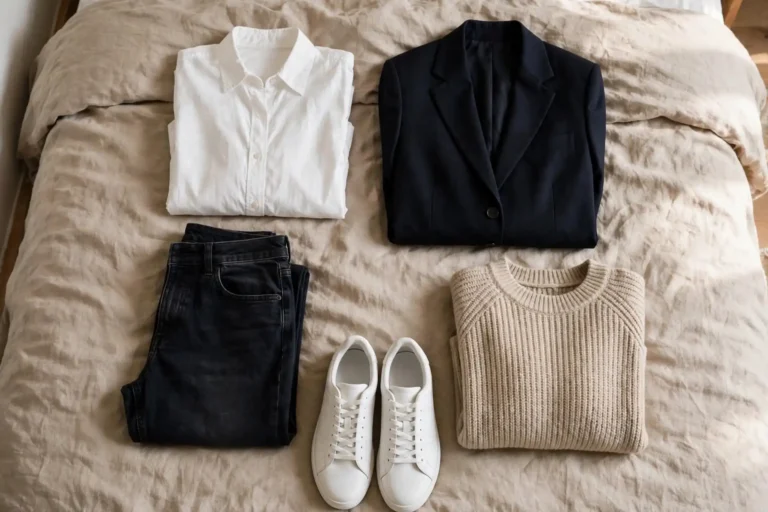
Where this earns its keep is at the shopping stage, not the styling stage. Before you add something to a cart, check it against the two or three colors you already know work on you. If a piece doesn’t fit your palette but you love the cut, buy it in a color that does — the same silhouette in the right shade will get more wear. This is a useful habit to pair with a small, deliberate wardrobe built around a handful of core pieces, since a tight color palette makes separates easier to mix without a coordinated head-to-toe plan.
It’s also worth applying before you shop online, where color reads differently on every screen and returns pile up fast when the color is the problem. Knowing your palette in advance cuts down on guessing from a product photo. For a broader look at how professional stylists and designers think about color relationships beyond the four-season system, the Council of Fashion Designers of America is a reasonable starting point.
Treat the four groups as a sorting tool, not a rulebook. If a color outside your group makes you feel good and you wear it anyway, that’s a fine outcome too — the palette is meant to narrow decisions, not make them for you.
Color analysis sounds like something reserved for celebrity stylists, but the underlying idea is refreshingly practical: some colors make you look healthy and rested, and others quietly drain the life out of your face. Seasonal palettes are just a system for naming which group you belong to. Once you understand yours, shopping stops feeling like guesswork, and building a wardrobe that actually coordinates becomes far simpler.
What the Four Seasons Really Describe
The system divides people into Spring, Summer, Autumn, and Winter based on three features: the undertone of your skin, the depth of your hair, and the contrast between your features. Spring and Autumn are warm-toned; Summer and Winter are cool-toned. Spring and Summer are light and soft; Autumn and Winter are deep and rich. Your season is the combination that matches you, and it tells you which version of any color will flatter you most.
Think of it less as a personality quiz and more as a lighting analysis. A warm Autumn doesn’t just “like” burnt orange; burnt orange reflects warm light onto warm skin in a way that reads as natural rather than clashing. Wear the wrong temperature and your face has to compete with the garment.
How to Find Your Season Without a Professional Analysis
You don’t need a draping session to get close. Start with metal: hold gold and silver jewelry against your cheek in natural daylight. If gold looks like it belongs and silver looks harsh, you’re warm. If silver glows and gold looks muddy, you’re cool. Next, check your veins in daylight — bluish suggests cool undertones, greenish suggests warm. Then consider contrast: do your features look dark against your skin, or is everything soft and low-contrast? High contrast plus cool points to Winter; low contrast plus warm points to Spring, and so on.
Be honest about what you see rather than what you wish you saw. Plenty of people mis-type themselves because they love Autumn colors and want to be Autumn. Your palette works whether or not it’s your favorite — the trick is learning to love it once you see what it does for you.
What Each Season’s Palette Looks Like in a Closet
Springs look best in warm, clear, light colors: coral, peach, warm turquoise, bright golden yellow, apple green, and warm ivory instead of stark white. Their neutrals run toward camel, warm taupe, and warm navy. If you’re building a capsule wardrobe, Spring palettes pair beautifully with light, fresh basics that stay vibrant rather than washed out.
Summers wear soft, cool, muted tones: powder blue, lavender, rose, sage, soft teal, and dusty mauve. Their neutrals are greys, soft navy, and cool taupe — and their white is soft white or off-white, never optic white, which can look harsh on Summer skin.
Autumns own the warm, rich, muted range: olive, rust, mustard, terracotta, teal, chocolate brown, and cream. Their neutrals — camel, chocolate, warm charcoal — are among the easiest to build a wardrobe around because they coordinate effortlessly with each other.
Winters wear cool, clear, saturated colors: true red, cobalt, emerald, black, icy pastels, and stark white. Winter is the one season that can carry high contrast — black and white together — without the outfit wearing the person.
Translating a Palette Into Pieces You Actually Wear
A palette is a direction, not a shopping list. The real payoff comes when you turn it into a repeatable buying habit. Start by choosing three neutrals from your season: one light, one medium, one dark. These become your trousers, shoes, bags, and jackets — the workhorses that everything else plugs into. Then add four to six accent colors from your palette for tops, knits, and dresses.
The math is satisfying: with three neutrals and five accents, nearly every combination works, because every color already shares your undertone and intensity. This is why people with a clear palette get dressed faster. They’re not deciding which colors go together; the system already decided.
When you shop, carry a small swatch card of your palette or a photo on your phone. Hold garments against your neckline in natural light before buying — the mirror test never lies. If a top makes your eyes look brighter and your skin look even, it’s yours. If you look tired, it isn’t, no matter how much you love it.
Handle the “But I Love Black” Problem Honestly
Black is the most commonly mourned color in seasonal analysis, since only Winters truly wear it at the neckline. If you’re not a Winter, you have options that don’t require a funeral for your style. Wear black on the lower half, where it can’t affect your face. Or keep black accessories — shoes, belts, bags — which are far enough from the jawline to matter less. A scarf or necklace in your best neckline color between black and your face solves the rest.
The same logic applies to any beloved color outside your palette. Proximity to the face is what counts. A dress in a wrong-season color can still work with a jacket or scarf in the right one layered over it.
Why Seasonal Dressing Makes a Small Wardrobe Work Harder
A capsule wardrobe lives or dies on coordination, and seasonal palettes are essentially a coordination system. If you’re building a capsule wardrobe, choosing pieces within one seasonal palette is the fastest route to a wardrobe where everything matches. Most people who struggle with capsules struggle because they bought nice pieces in four different color temperatures — nothing quite goes with anything.
The palette also solves the accessory problem. Once your neutrals and accents are fixed, buying a bag or shoes becomes a two-second decision instead of a research project. And it makes second-hand shopping — where you can’t order the exact color you want — far more productive, because you can evaluate any garment in seconds against your palette.
When Your Season Feels Wrong
Two common issues come up. First, hair dye: if you’ve dyed your hair darker or lighter than your natural color, your apparent season may have shifted. Analyze based on your natural hair color and skin — the palette that suits undyed you is still your palette, though a drastic dye job can change how much contrast you can carry.
Second, tanning. A summer tan warms your skin temporarily, but it doesn’t change your undertone. Browns and warm oranges may look better on tanned skin for a few weeks, but your underlying palette hasn’t moved. The same holds for spray tans. When you’re assembling capsule wardrobe essentials, buy for your baseline, not your vacation tan.
Some people also land between seasons — a “soft Autumn” or “bright Spring” situation. The twelve-season system exists for exactly this. If the four broad seasons feel close but not quite right, a finer analysis can pinpoint you. But the four-season version is enough to transform how you shop; don’t let perfection be the enemy of a much better wardrobe.
Frequently Asked Questions
Can I wear colors outside my seasonal palette?
Yes. Your palette identifies your most flattering colors, not your only allowed ones. Keep off-palette colors away from your face — on trousers, skirts, shoes, or accessories — and they’ll cause no harm.
Does my season change as I age?
Your undertone doesn’t change, but your hair and contrast can. Many people move from brighter to softer versions of their season as hair greys. A Winter might shift toward softer Winter shades, an Autumn toward soft Autumn. The family stays the same; the intensity softens.
What if my favorite color isn’t in my palette?
Wear it where it doesn’t touch your face, or find your season’s version of it. Every season has a red, a blue, and a green — Autumn’s red is brick, Winter’s is true red, Spring’s is coral, Summer’s is raspberry. There’s almost always a version of what you love.
Is seasonal color analysis actually backed by science?
The underlying observation — that certain colors reflect more flattering light onto certain skin tones — is basic color theory, and references like the Pantone color systems are built on the same principles. The four-season framework is a stylistic interpretation, not a clinical diagnosis, but the flattery effect is real and visible in a mirror.
Should couples or families share one palette?
Only by coincidence. Seasonal analysis is individual — a family can easily contain all four seasons. Shared shopping habits, though, can make life easier: if two people are both warm-toned, for instance, the same neutral basics can rotate between closets.
Conclusion
Seasonal color palettes aren’t about rules for their own sake. They’re a shortcut to the feeling of always having something to wear: buy within your temperature and intensity, and your clothes start cooperating with each other automatically. Whether you’re assembling your first capsule or just tired of a closet full of near-misses, the system pays for itself in saved time and money. Explore more wardrobe strategy here on Factblaze, and let your palette do the heavy lifting on your next shopping trip.