Puppy-Proofing Checklist: Prepare Your Home
Puppies investigate the world with their mouths, which means anything within reach at floor level is a candidate for chewing, swallowing, or knocking over. A walkthrough of your home at puppy height — literally getting down on your hands and knees — catches far more hazards than a mental checklist ever will.
Start With What’s on the Floor
- Loose cords and cables, tucked away or run through a protective sleeve
- Small objects within mouth reach: coins, batteries, rubber bands, hair ties
- Shoes and socks, which are common choking and blockage risks, not just chew targets
- Trash cans without a locking or step-pedal lid
- House plants, since several common varieties are unsafe if chewed
Get low enough to see the room from roughly a puppy’s eye level, since a lot of hazards that look obviously out of reach from standing height turn out to be exactly at nose height for a ten-week-old dog.
Foods and Plants Worth Knowing About
Puppies will try to eat almost anything once, including things dropped or left within counter-surfing range as they grow. For the full list of what’s genuinely dangerous to keep out of reach, see our guide to foods that are dangerous for dogs. It’s worth reading before move-in day rather than after an emergency vet visit, since several everyday kitchen staples are on that list.
Cabinets, Trash, and Closed Doors
Childproof latches work just as well on a determined puppy as they do on a toddler, and they’re worth installing on any cabinet holding cleaning supplies, medications, or anything with a strong scent that might draw a curious nose. Keep bathroom and laundry room doors closed by default until you know your puppy has no interest in what’s behind them, and store cleaning products on a shelf rather than under the sink where they’re easiest to reach. The same goes for sewing kits, glue, and small hardware in a junk drawer.
Set Up Spaces to Manage, Not Just Remove Hazards
You won’t catch every hazard on the first pass, so build in some structural backup. Baby gates or a playpen keep a puppy confined to a puppy-proofed room when you can’t watch closely, and a crate gives them a safe place to settle when supervision isn’t possible at all. Managing space this way matters as much as removing individual objects, because a bored, unsupervised puppy will find something you missed, usually within minutes rather than hours.
The ASPCA’s animal poison control resources are worth bookmarking before you need them, not after.
No home is fully puppy-proofed on day one. Expect to keep finding gaps for the first few months and adjust as your puppy grows, gets taller, and starts reaching things that used to be safely out of range. A second walkthrough a month in, once you know your puppy’s specific habits, usually turns up hazards the first pass missed entirely.
A checklist tells you what to do. This is the why behind each item, plus the spots most new owners miss entirely. Work through it room by room a few days before the puppy arrives, because once those paws hit the floor, your attention will be on the puppy, not the baseboards.
Start With a Puppy’s-Eye Tour of Your Home
The most effective proofing technique is also the simplest: get down on the floor. Crawl through each room at puppy height and look at what is actually within reach. Adult eyes glide over the phone charger dangling from the nightstand, the gap behind the bookshelf, and the shoes under the coffee table. From twelve inches off the ground, those are the three most interesting things in the room.
Puppies explore with their mouths the way toddlers do, but with sharper teeth and more determination. Anything they can reach, they will chew, and anything they can chew apart, they may swallow. The goal of proofing is not to make your home sterile. It is to remove the things that can injure the puppy or be destroyed in seconds, and to manage everything else with barriers and supervision.
Do this tour twice: once in daylight when you are calm, and once more the evening before arrival. Bring a laundry basket on the second pass and simply remove everything questionable to a closet. You can sort it out later.
The Kitchen: Food, Trash, and Cleaning Products
Kitchens concentrate more puppy hazards per square foot than any other room. Start with the trash can: chicken bones splinter, wrappers cause blockages, and coffee grounds contain enough caffeine to poison a small dog. A step-can with a locking lid, or better yet a can inside a latched cabinet, solves this permanently.
Move cleaning products to high cabinets or install childproof latches on the under-sink cabinet. Dishwasher pods and laundry packets are especially dangerous because they look like toys and burn on contact with mouth tissue. Check the pantry floor level too: onions, garlic, grapes, raisins, chocolate, xylitol, and macadamia nuts are all toxic to dogs, and puppies are remarkably good at nosing open low pantry doors.
Finally, think about the stove and counters. Puppies grow fast, and counter-surfing starts earlier than people expect. Never leave food unattended at the counter edge, and get in the habit of pushing everything back now. If you want a deeper plan for the sleeping setup that follows all this prep, see our guide to setting up a calm first night for a new puppy.
Cords, Electronics, and Small Objects Everywhere Else
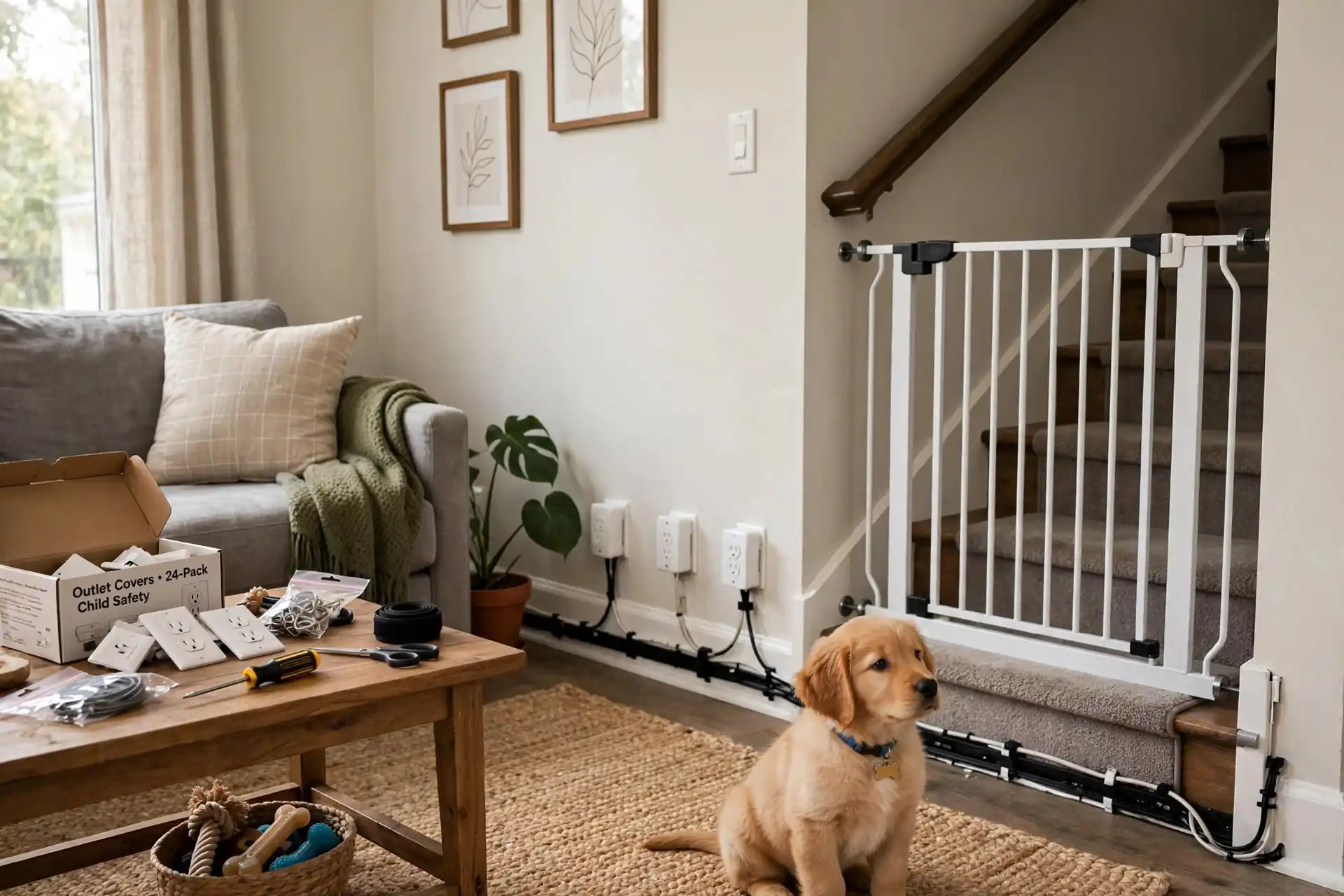
Electrical cords are the classic puppy hazard for good reason. A chewing puppy can bite through a lamp cord in seconds, risking burns or shocks. Walk every room and lift, hide, or cover every cord at puppy level: phone chargers, lamp cords, TV cables, and computer wires. Cord covers are cheap, and bitter-tasting deterrent sprays help for the cords you cannot move, though physical barriers beat sprays every time.
Beyond cords, scan for the small-object minefield that every home contains: hair ties, socks, coins, rubber bands, and children’s toys with small parts. Socks deserve special mention. They are the number one foreign object veterinarians surgically remove from young dogs, because puppies swallow them whole and they lodge in the intestines. If anyone in the house is casual about laundry, the puppy years are the time to change that habit.
Houseplants live in this category too, and they surprise people. Many common houseplants are toxic to dogs, and puppies chew leaves out of curiosity. Lilies, sago palm, oleander, and dieffenbachia are among the dangerous ones. Check every plant in the house against a reliable toxicity database and move or rehome the risky ones before arrival day.
Plants, Chemicals, and Medications
Go through the house with a trash bag and relocate every medication, vitamin, and supplement to a high, closed cabinet. Child-resistant caps slow down toddlers, not determined puppies, and dropped pills are a constant background risk in any home where people take daily medication. Make it a household rule that pills are handled over a counter, never over carpet the puppy walks on.
In the garage and yard, lock away antifreeze, rat poison, slug bait, fertilizers, and pesticides. Antifreeze tastes sweet to dogs and is lethal in tiny amounts, so clean any driveway drips and store containers sealed and high. The ASPCA’s toxic plant database is the standard reference most veterinarians point owners to, and it is worth bookmarking before you need it in a panic. If the puppy ever eats something suspicious, call your veterinarian or a poison helpline immediately rather than waiting for symptoms.
Household chemicals follow the same logic as medications: if it is under a sink, in a low cabinet, or on a laundry shelf the puppy could reach by standing on something, move it or latch it. Puppies learn to open low cabinets faster than you would believe.
Doors, Balconies, and the Great Outdoors
Every exterior door in the house is an escape route, and puppies are opportunistic darters. Until recall training is solid, which takes months, manage doors physically. Baby gates on hallways leading to entry doors and a routine of holding or crating the puppy when guests arrive prevent the heart-stopping moment of a puppy sprinting into the street.
Balconies and patios need dedicated attention, especially in apartments. Puppies can squeeze through railings that look narrow to adult eyes, and falls from height are a real emergency-room category for small dogs. Our full walkthrough on pet-proofing a balcony or patio covers railing gaps, safe barriers, and the outdoor hazards people forget, like hot surfaces and toxic balcony plants. If your outdoor space is not yet secured, treat it as off-limits until it is.
Walk the entire fence perimeter looking for gaps, loose boards, and gates that do not latch firmly. A puppy that fits through a gap will find it within the first week. Also scan the yard for mushrooms after rain, fallen fruit with pits, and standing water.
Set Up the Safe Zones Before Arrival Day
The puppy needs spaces where it can be safely unsupervised for short stretches, because you will need to shower, cook, and answer the door. A crate for sleeping and a gated pen or puppy-proofed room for awake time cover nearly every situation. Set both up before the puppy arrives, with water, safe chew toys, and bedding in each.
Stock a small puppy first-aid and cleanup kit in one spot: enzymatic cleaner, paper towels, a spare leash, poop bags, and your veterinarian’s phone number on the fridge. The first week involves enough surprises without hunting for supplies mid-incident.
Frequently Asked Questions
How early should I puppy-proof before the puppy arrives?
A few days before is ideal. That gives you time for the two walkthroughs, a shopping trip for gates and cord covers, and moving plants or chemicals without rushing. Doing it the morning of arrival means doing it badly while distracted by an excited puppy.
Are baby gates strong enough to contain a puppy?
Pressure-mounted gates work for most puppies in doorways, but determined or large-breed puppies can push them over. For the top of stairs, always use a hardware-mounted gate screwed into the wall. Puppies and stair falls are a bad combination.
What should I do if my puppy eats something potentially toxic?
Do not wait for symptoms. Call your veterinarian or an animal poison helpline immediately and describe exactly what was eaten and how much. Save any packaging. Fast professional guidance beats home remedies every time, and some common advice, like inducing vomiting, is wrong for certain substances.
Can I leave my puppy alone in a proofed room while I work?
For short stretches, yes, if the room is genuinely proofed and the puppy has water, toys, and a potty option appropriate for its age. Young puppies under twelve weeks should not be left alone for more than a couple of hours. Build up alone time gradually rather than starting with a full workday.
Do I need to proof the whole house or just some rooms?
Start with the rooms the puppy will actually access and gate off the rest. Most owners find that two or three well-proofed rooms plus barriers cover the first months. You can expand the puppy’s territory gradually as training progresses and you learn its particular mischief style.
Conclusion
Puppy-proofing is not about achieving perfection. It is about removing the true dangers, managing the chewable, and giving the puppy safe spaces while it learns the rules. Do the floor-level tour, lock down the kitchen and chemicals, secure the cords and small objects, check the plants against a reliable database, and manage every door and outdoor space physically. Handle those, and arrival day becomes what it should be: exciting instead of stressful. For more new-puppy guides, from first-night routines to training basics, explore the pet section here on Factblaze.