Positive Reinforcement Dog Training Day to Day
Positive reinforcement training means rewarding the behavior you want to see again, immediately and consistently, so your dog repeats it on their own rather than being corrected out of doing something else. In practice it looks less like a formal lesson and more like a habit woven into ordinary moments with your dog.
What It Looks Like at Home
Most of the training happens outside of dedicated sessions. A treat for sitting before the door opens instead of bolting through it, praise for four paws staying on the floor during a greeting, a scatter of kibble on the ground when the doorbell rings so barking gets replaced with sniffing — these small, repeated moments teach a dog what pays off far more effectively than one twenty-minute drill a week. Meals, walks, and even vet visits are all opportunities, not just the time you’ve set aside to call “training.”
Timing Beats the Treat Itself
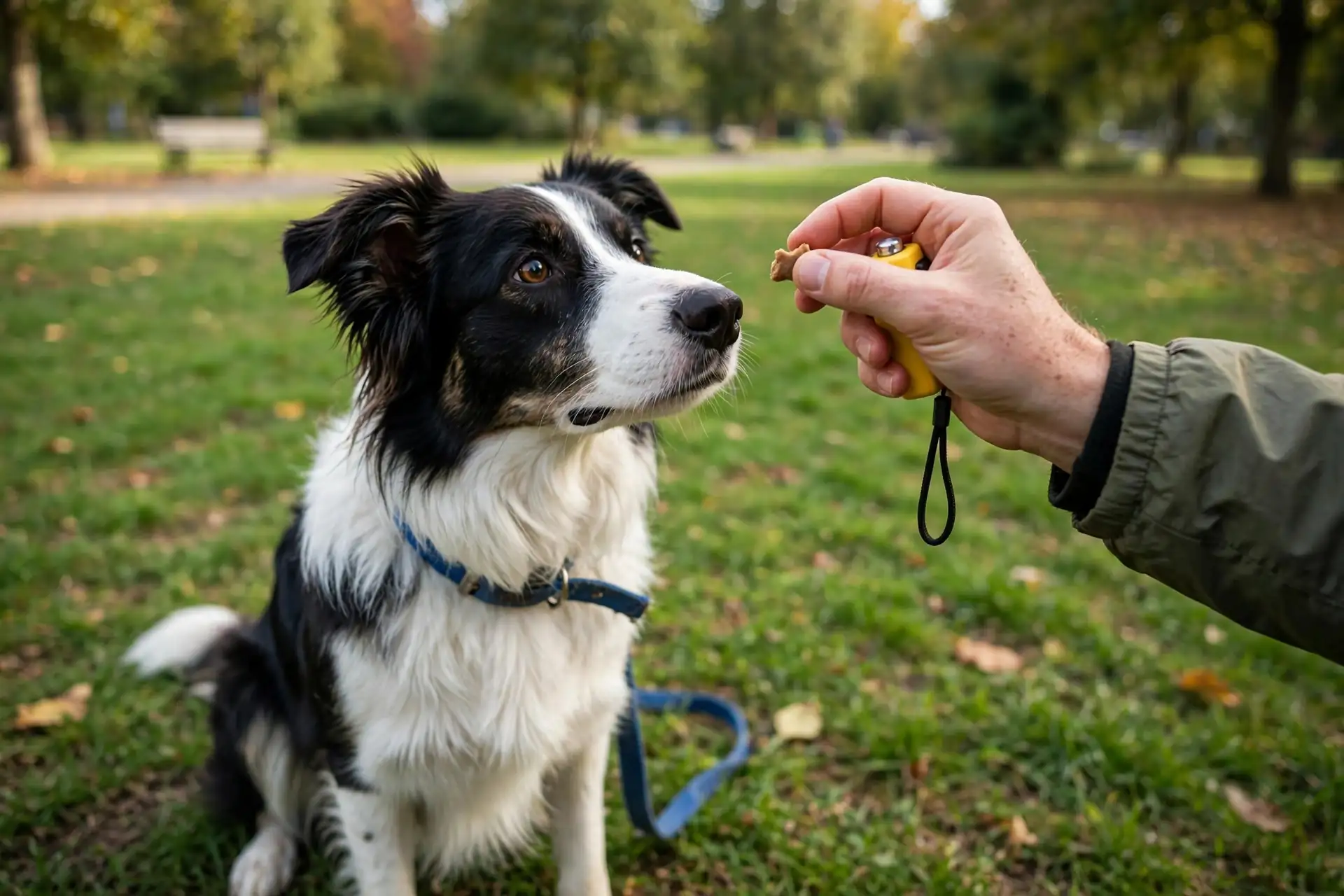
What matters more than the reward is how quickly it arrives. A treat delivered two seconds after your dog sits reinforces sitting; a treat delivered five seconds later, after your dog has already stood back up, reinforces standing up instead. A marker word like “yes” or a clicker solves this by marking the exact right moment, with the treat following a second or two behind it. Once the marker is reliable, you can reward from across a room instead of needing a treat already in hand.
What to Do When Your Dog Gets It Wrong
The instinct to correct an unwanted behavior is strong, but the more useful question is what you want your dog doing instead, and how to make that the easier choice. A dog jumping on guests gets rewarded for four paws on the floor rather than scolded for jumping; a dog pulling on leash gets a stop and a treat the moment the leash goes slack rather than a leash correction. Withholding the reward for the wrong choice, paired with reliably rewarding the right one, changes behavior without adding fear or confusion to the relationship. It also tends to hold up better over time, since a dog that isn’t anxious about getting something wrong is more willing to try new things in the first place.
Reading Your Dog Helps You Time It Right
Knowing what your dog’s body language is telling you before a situation escalates makes reinforcement training work faster, because you can reward calm before a dog reaches a stressed or reactive state rather than trying to reward your way out of one already underway.
The American Veterinary Society of Animal Behavior’s position statements on humane training methods are worth reading if you want the reasoning behind why this approach holds up better over the long term than correction-based methods.
Consistency matters more than any single technique. A dog rewarded for good behavior nine times out of ten will still test that tenth time, so the habit has to hold across the whole household, not just during training sessions.
The theory of positive reinforcement fits on an index card: reward the behavior you want and it happens more often. The practice is a full day of small decisions, and that is where most owners get stuck. What follows is a realistic tour of a day built around reward-based training, meal by meal, walk by walk, including the mistakes that quietly undo good work.
What “Day to Day” Actually Means
Positive reinforcement is not a class you attend twice a week; it is a way of interacting with your dog all day. Every time you respond to your dog, you are teaching something, whether you meant to or not. The dog that gets a treat for sitting before the leash goes on learns that sitting works. The dog that gets let out while barking at the door learns that barking works. Day-to-day training simply means being deliberate about which of those lessons you are delivering.
This does not require hours of formal sessions. In fact, short bursts of two to three minutes, scattered through the day, teach faster than one long drill. Dogs, especially puppies, learn best when training feels like a game slotted between the ordinary events of the day: meals, walks, play, and rest.
Morning: Breakfast Becomes a Training Session
Instead of pouring kibble into a bowl and walking away, use part of breakfast as training currency. Ask for a sit before the bowl goes down, then release with a clear word like “okay.” Scatter a handful of kibble in the grass or a snuffle mat so the dog forages, which burns mental energy and slows down gulpers. Hand-feed a portion while practicing gentle takes, rewarding soft mouths and ignoring snatching by simply closing your hand and trying again.
Morning routines are also prime time for impulse control, the skill behind most “bad” behavior. Reward the dog for waiting at the door instead of bolting, for choosing a toy instead of your sleeve, for lying on a mat while you make coffee. Each of these is a tiny deposit in the calm-behavior account, and they add up faster than people expect.
Walks: The Moving Classroom
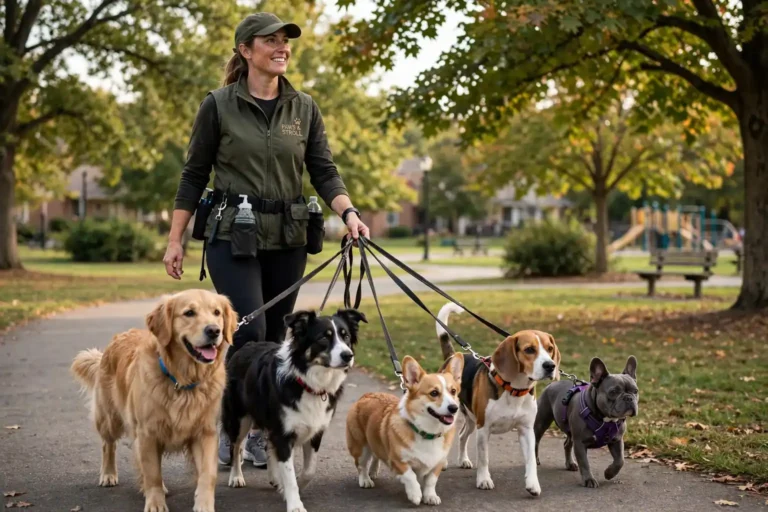
A walk is the richest training environment of the day because distractions are everywhere. The day-to-day approach treats the walk as a series of small exercises: reward check-ins when the dog glances back at you, reward a loose leash with forward movement itself, and use sniff breaks as the paycheck for a stretch of nice walking. Sniffing is a powerful natural reward, so “walk nicely for a minute, then go sniff” is a trade most dogs accept happily.
For the mechanics of polite walking, our walkthrough of leash training a puppy covers the step-by-step progression from indoor practice to real sidewalks. The key day-to-day habit is consistency: if pulling sometimes gets the dog to the interesting smell faster, pulling will persist. Reward the leash position you want every single time and the dog will offer it by default.
Playtime Without the Nips
Play is training in disguise, and it is where mouthy behavior gets rehearsed or resolved. Keep a toy between your hands and the dog’s mouth during rowdy play, and the instant teeth touch skin, play stops for a few seconds. Calm returns, play resumes. The dog learns the rule quickly: teeth end the fun, toys keep it going. Short play bursts with built-in pauses also teach the dog to switch off arousal, a skill that pays off at the vet, at cafes, and around children.
If nipping is already a pattern rather than an occasional accident, you need a dedicated plan rather than hoping it fades. Our guide to training a puppy to stop biting lays out the redirection and impulse-control exercises that fix it. In daily life, the supporting habits are management first: tired, well-exercised puppies bite less, and overtired puppies bite more, so watch for the witching hour and enforce naps before the teeth come out.
Evenings: Settling Down Is a Skill
Many owners train active behaviors and forget to train calmness, then wonder why the dog cannot relax. Capturing calmness is simple: when the dog lies down quietly on their own, especially on a designated mat or bed, deliver a treat quietly between the paws. Do it without fanfare so you do not rev the dog back up. Over days, the mat becomes a place associated with settling, which gives you a portable “off switch” for restaurants, friends’ houses, and busy evenings.
Evening is also when you proof the day’s lessons with mild distractions: a sit while dinner is served, a down-stay during a TV show with treats for staying put, a recall from one room to another before bedtime. Keep criteria fair. A behavior the dog knows in the kitchen may fall apart in the park, so lower your standards in harder environments and rebuild gradually.
The Mistakes That Undo Good Work
The most common day-to-day error is accidental inconsistency: rewarding a behavior on Monday and ignoring it on Tuesday teaches the dog that trying is pointless. Close behind is the forever lure, where the treat stays in the hand as a bribe for months instead of fading into intermittent rewards. Another is punishing after the fact, which the dog cannot connect to the crime and which damages trust. Finally, many owners train only when the dog misbehaves, which means all training attention arrives in moments of conflict.
This approach is not just folk wisdom. The American Veterinary Society of Animal Behavior has published position statements concluding that reward-based methods are both effective and associated with fewer behavior problems than punishment-based techniques. If you take one principle into your daily routine, make it this: set the dog up to succeed, reward success generously, and manage the environment so failure is rare.
Frequently Asked Questions
How many treats is too many in a day?
Training treats should stay around ten percent of daily calories, so use pea-sized soft treats and subtract from meals when you train heavily. You can also use part of the dog’s regular kibble as rewards, which keeps the diet balanced.
What if my dog is not motivated by food?
Try higher-value rewards first: real meat, cheese, or a favorite toy often unlock motivation that dry biscuits do not. Some dogs work for play, sniffing privileges, or access to people. The principle stays the same; only the currency changes.
How long before I see results?
Simple behaviors like sit or touch often click within days of short daily practice. Reliable behavior around distractions takes weeks to months, because reliability is built through gradual practice in harder environments, not through drilling one context.
Can I train with praise alone and skip treats?
Praise works best as a marker paired with something the dog already values. For most dogs, praise alone is a weak paycheck for difficult tasks. Use treats to build the behavior, then let praise and real-life rewards maintain it.
My dog only listens when I have treats. What am I doing wrong?
Nothing is broken; the lure just never faded. Practice asking first and rewarding after, then shift to unpredictable rewards: sometimes a treat, sometimes a game, sometimes just life moving forward. Unpredictable rewards build stronger habits than constant ones.
Conclusion
Positive reinforcement day to day is less about technique and more about attention: noticing the good choices your dog already makes and paying for them, dozens of times a day, in the kitchen, on the walk, and on the couch. Keep sessions short, stay consistent, fade the lures, and train calmness as deliberately as you train tricks. For more practical dog guidance, visit Factblaze, and enjoy the small daily wins; they compound into the dog everyone compliments.