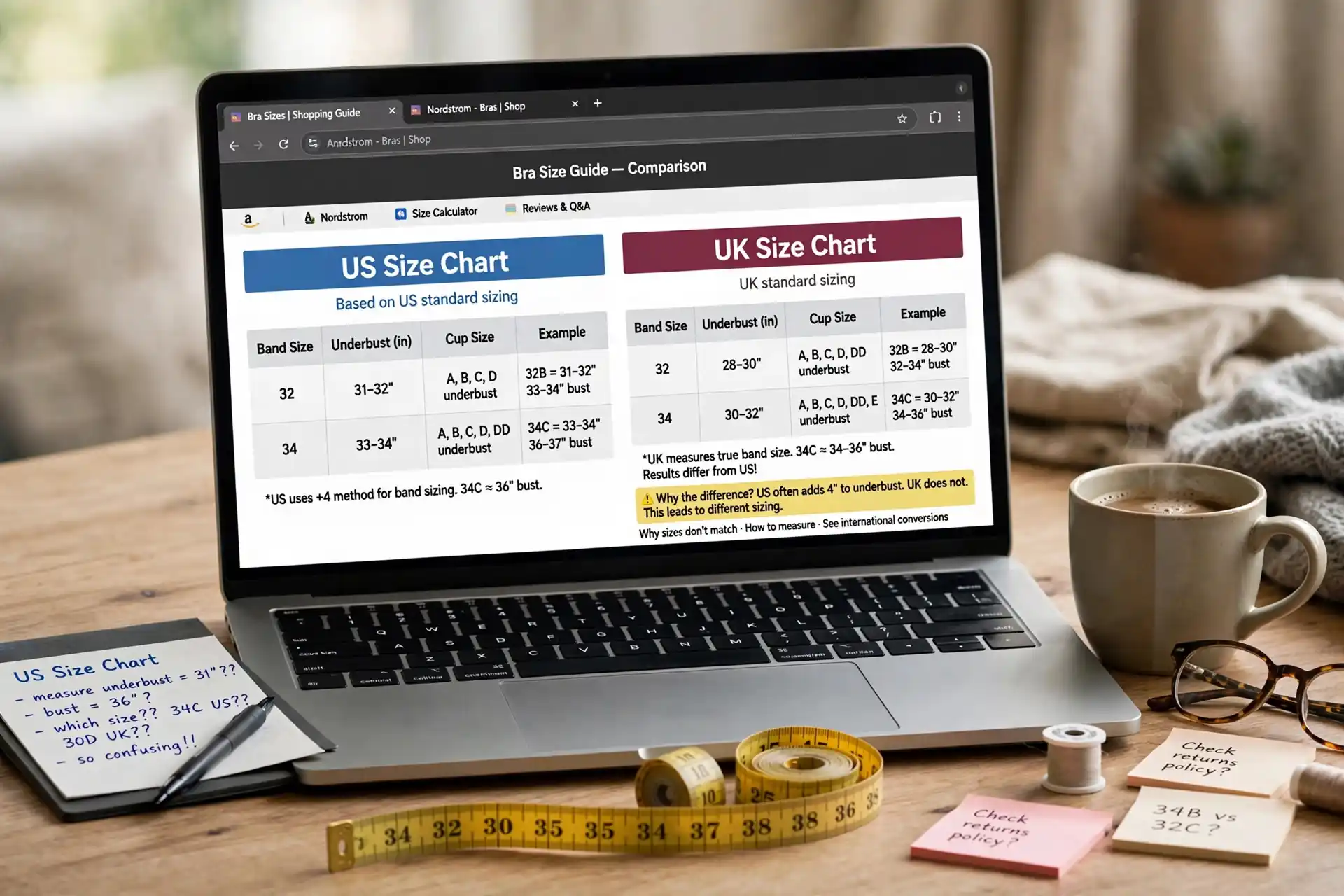
Choosing a Bra Size When Online Charts Don’t Agree
Two brands can take your exact same measurements and hand back different sizes, because there’s no single industry standard for how a band or cup number is calculated. Trust your own fit checklist over any single chart, and expect to size differently brand to brand.
Why the Same Measurements Produce Different Sizes
Band sizing alone varies by method: some brands measure directly under the bust and add nothing, others add four or five inches to that number following an older convention. Cup sizing compounds the problem, since a cup letter only means something relative to its own band size — a C cup on a 32 band and a C cup on a 38 band hold very different volumes. A size chart built around one of these methods will misfit you the moment you shop a brand using the other.
Fabric behavior adds another layer. A bra with more structured, less stretchy fabric needs a truer-to-measurement fit, while a soft, stretch-lace style can run a full band size smaller than the number suggests and still feel comfortable. This is part of why buying clothes online without trying them on trips people up more with bras than almost any other garment.
Pregnancy, weight changes, and even the time of day can shift these measurements slightly, which is one more reason a single static chart number rarely stays accurate for long. Re-checking fit every six months to a year, rather than assuming last year’s size still applies, catches most of the drift before it becomes uncomfortable.
What to Check Instead of the Chart
- The band should sit level around your ribcage, not riding up in the back, and feel snug on the loosest hook so you have room to tighten it as it stretches with wear.
- The center gore (the piece between the cups) should lie flat against your sternum, not float above the skin.
- Cups should fully contain tissue with no spilling over the top or gapping with visible empty space.
- Straps should stay in place without digging in or needing constant adjustment through a normal day.
If a chart and your own fit check disagree, follow the fit check. A brand’s stated size is a starting guess for where to begin trying garments on, not a guarantee, and a wardrobe built around a handful of well-fitting basics only works if the basics actually fit — sizing off a chart you haven’t verified against your own body defeats that from the start. Return policies exist for exactly this gap between chart and reality, so ordering two adjacent sizes from a new brand and returning the one that doesn’t work is often faster than guessing from measurements alone. For background on how sizing conventions developed, this overview covers the history.
Adjustable features help absorb some of this uncertainty. Multiple hook-and-eye rows, adjustable straps, and a gore designed to sit close rather than rigid all give a bra some room to be fine-tuned after purchase, which matters more with an unfamiliar brand than with one you’ve already tested and trust.
Once you find a band-and-cup combination that checks all four points in one brand, note it down. It won’t transfer exactly, but it gives you a real reference point instead of starting from zero every time.
Why the Charts Disagree
Online bra size charts disagree because there is no governing standard for bra sizing. Unlike shoe sizes, which have at least regional conventions, bra sizing is entirely manufacturer determined. Each brand develops its patterns on its own fit model, grades sizes according to its own formulas, and labels the results with letters and numbers that look universal but are not. A 34C from a European brand, an American brand, and a UK brand can be three meaningfully different garments.
The disagreement starts at measurement methodology. Some charts use the outdated plus four method, adding inches to your underbust. Others use your actual underbust. Some measure over a bra, others without. Cup progression varies too: most brands increase cup volume consistently per letter, but the increment differs, and beyond DD the lettering systems diverge completely between US and UK conventions. When charts built on different foundations give different answers from the same measurements, the charts are not broken. They are describing different products. Understanding what band size actually determines helps you see through the chart confusion to the fit principles beneath.
US vs UK Sizing: The Letter Trap
The most consequential disagreement is the US versus UK cup lettering beyond DD. UK sizing progresses DD, E, F, FF, G, GG and so on, with each step a consistent increment. US sizing is chaotic by comparison: after DD comes DDD or E or F depending on the brand, with no consistency. A UK 30F and a US 30F are different sizes. If you shop international brands, learn which system each uses and convert accordingly. Many fit problems blamed on body weirdness are actually system mismatches.
A Practical Strategy for Online Shopping
Stop looking for the one true size and start working in ranges. Calculate your starting size using the modern method: snug underbust for band, bust minus underbust for cup. Then identify your sister size range: one band up with one cup down, one band down with one cup up. When ordering online, get your calculated size plus one sister size in each direction in the same bra. Yes, this means ordering three bras to keep one. Free returns make this practical, and it is far more efficient than sequential single orders.
Read the brand’s specific size guide, not a generic chart. Look for the model measurements and what size she wears, which many quality retailers provide. Check reviewer fit notes filtered by people near your size. Comments like runs small in the band or cups run shallow are more valuable than any chart. Over time you will learn which brands match your shape, and shopping gets dramatically easier.
Shape Matters as Much as Size
Two people with identical measurements can need different bras because breast shape varies: shallow versus projected, full on top versus full on bottom, wide roots versus narrow roots, close set versus wide set. Charts cannot capture shape. This is why a bra in your exact calculated size can still fit badly. If cups gap at the top but spill at the sides, or the gore will not tack despite correct measurements, the issue is shape mismatch, not size error. Learning your shape vocabulary, through trying different cup styles like balconette versus plunge versus full coverage, resolves problems that size changes alone cannot.
Building a Reliable Personal System
How To Measure Yourself Accurately at Home
Wear an unpadded bra or no bra, and stand in front of a mirror with a soft tape measure. Start with the band. Wrap the tape snugly around your ribcage directly under your bust, where the band will sit. Breathe out normally and read the number. Round to the nearest whole inch. This is your band measurement, and it is the one most people get wrong.
Now the bust. Lean forward at about ninety degrees so your breasts hang freely, and measure around the fullest point, keeping the tape level across your back. Write that number down. Then stand upright and measure the fullest point again. Take the average of the leaning and standing numbers. Leaning catches tissue that standing misses, which is why this beats the old stand up straight method.
Subtract your band measurement from your bust average. Each inch of difference is one cup size: one inch is an A, two is a B, three is a C, four is a D, and so on past DD. A 32 inch band with a 36 inch bust average is a 32D. Most sizing disasters come from a band that is too big, so if the tape felt loose under your bust, go down a band and up a cup, which keeps the same cup volume.
Re-measure every six to twelve months. Weight shifts, and the same size fits differently across brands, so treat the tape as your starting point and the fitting room as the judge.
Keep notes. When a bra fits well, record the brand, model, and size. This becomes your personal reference that no chart can replace. Note also what did not work and why: band too loose, cups too shallow, gore too wide. Patterns emerge quickly. You might discover that you consistently need to size down in the band for one brand, or that plunge styles never work for your shape regardless of size.
Get professionally fitted once as a calibration exercise, ideally at a specialty boutique rather than a chain store with sales incentives. A good fitter assesses shape as well as size and can articulate why specific bras work. Treat the result as data, not gospel: fitters have brand biases and the occasional bad day. But one solid fitting session teaches you what correct fit feels like, which makes all future online shopping more accurate. For the underlying mechanics of why fit works the way it does, band size fundamentals explain the support structure. More clothing fit guides are at Factblaze.
Frequently Asked Questions
Which online bra size calculator is most accurate?
Calculators using the modern method, actual underbust without adding inches, tend to be more accurate than those using plus four. But any calculator is only a starting point. The most accurate approach is calculating a range, then trying sister sizes. No calculator accounts for shape, which is half the fit equation.
Why does my size differ between sports bras and regular bras?
Sports bras use different construction with compression or encapsulation designs that fit differently from everyday bras. Many use S/M/L sizing instead of band and cup. Expect to experiment separately. Your regular bra size is a rough guide, not a direct translation.
Should I trust the size chart on the brand’s own website?
More than a generic chart, since it describes that brand’s actual grading. But still treat it as a starting point. Brand charts are accurate to the brand’s intentions, which may still differ from your body’s reality. Combine the chart with reviewer fit notes for best results.
How do I convert between US and UK sizes?
Bands convert directly: a 34 is a 34. Cups match through DD, then diverge. US DDD equals UK E, US G roughly equals UK F, but beyond that the systems scatter by brand. When in doubt, shop by UK sizing for larger cups, since it is more consistent, and check each brand’s conversion chart.
Is it worth getting fitted in person?
Yes, once, at a reputable specialty store. The value is educational: learning what correct fit feels like and discovering your shape characteristics. After that, online shopping with your personal notes is usually sufficient. Refit after major body changes.
Conclusion
Charts disagree because they describe different manufacturers’ products, not universal truth. Work in size ranges rather than single sizes, order sister sizes when shopping online, learn your shape as well as your measurements, and keep personal notes on what fits. The goal is not to find the chart that finally agrees with you. It is to build enough personal data that charts become unnecessary. For detailed fitting methodology, Bratabase offers community driven fit data across thousands of bra models.