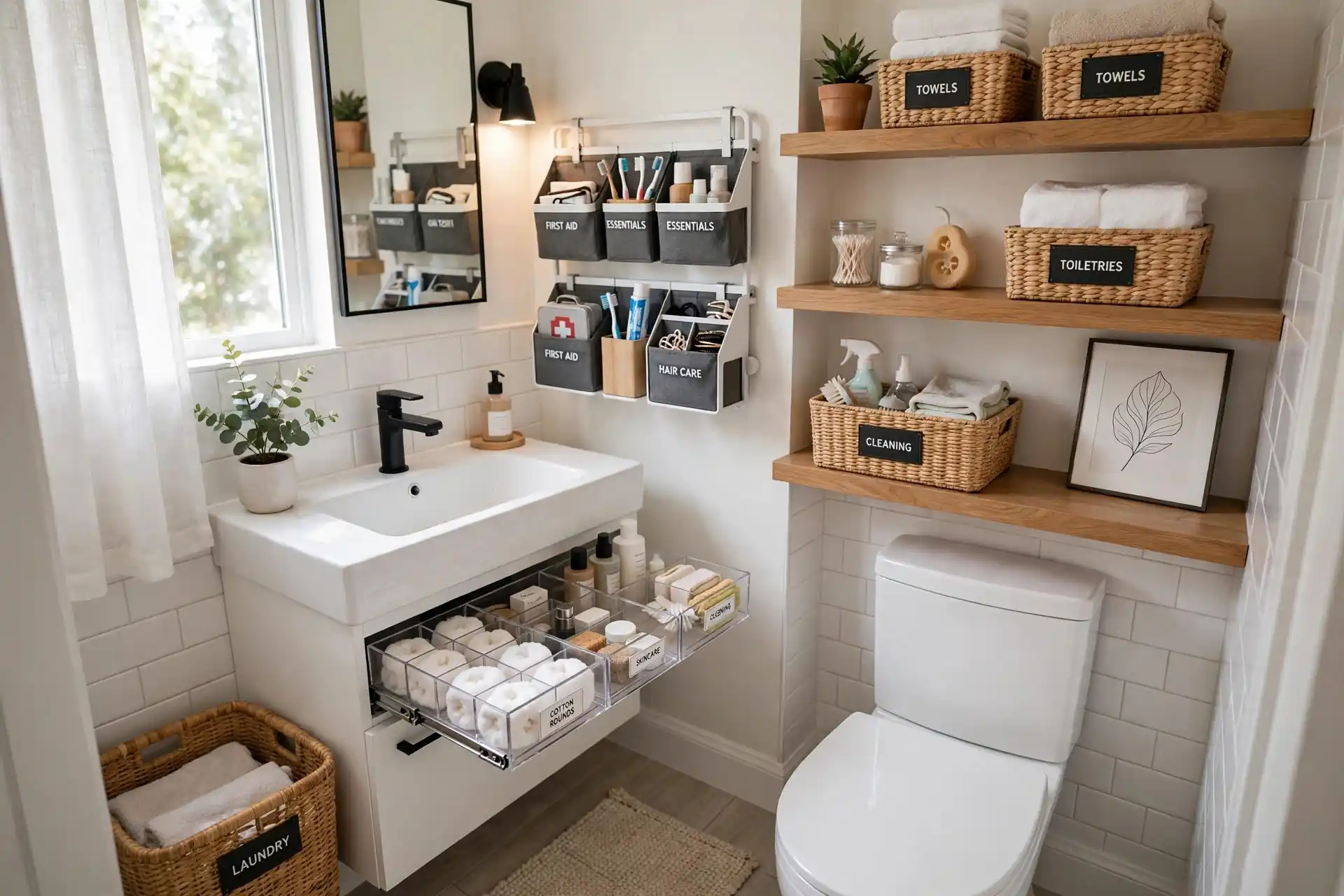
Small bathroom organization hacks
Of all the rooms in a home, the bathroom tends to generate the most clutter relative to its size. A single counter might need to accommodate skincare products, hair tools, toothbrushes, soap, and whatever else gets left there between uses. In a small bathroom, the stakes are even higher — every square foot matters, and a poorly organized space feels chaotic in a way that a cluttered living room simply does not.
The good news is that bathroom storage problems are almost always solvable without a renovation. The solutions range from a few minutes with an adhesive hook to a weekend installing floating shelves, and the cumulative effect of several small changes is a space that feels significantly larger and more functional than it did before.
This guide covers the most effective small bathroom organization hacks organized by area, with specific attention to solutions that work in rentals, on tight budgets, and in bathrooms with no useful existing storage.
The Rule That Makes Everything Else Work: Declutter First
Every bathroom organization project fails when it skips this step. Before purchasing a single bin, shelf, or organizer, remove everything from every cabinet, drawer, and surface and make three categories: keep, discard, and relocate.
Discard expired products. Check the dates on sunscreen, medications, and skincare products — most people are surprised by how much is out of date. Discard anything that has not been used in six months with no clear plan for using it in the next six. Relocate anything that is stored in the bathroom out of habit rather than necessity — extra towels, cleaning supplies for other rooms, and products that belong in a different cabinet.
What remains is the set of items your bathroom actually needs to store. Only then does it make sense to choose organizational products, because the quantity and type of what you own determines what storage format will work. Buying organizers first almost always results in purchasing the wrong size or the wrong system for what you actually have.
Countertop Organization: The Visible Priority
The countertop has an outsized effect on how a bathroom feels because it is always visible. A clear counter makes even a genuinely small bathroom feel spacious and intentional; a cluttered one makes the room feel chaotic regardless of how organized the cabinets are.
The Flat Surface Rule
Keep only daily essentials on the counter — the things that are used every single morning and evening. For most people, that is hand soap, a toothbrush holder, and perhaps one or two skincare items. Everything else goes away. A useful discipline is this: if it needs a flat surface, earn that surface by using it daily. If you use it every few days, it belongs in a drawer or cabinet.
Trays as Visual Containers
Grouping items on a small tray does something psychologically interesting — it turns a collection of objects into a styled vignette. Three bottles on a counter look like clutter; the same three bottles on a marble or acrylic tray look deliberate. The tray also has the practical benefit of making the counter easier to wipe clean because you move one item rather than eight.
Wall-Mounted Dispensers and Holders
Moving soap dispensers, toothbrush holders, and cup dispensers to wall-mounted versions clears the counter completely and gives it back to you as usable space. Command strip-mounted versions work well for renters; screw-mounted versions are more secure for homeowners. A wall-mounted soap dispenser is one of the most underrated small bathroom organization hacks because its impact on counter clarity is immediate and it costs very little.
Under-Sink Storage: The Most Underused Space in Most Bathrooms
The cabinet under the bathroom sink is typically the largest storage area in a small bathroom, and it is usually the most poorly used. The main obstacle is the plumbing — the P-trap and supply lines take up central space and make a single large bin impractical.
Working Around the Plumbing
The solution is not a large single container but a set of smaller, thoughtfully arranged ones. Two stackable bins positioned on either side of the P-trap immediately create usable storage without needing to modify anything. Two-tier pull-out organizers with a cutout in the center for the drain pipe are also widely available and make the back of the cabinet accessible without removing the front items first.
Clear acrylic bins or stackable drawers are particularly useful here because they let you see what is inside without pulling everything out. Label each container by category — hair care, skin care, first aid, cleaning — and the cabinet effectively becomes a functional storage system rather than the default repository for whatever does not have anywhere else to go.
The Tension Rod Trick
One of the more clever under-sink organization hacks requires nothing beyond a tension rod from a hardware or dollar store. Install it horizontally inside the cabinet, roughly halfway up, and use it to hang spray bottles by their trigger handles. This frees the floor of the cabinet for bins and baskets and makes cleaning products easy to access without rummaging.
Shelf Risers for Stacking
If your under-sink cabinet has more vertical height than you are currently using, a wire shelf riser doubles usable surface area for almost no cost. Place shorter items below the riser and taller ones beside it, and you have effectively created a second tier of storage in a space most people treat as a single flat surface.
Vertical Space: The Most Valuable Square Footage You Are Not Using
In a small bathroom, the walls are your greatest untapped resource. Most small bathroom organization strategies fail because they focus on the floor footprint when height offers far more available space.
Over-the-Toilet Storage
The area above the toilet is a significant dead zone in most bathrooms — typically 36 to 48 inches of clear wall space that is simply not used. An over-the-toilet shelving unit or cabinet hutch addresses this directly. Freestanding units that stand on the floor and frame the toilet require no drilling and are excellent for renters. Wall-anchored units are more stable and look more built-in for homeowners.
This space is ideal for rolled towels, extra toilet paper, small baskets of infrequently used items, and decorative objects that double as storage vessels — a small wooden crate, a woven basket, a lidded ceramic jar.
Floating Shelves
Floating shelves installed above the toilet, beside the mirror, or in any available wall space provide storage and display surface without the visual bulk of a cabinet. Because they do not extend to the floor, they keep the floor line open and make the room feel less crowded. A single row of three floating shelves in a staggered arrangement can hold a substantial amount — rolled hand towels, small plant pots, glass jars of cotton rounds, a candle — while reading as organized and intentional rather than stuffed.
For renters, peel-and-stick floating shelves rated for several pounds are available and work on smooth, non-textured walls. For homeowners, stud-mounted shelves or toggle bolt installations are more secure and can hold significantly more weight.
Towel Ladders
A freestanding towel ladder offers a significant storage upgrade over a single towel bar at essentially no installation cost. It leans against the wall and can hold four to six towels across its rungs, making it genuinely useful in bathrooms where multiple people are sharing towel space. It also functions as a styling element — layered towels in coordinating colors on a natural wood or matte black ladder read as a considered design choice rather than a storage solution.
Shower and Tub Organization
The shower is a particular challenge in a small bathroom because it has limited wall space, moisture restrictions on what can be installed, and typically a high volume of products relative to that space.
Tension Pole Caddies
The tension pole caddy is the most practical renter-friendly shower storage solution available. It uses a spring-loaded pole that extends from the tub rim or floor to the ceiling and provides multiple tiers of shelving along its height. No screws, no drilling, no damage to tile. The quality varies significantly — cheaper versions tend to rotate and fall; heavier stainless steel versions with grip pads on both ends are notably more stable and worth the additional cost.
Adhesive Shower Shelves
High-quality adhesive shower shelves have improved substantially in recent years. The best versions use a two-component adhesive that cures fully over 24 to 48 hours and holds considerable weight on clean, smooth tile surfaces. The key factors are surface preparation — the tile must be completely clean and dry before application — and not applying on grout lines, which compress slightly and allow air infiltration that weakens the bond.
Shower Caddies That Hang
Hanging caddies that loop over the showerhead are simple, portable, and genuinely effective for a small number of products. The main limitation is weight capacity and the potential for rust on lower-quality versions. Stainless steel or rust-resistant coated options last significantly longer in a humid shower environment.
Medicine Cabinet and Mirror Organization
Internal Medicine Cabinet Hacks
Most medicine cabinets have three or four shelves but are used as a single flat surface stacked with products. Adding small acrylic shelf risers or shallow bins inside the cabinet creates a second tier and makes items at the back visible and accessible without moving everything in front of them. A magnetic strip adhered to the inside of the cabinet door holds metal-cased cosmetics, bobby pins, tweezers, and nail scissors without taking up any shelf space at all.
Mirror-Side Magnetic Storage
For bathrooms without a medicine cabinet, a slim magnetic strip mounted beside the mirror provides a clean, space-efficient solution for metal items. Small magnetic containers that attach to the strip can hold cotton swabs, hair pins, and small brushes. The result is a functional display that keeps these items off the counter without requiring a cabinet.
Bathroom Organization Hacks for Renters: No-Drill Solutions
Renting adds a constraint that homeowners do not have — no permanent modifications to the walls, doors, or fixtures. But the available no-drill solutions have expanded considerably, and a fully organized rental bathroom is entirely achievable.
Over-the-door organizers that hang on the door frame require no installation and can hold a substantial amount — hair tools, extra toiletries, cleaning products. Clear pocket styles let you see what is in each compartment without rummaging.
Adhesive hooks rated for bathroom use hold towels, robes, and frequently used tools at the level that makes most sense. Command strips in particular have a well-documented track record in bathroom environments when instructions are followed precisely: the surface must be clean, dry, and allowed to cure for the full specified time before weight is applied.
Freestanding rolling carts in slim three-tier configurations fit in narrow gaps — beside the toilet, between the vanity and the wall, in the corner behind the door — and provide flexible storage that moves with you when the lease ends. The slim profile of most bathroom rolling carts (typically 10 to 12 inches wide) allows them to fit in spaces that seem too narrow to be useful.
Command hooks inside cabinet doors hold hair dryers, flat irons, and styling tools vertically rather than taking up shelf space. Most full-size hair dryers weigh under two pounds, well within the capacity of large Command strips used on a flat cabinet interior surface.
Makeup and Skincare Organization
Makeup storage is where small bathroom organization hacks tend to pay off most visibly, because cosmetics and skincare products are typically numerous, varied in size, and used daily.
Lazy Susans for Corner Spaces
A rotating Lazy Susan organizer placed in a corner of the counter or inside a cabinet turns an awkward, hard-to-reach space into easily accessible storage. A single rotation brings any item to the front without unpacking anything around it. This is particularly useful for tall bottles and spray products that cannot be stacked.
Acrylic Organizers
Clear acrylic drawer organizers and tiered cosmetic stands are the most consistently useful bathroom organization product because they allow you to see everything at a glance and remove the time cost of searching through opaque containers. The drawback is that they show fingerprints and dust, requiring more frequent wiping than opaque alternatives. For items used daily, this trade-off is almost always worth it.
Portable Makeup Caddies
For shared bathrooms or bathrooms with very limited counter space, a handled portable makeup caddy stored under the sink and carried to the mirror as needed is a genuinely effective organizational strategy. It keeps the counter clear when the bathroom is not in active use and consolidates all makeup into a single container that can be moved, cleaned, and refilled easily.
Maintenance: Keeping It Organized
The effort of organizing a bathroom pays off only if the system holds over time. A few practices make this significantly more likely:
Assign a home to every item. The reason bathrooms become cluttered is not that people are disorganized — it is that items do not have designated spots and get set down wherever there is room. When every product has a specific location, putting it back is as easy as using it.
Do a monthly five-minute reset. Set a timer and return everything to its home, discard anything that has run out, and check for expired products. This prevents the slow drift of clutter that makes a bathroom feel unmanageable.
Resist the temptation to fill newly created space. The common mistake after organizing is treating available space as an invitation to accumulate more. The value of the newly organized space is its availability — resist filling it immediately.
For related home organization ideas across different rooms, our guide to budget-friendly kitchen organization and remodeling applies the same principle of working with existing space more intelligently rather than assuming renovation is required. And for anyone managing a pet-friendly household where bathroom and kitchen spaces double as storage for pet supplies, resources like homemade dog treat recipes can help you think about dedicated storage for pet items in the kitchen rather than letting them spill into bathroom cabinets.
For current product recommendations, pricing comparisons, and community reviews of specific bathroom organizers, Google’s search results for small bathroom organization hacks surface a wide range of curated product lists and before-and-after demonstrations worth exploring.
Frequently Asked Questions
What are the best small bathroom organization hacks for renters?
Tension pole shower caddies, over-the-door pocket organizers, freestanding over-toilet shelving units, adhesive hooks rated for bathroom use, and slim rolling carts are the most effective no-drill solutions for renters. None of these require permanent installation, and most can be relocated when moving. Adhesive products work best on clean, smooth, non-porous surfaces following the manufacturer’s curing instructions precisely.
How do I organize under the bathroom sink with plumbing in the way?
Use two smaller bins rather than one large container, positioned on either side of the P-trap. Two-tier pull-out organizers with a center cutout specifically designed for bathroom plumbing are also widely available. A tension rod installed horizontally creates hanging space for spray bottles and cleaning products without blocking the bins. Clear stackable drawers on either side make items visible without requiring you to unpack the cabinet to find what you need.
What should I keep on the bathroom counter?
Only daily-use items that genuinely require a flat surface. For most households, that means hand soap, a toothbrush holder, and one or two skincare products in active use. Everything else belongs in a cabinet, drawer, or organizer. Using a small tray to contain counter items makes the surface easier to clean and gives the counter a more organized appearance without requiring everything to be hidden away.
How do I create more storage in a bathroom with no storage?
Vertical wall space is your primary resource. Floating shelves above the toilet or beside the mirror add substantial storage without taking any floor space. An over-the-toilet freestanding shelving unit addresses the largest unused vertical zone. Behind-the-door organizers add storage to a surface that is otherwise never used. A slim rolling cart adds movable storage in whatever gap exists between existing fixtures.
How do I keep a small bathroom organized long-term?
Assign a specific home to every item so that putting things back is as automatic as taking them out. Conduct a brief monthly reset to return items to their locations, discard empties, and check for expired products. Avoid filling newly created storage space immediately — treat available space as a functional reserve rather than an invitation to accumulate more products.
Conclusion
A small bathroom does not require renovation to function well. What it requires is a systematic approach to the space it already has — clearing unnecessary clutter, optimizing the under-sink cabinet, utilizing vertical wall space, managing the shower efficiently, and maintaining whatever organizational system is put in place.
The hacks in this guide range from a five-minute countertop reset to a weekend installation of floating shelves. All of them address a real organizational problem rather than adding complexity. Start with the area that bothers you most — usually the counter or under the sink — and work outward. The cumulative effect of several small improvements produces a bathroom that feels noticeably different without anything structural having changed.