
Why is my cat crying at night
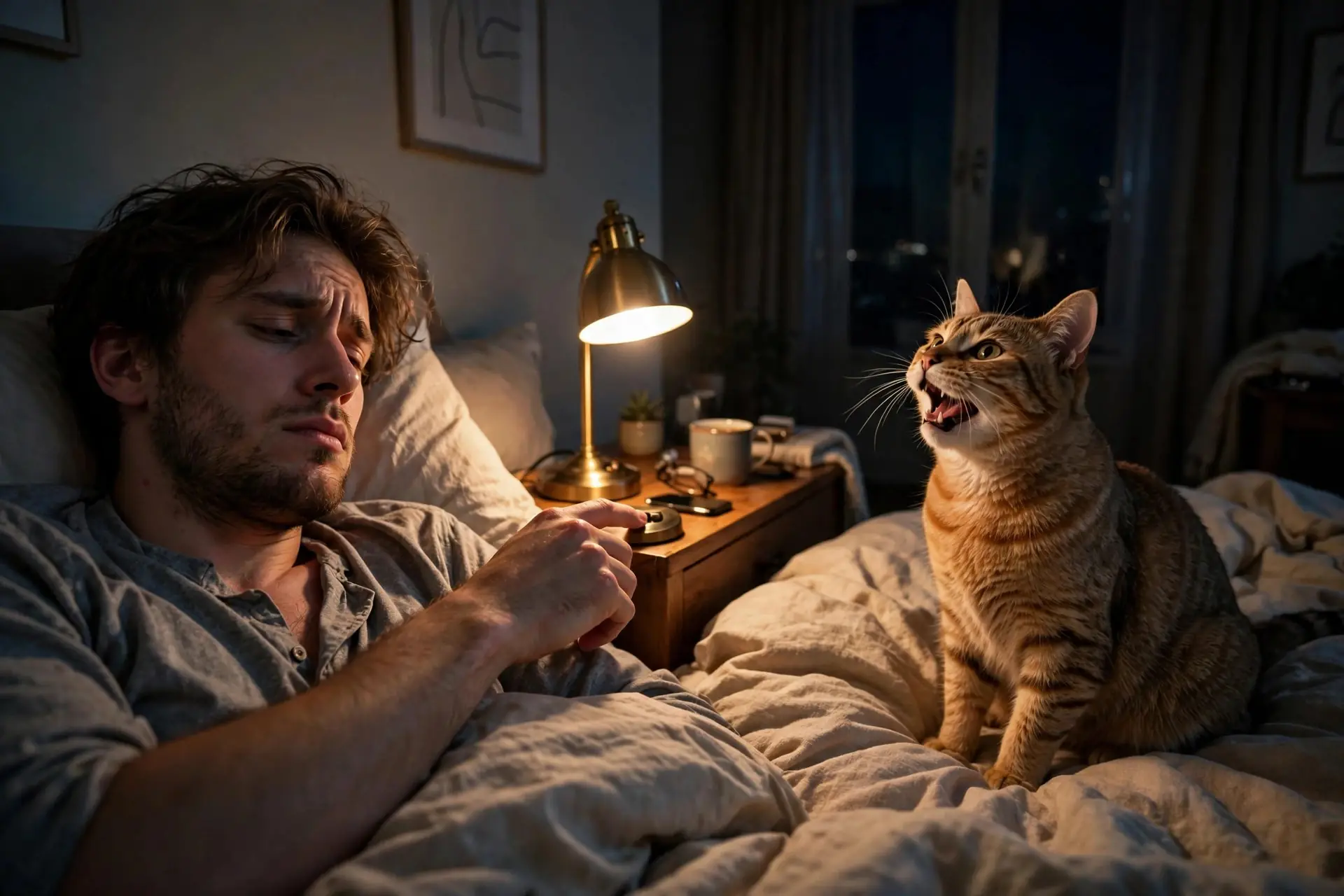
Few things are more disorienting than being pulled out of deep sleep by the sound of a cat crying. Whether it is a low moan from across the hallway, insistent yowling at a closed bedroom door, or a sound that seems to come from nowhere in particular, nighttime vocalizations in cats are among the most common complaints cat owners bring to veterinarians and behavior consultants.
The important thing to understand from the start is that when a cat cries at night, it is communicating something specific. The behavior is always meaningful, even when the cause is not immediately obvious. This guide works through the most common reasons a cat cries at night — including why female cats, unneutered males, senior cats, and newly adopted cats are particularly prone to it — and what you can do about each one.
Understanding Why Cats Are More Active at Night
Before getting into specific causes, it helps to understand something basic about feline biology. Cats are not nocturnal in the strict sense, but they are crepuscular — meaning they are naturally most active at dawn and dusk. In the wild, these are the optimal hunting windows when prey animals are also active.
Domestic cats retain this biological rhythm regardless of the schedule their human household operates on. A cat that has spent the day resting while the house is empty will often experience a surge of energy in the late evening and early morning that does not align with a human sleep schedule. When that energy has no outlet, it frequently becomes vocalization — your cat is not misbehaving, it is doing what its biology is pushing it to do.
This does not mean nighttime crying is just something you have to accept. It means the solution often involves adjusting what happens during the hours before you go to sleep.
The Most Common Reasons Your Cat Is Crying at Night
Hunger and Timing of Meals
One of the simplest explanations is that your cat is hungry. If their last meal comes early in the evening and they burn through their energy during a late-night active period, vocalizing near the kitchen or food storage area is a direct request. Some cats are also simply better at holding grudges about their feeding schedule than their owners expect.
The fix is often straightforward: move the last meal of the day as close to your bedtime as possible. If you use a scheduled feeding routine with dry food, adding a small portion of wet food just before lights out can satisfy hunger for longer, since wet food takes more time to digest and tends to be more calming in terms of the “hunt-eat-sleep” biological cycle.
Attention-Seeking Behavior
Cats learn very quickly what works. If, at some point, crying at night resulted in you getting up, offering food, or providing attention — even briefly, even while half-asleep — your cat has learned that this behavior produces a desired outcome. The problem is self-reinforcing: the more times it works, the more reliably the cat repeats it.
The only way to genuinely address attention-seeking crying is to stop responding to it entirely. This is harder than it sounds, particularly at 3 a.m. Any response — including raising your voice, getting up to check, or giving a small amount of food to make the noise stop — extends the behavior by confirming that it works. With total consistency, most cats will reduce or stop the behavior within one to two weeks. In the short term, it tends to get louder before it stops.
Your Cat Is in Heat
If your female cat is not spayed, and she is crying loudly at night with a particularly insistent, wailing quality, she is almost certainly in heat. Female cats enter estrus cycles approximately every two to three weeks during breeding seasons and will vocalize intensely to attract a mate. The sound is distinctive — more urgent and melodic than a standard meow, sometimes unsettling if you have not heard it before.
The only permanent solution for a female cat cycling into heat is spaying. Temporary measures like keeping her indoors or adjusting her environment do not address the hormonal drive creating the behavior. If you are wondering why your female cat is always crying at night during certain periods and then stops, the pattern of recurring cycles is usually the answer.
Why Your Unfixed Male Cat Is Crying at Night
Unneutered male cats are driven to seek mates and to announce their presence to other male cats. If there is a female in heat anywhere in the vicinity — inside the same home or in a neighboring home — an intact male will often pace, cry, and try to escape. The vocalization can be very loud and very persistent.
This is a hormonal response rather than a behavioral problem in the conventional sense, which means training approaches alone will not resolve it. Neutering significantly reduces or eliminates mating-related vocalizations in most male cats. If your unfixed male cat is constantly crying at night, particularly if the sound is directional — oriented toward a door or window — hormonal drive is almost certainly the cause.
A New Cat Crying at Night
If you have recently adopted a cat and the nighttime crying started shortly after they came home, separation anxiety and environmental unfamiliarity are the most probable causes. Moving to a new home is genuinely stressful for cats, whose sense of safety is closely tied to familiarity with their territory. At night, when the house is quiet and dark and there are no distracting activities, that disorientation can become acute.
New cats benefit from a predictable pre-bedtime routine established from the first days in the home. A structured interactive play session followed by a meal, and a comfortable, familiar-smelling sleeping area — not necessarily in your bedroom if that is causing the crying to escalate — gives the cat both the physical tiredness and the environmental cues it needs to settle. Feline pheromone diffusers, which release synthetic calming compounds, are widely used by veterinary professionals for this kind of transitional anxiety and are worth considering during the adjustment period.
Avoid rushing in to comfort a new cat every time it cries. The instinct to reassure is understandable, but if your new cat learns that crying produces your immediate presence, the behavior will consolidate rather than diminish.
Why Your Old Cat Is Crying at Night
Sudden or new nighttime vocalizations in a senior cat — generally considered to be a cat over ten years of age, though some sources place this threshold at seven — should always prompt a veterinary visit rather than a behavioral adjustment plan.
There are several medical conditions common in older cats that produce nighttime crying:
Hyperthyroidism is one of the most common hormonal disorders in older cats. It accelerates metabolism, causing restlessness, increased appetite, weight loss despite eating well, and often significant nighttime vocalization. A simple blood test can confirm or rule it out.
Hypertension, or high blood pressure, frequently develops alongside kidney disease or hyperthyroidism in senior cats. It causes neurological symptoms including disorientation and agitation, both of which tend to worsen at night.
Chronic kidney disease is extremely prevalent in older cats and causes discomfort, increased thirst, and general restlessness that can manifest as crying.
Cognitive Dysfunction Syndrome (CDS), sometimes called feline dementia, shares characteristics with Alzheimer’s disease in humans. Affected cats may become disoriented — particularly in dark, quiet environments — and cry because they feel lost or anxious. They may forget where their litter box or food bowl is, wake confused, and vocalize without an apparent reason. A nightlight in rooms where the cat moves around at night can reduce disorientation. Pheromone diffusers and, in some cases, medications prescribed by a veterinarian can help manage symptoms of Why is my cat crying at night ..
Pain from arthritis, dental disease, or internal conditions can also cause an older cat to cry. Cats are skilled at concealing discomfort, which is why this often goes unrecognized until the behavior changes become pronounced. If your old cat is suddenly crying at night and this is new, do not assume it is simply an age-related quirk — get a checkup.
Your Cat Is Crying to Go Outside
A cat crying at the door at night is asking to be let out. Whether this is appropriate to accommodate depends on your living situation and your stance on indoor versus outdoor access, but the cause is simple: your cat wants to be on the other side of the door.
Cats that previously had outdoor access and now do not will often persist in this behavior for a long time. Environmental enrichment that mimics outdoor stimulation — window perches with views of the garden, bird feeders positioned where the cat can watch them, puzzle feeders, and regular interactive play — reduces but does not always eliminate the drive to go outside for cats that are accustomed to it.
If the crying at the door is new in a cat that has always been indoor-only, it may be a response to detecting an outdoor cat — a rival or potential mate — through scent or sound.
A Cat Is Crying Outside Your House
If the crying is coming from outside rather than within your home, a stray or neighborhood cat is vocalizing for its own reasons — usually mating behavior if unfixed, territory signaling, or a search for resources like food and water. This is generally not something you can train away, since it involves a cat you do not own.
If the cat is a regular presence, contacting a local Trap-Neuter-Return (TNR) program is the most effective long-term approach. Spaying and neutering dramatically reduces mating-related outdoor vocalizations. In the short term, ensuring your own indoor cats cannot see or smell the outdoor cat — by blocking low window views during nighttime hours — can reduce the indoor cat’s response to the outdoor presence.
How to Stop Your Cat from Crying at Night: A Practical Guide
Establish an Evening Routine That Works With Feline Biology
The most consistently effective behavioral approach for cats with no underlying medical issue is structured play followed by feeding before bed. A 15 to 20 minute interactive play session with a wand toy or something that mimics prey movement — dragging, darting, unpredictable — followed immediately by a meal, replicates the natural hunt-eat-groom-sleep sequence. A cat that has “hunted,” eaten, and groomed is biologically primed to sleep.
Timing matters. The play and feeding should happen as close to your bedtime as possible, not two or three hours earlier.
Ensure Basic Needs Are Met Before Lights Out
Check the water bowl, clean the litter tray if needed, and confirm the sleeping environment is comfortable and accessible. Some cats cry simply because something they rely on is not available. Fixing a mechanical problem is faster than modifying behavior.
Do Not Respond to Attention-Seeking Vocalization
This is repeated because it is the element most owners find difficult to maintain. The only way to extinguish attention-seeking crying is complete non-reinforcement. No food, no eye contact, no verbal response, no getting up. Be aware that the behavior will typically intensify for several days before it decreases — this is called an extinction burst and is a normal part of the process.
Use Enrichment to Reduce Nighttime Energy
A cat that is mentally and physically active during the day has less surplus energy to burn at 2 a.m. Puzzle feeders that require the cat to work for a portion of its daily food, rotating toys to maintain novelty, window access to watch outdoor activity, and vertical climbing structures all contribute to a more tired, settled cat at night.
Address Hormonal Causes With Spaying or Neutering
If the root cause of nighttime crying is hormonal — a female cat cycling into heat or an intact male responding to nearby females — behavioral and environmental modifications will not resolve it. Spaying and neutering remain the most effective and permanent solutions.
See a Veterinarian If the Behavior Is New or Has Changed
Any sudden or new onset of nighttime crying in a cat that was previously quiet at night is a reason to book a veterinary appointment. The causes to rule out — hyperthyroidism, hypertension, kidney disease, pain, cognitive dysfunction — are all better managed with early detection. Do not wait to see if it resolves on its own.
If you are thinking broadly about building a pet-friendly home and lifestyle, our detailed resource on choosing the best dog breeds for families covers how different animals fit different living environments — useful context even for multi-pet households navigating new dynamics. And for those balancing home life and personal style, FactBlaze covers everything from pet care to fashion and seasonal wardrobe planning.
For the most current veterinary-backed guidance on cat behavior and nighttime vocalization, Google’s search results for why cats cry at night surface a range of specialist resources and veterinary organization articles worth consulting.
Frequently Asked Questions
Why is my cat suddenly crying at night when it never used to?
A sudden change in nighttime behavior is almost always worth a veterinary visit, particularly if your cat is over seven years old. The most common medical causes of new nighttime crying in cats include hyperthyroidism, hypertension, kidney disease, pain, and cognitive dysfunction syndrome. Ruling these out before assuming a behavioral cause is the responsible starting point.
Why is my female cat crying at night so loudly?
If your female cat is not spayed, loud nighttime crying is a hallmark of estrus, the feline heat cycle. Female cats vocalize intensely to attract mates and can repeat this cycle every two to three weeks. Spaying is the only permanent resolution. If your female cat is already spayed and has suddenly started crying loudly, a veterinary visit to check for medical causes is warranted.
Why is my unfixed male cat crying at night?
An unneutered male cat crying at night is almost always responding to hormonal drive — either detecting a female in heat nearby or signaling his presence to rival males. This is a biological response rather than a behavioral problem, and neutering is the most effective solution. Environmental adjustments alone are unlikely to stop the behavior while the hormonal drive remains.
Why is my old cat crying at night?
Senior cats that begin crying at night are among the most important to evaluate medically. The most common underlying causes are hyperthyroidism, high blood pressure, kidney disease, pain, and cognitive dysfunction syndrome. These conditions are treatable or manageable when identified early, but none of them resolve on their own. Schedule a veterinary checkup rather than assuming nighttime crying is simply an aging behavior.
How do I stop my cat from crying at night for attention?
Complete non-reinforcement is the only approach that works for attention-seeking behavior. Do not respond to the crying in any way — no food, no eye contact, no verbal response, no getting up. Simultaneously, establish a pre-bedtime play and feeding routine that tires the cat out before you go to sleep. Expect the behavior to intensify for several days before it diminishes. If it does not improve after two weeks of consistent non-reinforcement, speak to a veterinarian about whether an underlying cause may be sustaining the behavior.
Conclusion
A cat crying at night is always communicating something. Working out what that something is — whether it is hunger, hormonal drive, a medical condition, environmental anxiety, or simply surplus energy with nowhere to go — is the first step toward resolving it.
The approach that works depends entirely on the cause. For behavioral issues with healthy adult cats, establishing a structured evening routine and refusing to reinforce nocturnal demands is usually effective within a couple of weeks. For senior cats with new or sudden nighttime vocalization, for unneutered cats with obvious hormonal motivation, or for cats whose crying is accompanied by other behavioral or physical changes, the right first step is always a veterinary visit.
Nighttime quiet is achievable in most cases. Understanding why your cat is crying at night gets you most of the way there.