Polar Bear Facts: Size, Diet, Habitat, and Behavior
If you picture the Arctic, a polar bear is probably the first thing that comes to mind. These massive white bears are among the most recognizable animals on Earth and among the most misunderstood. Most people know they’re big, white, and live somewhere cold — but the real story is a lot more interesting.
This guide covers everything worth knowing about polar bears: their size, diet, hunting style, family life, and the environmental pressures they face today. Whether you’re researching for school, planning an Arctic trip, or just curious about ice bear facts, you’ll find clear, accurate answers here.
Quick Polar Bear Facts
Before diving into the details, here’s a fast overview:
- Scientific name: Ursus maritimus (“sea bear”)
- Size: Males up to 1,500 pounds; females up to 650 pounds
- Lifespan: 20–30 years in the wild
- Habitat: Arctic sea ice across the U.S. (Alaska), Canada, Russia, Norway, and Greenland
- Diet: Mostly ringed and bearded seals
- Population: Roughly 22,000 to 31,000 worldwide
- Conservation status: Vulnerable (IUCN Red List)
What Is a Polar Bear?
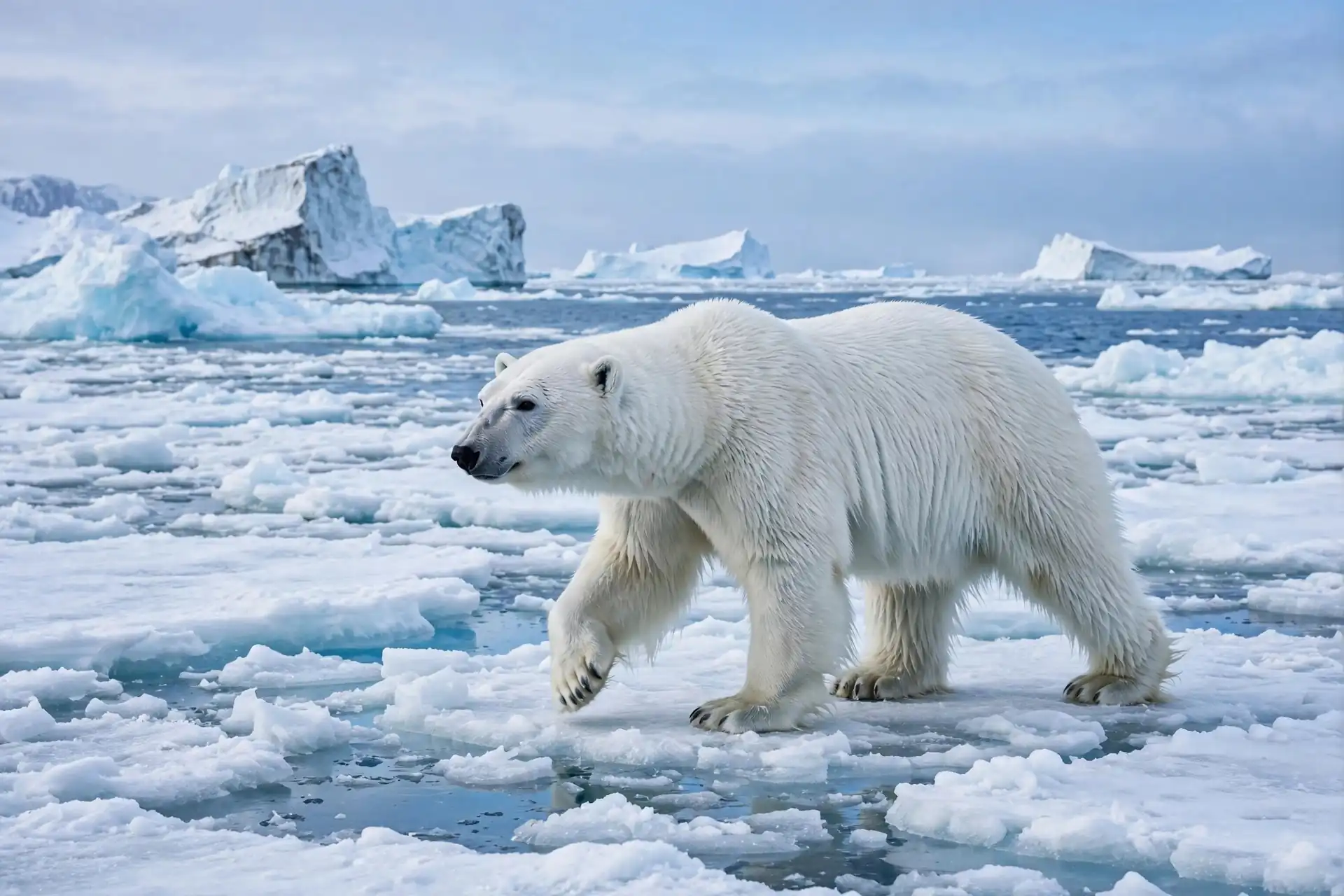
The polar bear is the largest land carnivore on the planet, though it spends so much time in the water that scientists classify it as a marine mammal. Its scientific name, Ursus maritimus, literally means “sea bear,” which fits — polar bears are strong swimmers that can travel dozens of miles between ice floes in open water.
Polar bears evolved from brown bear ancestors, likely somewhere between 500,000 and 700,000 years ago, adapting over time to life on sea ice. Genetic studies show polar bears and brown bears are close enough relatives that they can still interbreed in the wild, producing hybrids sometimes nicknamed “pizzly bears” or “grolar bears.”
Polar Bear Size and Physical Features
Polar bears are big by any measure, but there’s a real size difference between males and females.
How Big Do Polar Bears Get?
Adult males typically weigh between 900 and 1,500 pounds (400–680 kg) and can stand over 10 feet tall on their hind legs. Females are noticeably smaller, usually weighing 330 to 650 pounds (150–295 kg). A pregnant female can nearly double her weight before denning for the winter.
For comparison, an adult male polar bear outweighs a grizzly bear and can rival the largest Kodiak bears, making it one of the two biggest bear species alive today.
Why Polar Bear Fur Isn’t Actually White
This is one of those facts that surprises almost everyone: polar bear fur has no pigment at all. Each hair is actually transparent and hollow, and it only looks white because it scatters visible light the same way snow does. Underneath all that fur, polar bear skin is jet black — a trait that helps absorb and retain heat from the sun.
That black skin is paired with a thick layer of blubber, sometimes up to 4 inches thick, which insulates the bear in water that hovers near freezing. Together, the fur and fat make polar bears so well insulated that infrared cameras have trouble detecting their body heat.
Paws Built for Ice and Water
Polar bear paws can measure up to 12 inches across, acting almost like snowshoes that spread the bear’s weight over thin ice. Small bumps on the pads, called papillae, grip slick ice, while thick fur between the toes adds extra traction. The paws are also partially webbed, which makes polar bears powerful, if unhurried, swimmers.
Where Do Polar Bears Live?
Polar bears live exclusively in the Arctic, across five countries often called the “polar bear nations”: the United States (Alaska), Canada, Russia, Norway, and Greenland (Denmark). Scientists divide the global population into 19 recognized subpopulations spread across roughly 23 million square kilometers of sea ice and coastal habitat.
Canada holds the largest share of the world’s polar bears, with an estimated 60% of the global population living within its borders, particularly around Hudson Bay and the Canadian Arctic Archipelago.
Unlike animals that live on land year-round, polar bears depend on sea ice as a platform. It’s not just habitat — it’s their hunting ground.
What Do Polar Bears Eat?
Polar bears are carnivores, and their diet is built almost entirely around one prey animal.
Their Main Food Source: Seals
Ringed seals and bearded seals make up the bulk of a polar bear’s diet. Polar bears prefer the fat-rich blubber of these seals, which provides the dense calories needed to survive long stretches without eating. A single adult seal can supply enough energy to sustain a bear for several days.
How Polar Bears Hunt
The classic hunting method is called “still-hunting.” A bear will sit motionless beside a seal’s breathing hole in the ice for hours, sometimes over a day, waiting for a seal to surface for air before striking. It’s a strategy that rewards patience over speed.
Polar bears also stalk seals resting on the ice, using their excellent sense of smell — strong enough to detect a seal’s scent from nearly a mile away, even through snow and ice.
What Happens When Seals Aren’t Available
When sea ice melts and hunting grounds disappear, polar bears will eat bird eggs, fish, kelp, and even scavenge whale carcasses. These substitute foods don’t come close to matching the calories from seal blubber, though, which is a major reason food scarcity has become such a serious problem as sea ice seasons shorten.
Polar Bear Behavior and Life Cycle
Solitary by Nature
Outside of mothers with cubs, polar bears are largely solitary animals. Adult males in particular roam and hunt alone, only coming together temporarily during the spring breeding season or when drawn to a shared food source, like a whale carcass.
Mating and Reproduction
Breeding season runs from March through June. After mating, a female polar bear experiences delayed implantation — the fertilized egg doesn’t begin developing until autumn, and only if she’s built up enough fat reserves to sustain a pregnancy. This is a survival adaptation: if food has been scarce, her body simply won’t proceed with the pregnancy.
Pregnant females dig maternity dens in snowdrifts, usually on land, where they give birth in December or January. Cubs are born blind, hairless, and weighing about one pound — roughly the size of a guinea pig compared to their 500-plus-pound mothers.
Raising Cubs
Mothers typically give birth to one to three cubs and nurse them in the den through the winter. Cubs stay with their mother for about two to two-and-a-half years, learning to hunt and survive on the ice before heading out on their own. During this period, the mother won’t mate again, which naturally spaces out polar bear reproduction.
Do Polar Bears Hibernate?
Not in the way black bears or grizzlies do. Most polar bears stay active through the winter to keep hunting seals on the ice. The exception is pregnant females, who enter a den and undergo a hibernation-like state while gestating and nursing cubs, without eating, drinking, or passing waste for several months.
Polar Bears and Climate Change
No article on ice bear facts would be complete without addressing the biggest challenge polar bears face today: the loss of sea ice.
Arctic sea ice has been shrinking by roughly 13% per decade since satellite records began in 1979, and current extent is at some of the lowest levels recorded in centuries. Because polar bears rely on sea ice to hunt seals, less ice means fewer hunting opportunities and longer periods on land living off fat reserves.
Research on well-studied subpopulations, such as western Hudson Bay, points to reduced reproductive success — not adult die-offs — as the main way declining ice is affecting bear numbers. Thinner cubs, lower birth weights, and shorter hunting seasons all add up over time.
The IUCN currently lists the polar bear as Vulnerable, projecting that under high-emission climate scenarios, the global population could decline by around 30% by 2050. Conservation groups and range-state governments have national action plans covering roughly 90% of subpopulations, though outcomes vary widely by region.
Common Polar Bear Myths, Debunked
Myth: Polar bear skin is white. False — it’s black underneath, which helps with heat absorption.
Myth: Polar bears hibernate all winter like other bears. Only pregnant females den up; most polar bears stay active and hunting through winter.
Myth: Polar bears and penguins live in the same place. Not even close. Polar bears live in the Arctic (Northern Hemisphere); penguins live in the Southern Hemisphere, mostly Antarctica. The two species have never crossed paths in the wild.
Myth: Polar bears are the same as grizzly bears, just white. They share ancestry, but polar bears have distinct adaptations — webbed paws, black skin, a longer skull, and a diet built almost entirely around seal blubber — that set them apart, much the way facts about lions highlights adaptations unique to Africa’s big cats.
Tips for Learning More or Viewing Polar Bears Safely
If you’re planning an Arctic trip or just want to responsibly engage with polar bear conservation, keep these points in mind:
- Never approach a polar bear in the wild; guidelines in places like Svalbard require staying at least 500 meters away.
- Support accredited conservation organizations that fund subpopulation monitoring and habitat research.
- Choose responsible tour operators who follow wildlife-distance regulations rather than promising close encounters.
- Reduce your own carbon footprint where practical, since sea ice loss is the single biggest driver of long-term population decline.
Frequently Asked Questions
How many polar bears are left in the world? Current estimates put the global population between 22,000 and 31,000 individuals, spread across 19 subpopulations. Some subpopulations are stable, while others are declining, which is why scientists track them separately rather than relying on one global number.
What is the biggest threat to polar bears? Sea ice loss from climate change is the primary threat. Less ice means fewer opportunities to hunt seals, leading to lower body condition and reduced reproductive success.
How fast can a polar bear run? Polar bears can sprint up to 25 miles per hour over short distances on land, though they tire quickly and prefer to conserve energy by stalking prey slowly rather than chasing it.
Are polar bears dangerous to humans? Yes. As apex predators with no natural fear of humans, polar bears are considered one of the more dangerous large carnivores to encounter in the wild, which is why strict distance rules exist in places like Alaska, Canada, and Svalbard.
How long do polar bears live? Wild polar bears typically live 20 to 30 years, though few reach the upper end due to the physical demands of Arctic life. Bears in professionally managed zoos or sanctuaries sometimes live longer.
What is a baby polar bear called? A baby polar bear is called a cub. Cubs are born weighing about one pound and stay with their mother for roughly two to two-and-a-half years before becoming independent.
Final Thoughts
Polar bears are far more than an Arctic icon — they’re a highly specialized predator shaped by hundreds of thousands of years of adaptation to one of the harshest environments on the planet. From their transparent, light-scattering fur to their reliance on sea ice for hunting, nearly every trait ties back to survival in the cold.
Understanding these ice bear facts matters because the challenges polar bears face today — shrinking ice, shorter hunting seasons, and reduced reproductive success — are early signals of how the broader Arctic ecosystem is changing. Whether that story ends well depends largely on what happens outside the Arctic itself.