
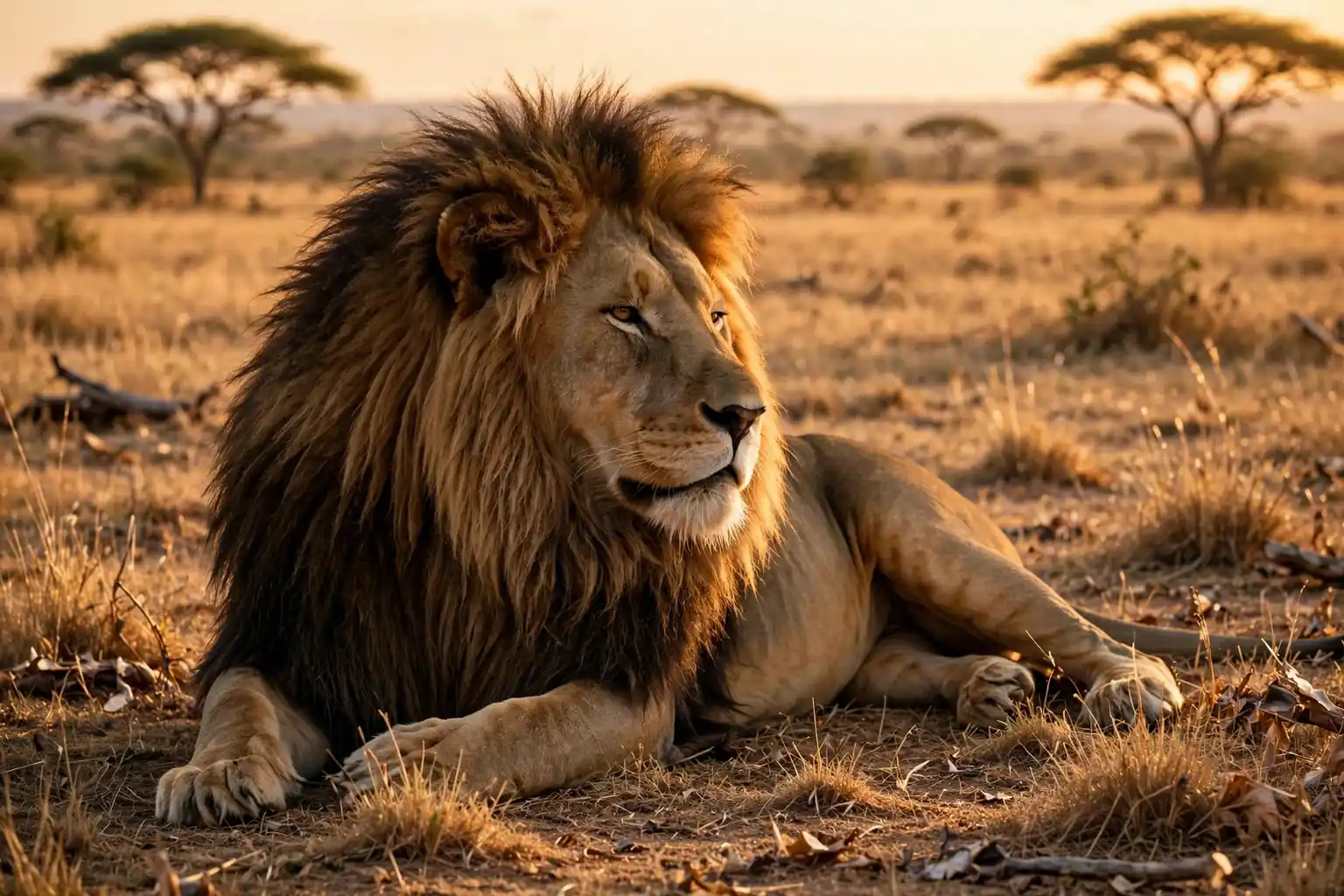
25 Fascinating Facts About Lions You Probably Didn’t Know
Lions have earned the nickname “king of the jungle,” even though they don’t actually live in jungles at all. These powerful big cats prowl the grasslands and savannas of Africa, with one small population tucked away in a forest in India. They’re loud, social, surprisingly lazy, and endlessly fascinating.
Whether you’re researching lions for a school project, planning an African safari, or you’re just a big cat enthusiast, this guide covers everything worth knowing: how lions live, hunt, communicate, and why their future is far less secure than most people realize.
Quick Lion Facts at a Glance
- Scientific name: Panthera leo
- Habitat: Savannas, grasslands, and open woodlands in sub-Saharan Africa; one population in Gir Forest, India
- Group name: Pride
- Roar distance: Up to 5 miles (8 kilometers)
- Top speed: Around 50 miles per hour in short bursts
- Lifespan: 10 to 14 years in the wild; up to 20+ years in captivity
- Conservation status: Vulnerable (IUCN Red List)
- Wild population: Roughly 20,000 to 25,000 in Africa, with fewer than 700 in India
1. Lions Are the Only Cats That Live in Family Groups
Every other big cat species is a loner. Tigers, leopards, jaguars, and cheetahs hunt and live on their own except when raising cubs. Lions are the exception. They live in social units called prides, typically made up of related lionesses, their cubs, and one or more resident males.
A pride can range from a handful of lions to more than 30 individuals, depending on the availability of prey and territory. Female lions usually stay with the pride they were born into for life. Males, on the other hand, are pushed out around age two or three and must go find or fight for a pride of their own.
2. A Lion’s Roar Can Travel Five Miles
That deep, rumbling roar isn’t just for show. It’s one of the loudest sounds any land animal makes, reaching up to 114 decibels, louder than a chainsaw. A special structure in a lion’s larynx allows the vocal cords to vibrate at low frequencies, producing a roar that can be heard up to 5 miles (8 kilometers) away on a still night.
Lions roar to mark territory, warn off rival prides, and help scattered members find their way back to the group. Most roaring happens after dusk.
3. Female Lions Do Most of the Hunting
Despite their reputation for laziness, lionesses are the primary providers for the pride. They handle roughly 85 to 90% of all hunting, working in coordinated groups to stalk, surround, and take down prey like zebras, wildebeests, buffalo, and antelope.
Male lions, with their bulkier build and heavy manes, are built more for fighting off rivals and defending territory than for the speed and stealth that hunting requires. That said, males do join in when large or dangerous prey, such as buffalo, is on the menu.
4. Lions Sleep Up to 20 Hours a Day
If you’ve ever felt lazy on a Sunday, you have nothing on a lion. These big cats spend as much as 20 hours a day resting or sleeping. Hunting and defending territory burn enormous amounts of energy, so lions conserve strength between meals by lounging in the shade.
This is one reason wildlife guides on safari often schedule game drives for early morning or late afternoon, when lions are most likely to be active.
5. A Male Lion’s Mane Signals Strength and Health
The thick mane framing a male lion’s face isn’t just for looks. Research shows that mane size and color are linked to testosterone levels and overall health. Darker, fuller manes tend to signal a stronger, more dominant male, and lionesses are more likely to favor these males as mates.
Manes also help protect a lion’s neck during fights with rivals. Interestingly, not every male lion grows one. In Kenya’s Tsavo National Park, “maneless” lions are common, likely an adaptation to the region’s hot climate, since a heavy mane can trap heat.
6. Lions Can Sprint Nearly 50 Miles Per Hour
Lions aren’t built for endurance running. Instead, they rely on short, explosive bursts of speed, reaching up to 50 miles per hour when chasing prey. That speed only lasts for a few seconds, so lions depend on stealth and teamwork to get close before the final sprint.
A lion can also leap remarkable distances, covering up to 36 feet in a single bound when needed.
7. Cubs Are Born Blind and Extremely Vulnerable
Lion cubs enter the world blind, weighing just 2 to 4 pounds, and completely dependent on their mothers. Their eyes typically open within a week, but cub mortality is high. Fewer than half of all lion cubs survive to adulthood, due to predation, starvation, and territorial takeovers by new males.
When an unfamiliar male takes over a pride, he will often kill any existing cubs that aren’t his own. This behavior, while brutal, brings lionesses back into fertility sooner, allowing the new male to father his own offspring.
8. Lions Aren’t Actually “King of the Jungle”
It’s one of the most repeated facts about lions, and it’s technically wrong. Lions don’t live in jungles. They inhabit open savannas, grasslands, scrubland, and semi-arid plains across sub-Saharan Africa. The phrase likely stuck around because of old folklore and children’s media rather than actual geography.
The one exception to the “grassland only” rule is the Asiatic lion, a subspecies found exclusively in Gir Forest National Park in Gujarat, India, home to the world’s only wild population of lions outside Africa.
9. Some Lions Climb Trees
Tree-climbing isn’t typical lion behavior, but it does happen. In Uganda’s Queen Elizabeth National Park and Tanzania’s Lake Manyara National Park, lions are regularly spotted lounging in the branches of fig and acacia trees, sometimes 30 feet off the ground. Scientists believe this helps them escape biting insects, cool off, and get a better vantage point to scan for prey.
It’s an impressive sight, considering a full-grown lion can weigh over 400 pounds.
10. Lions Once Lived Across Three Continents
Today, lions are mostly confined to sub-Saharan Africa and one small forest in India. But that wasn’t always the case. Fossil evidence and ancient artwork show that lions once roamed across Africa, southern Europe, and large parts of Asia, disappearing from Europe by around the fourth century BCE.
This dramatic range collapse is part of why conservationists consider the modern lion population a shadow of its historical numbers.
11. A Lion’s Diet Depends on Teamwork
Lions are carnivores and apex predators, meaning they sit at the top of the food chain with no natural predators of their own (aside from humans). A single lion can eat up to 40 kilograms (about 88 pounds) of meat in one sitting, roughly a quarter of its own body weight, then go days without eating again.
Because hunting large prey like buffalo or giraffe is risky and difficult alone, lionesses coordinate their movements, often taking on different roles during a hunt to corner and bring down animals far larger than any single lion could handle.
12. Lions Communicate Through More Than Roars
Beyond their famous roar, lions use a whole range of vocalizations and body language to communicate within the pride. Grunts, moans, and low growls help coordinate movement and signal mood. Head-rubbing and licking reinforce social bonds between pride members, similar to how domestic cats greet each other.
Scent marking is another key communication tool. Males spray urine and rub their faces on trees and grass to mark territory boundaries, warning off rival males before a confrontation is even necessary.
13. Lions Are Classified as Vulnerable
This is one of the most important facts about lions, and it’s often left out of lighter fact lists. According to the International Union for Conservation of Nature (IUCN) Red List, lions are classified as Vulnerable, with the global wild population estimated at roughly 20,000 to 25,000 individuals in Africa, plus fewer than 700 Asiatic lions in India.
That may sound like a lot, but lion numbers have dropped by an estimated 40 to 50% over the past three lion generations (about 21 years). The species has also disappeared from more than 90% of its historical range.
Main Threats to Lion Populations
- Habitat loss: Expanding farmland and human settlements shrink and fragment lion territory.
- Human-wildlife conflict: Lions that prey on livestock are often killed in retaliation.
- Declining prey populations: Bushmeat hunting has reduced the herbivores lions rely on for food, particularly in West and East Africa.
- Poaching: Lion bones and body parts are trafficked for use in traditional medicine and jewelry markets.
- Climate change: Shifting rainfall patterns affect prey migration and water availability across lion habitat.
14. Conservation Efforts Are Making a Difference
The picture isn’t entirely bleak. Organizations working across Africa are demonstrating that lion populations can stabilize, and even recover, with the right support. Anti-poaching patrols, community compensation programs for livestock losses, and habitat protection have helped some populations grow, including recoveries documented in parts of Zambia and Senegal.
Programs that involve local communities directly, through education, shared conservation benefits, and improved livestock enclosures, tend to be the most successful long-term, since human-lion conflict remains one of the biggest threats lions face.
15. Not All Lions Live in Prides
While pride life is the norm, some male lions live a nomadic, solitary existence, particularly younger males that have been pushed out of their birth pride and haven’t yet claimed territory of their own. These nomadic males may travel alone or form small bachelor coalitions with other males until they’re strong enough to challenge for a pride.
Common Misconceptions About Lions
Myth: Lions live in jungles. As covered above, lions prefer open grasslands and savanna, not dense forest.
Myth: The male lion does most of the hunting. In reality, lionesses handle the vast majority of hunts. Males primarily defend territory.
Myth: A lion’s roar means it’s about to attack. Roaring is mostly used for communication and territory marking, not as a direct precursor to an attack.
Myth: Lions are endangered. Lions are classified as Vulnerable, not Endangered, though some regional populations, such as West African lions, are considered Critically Endangered.
Frequently Asked Questions About Lions
How many lions are left in the world? There are an estimated 20,000 to 25,000 wild lions remaining in Africa, along with fewer than 700 Asiatic lions in India’s Gir Forest, putting the global total at roughly 21,000 to 25,000 lions.
Why are lions called the king of the jungle if they don’t live in jungles? The nickname likely comes from folklore, storytelling, and children’s books rather than actual habitat. Lions live in savannas and grasslands, not jungles.
How fast can a lion run? A lion can reach speeds of up to 50 miles per hour in short bursts, though they can only sustain this speed for a few seconds before tiring.
What do lions eat? Lions are carnivores that primarily prey on large mammals such as zebras, wildebeests, buffalo, antelope, and giraffes. An adult lion can eat up to 40 kilograms of meat in a single meal.
How long do lions live? Wild lions typically live 10 to 14 years, though some individuals reach 16. In captivity, with veterinary care and no predation risk, lions can live 20 years or more.
Do female lions have manes? No. Manes are found only on male lions and are linked to testosterone levels, though some males, particularly in hot climates like Tsavo, Kenya, grow little to no mane at all.
Are lions dangerous to humans? Lions generally avoid humans and prefer natural prey, but attacks can occur, particularly in areas where human settlements border lion habitat and livestock is unprotected. Most human-lion conflict stems from lions preying on livestock rather than unprovoked attacks on people.
What is a group of lions called? A group of lions is called a pride. A group made up only of males, without any females, is called a coalition.
Final Thoughts
Lions are far more complex than their fierce reputation suggests. They’re deeply social animals with intricate family structures, remarkable communication skills, and a surprising amount of downtime built into their daily routine. At the same time, their declining numbers are a reminder that even an animal as iconic as the lion isn’t guaranteed a secure future.
Understanding these facts about lions is a good first step. Supporting habitat protection, responsible tourism, and community-based conservation programs is how that future actually gets secured.