
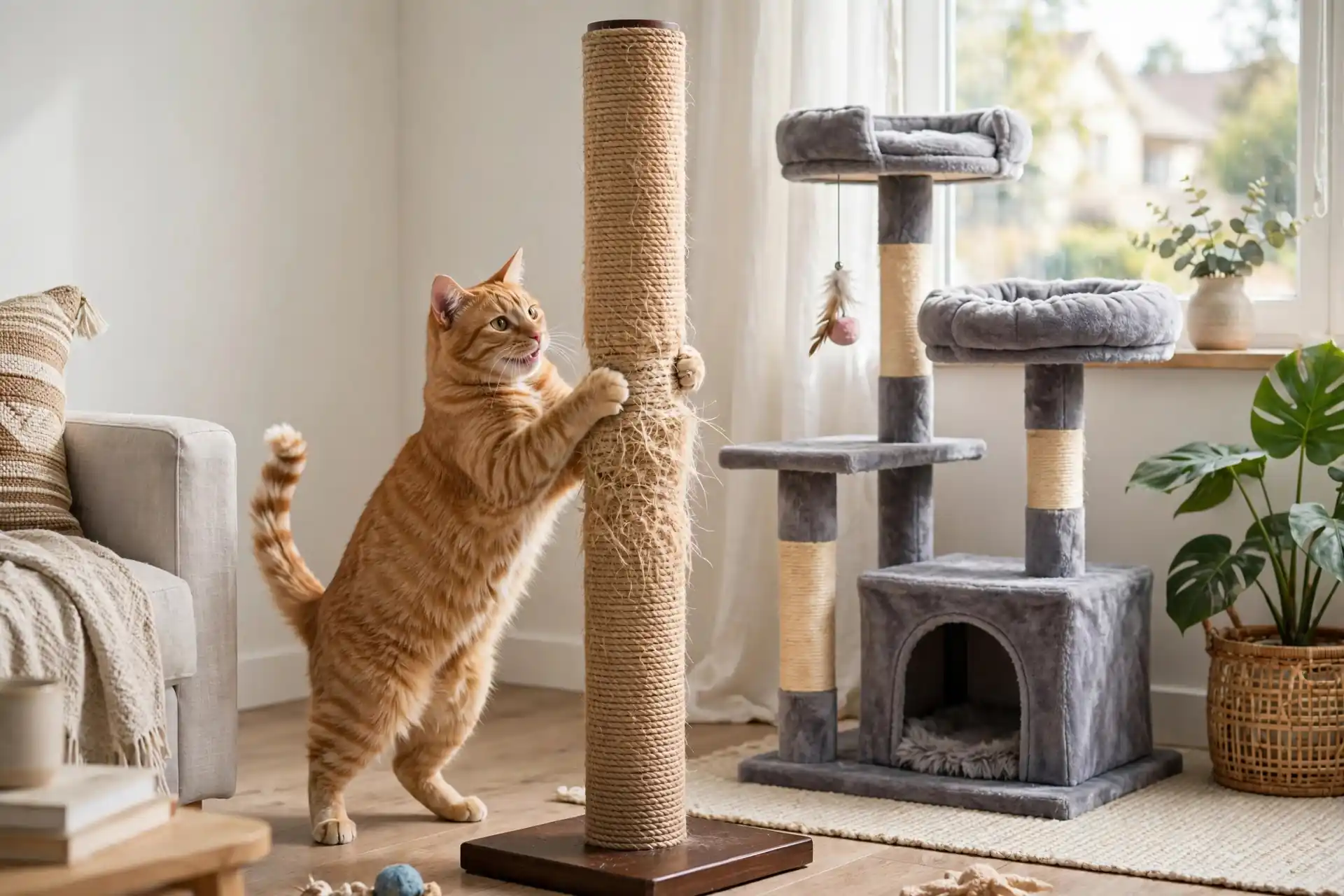
What Makes a Scratching Post Something a Cat Will Use
A cat ignores a scratching post for one of three reasons: it’s too short, too wobbly, or covered in the wrong material. Fix those three things and most cats will use a post without any training at all.
Height comes first. A cat scratches to stretch its whole body, front paws extended overhead, and a post shorter than about 30 inches doesn’t let it do that. Watch a cat that’s ignoring a short post and it’s often scratching the nearest doorframe or couch arm instead, because those give it the vertical reach the post doesn’t.
Stability matters more than most owners expect
A post that wobbles or tips when a cat digs its claws in gets abandoned after one try. Test any post yourself before buying: push down and sideways on the top. If it rocks, the base is too light or too narrow relative to the height. A heavy, wide base is worth paying more for than a taller post on a flimsy stand.
Material is the third variable, and it’s the one owners get wrong most often. Carpet-covered posts feel familiar to a shopper because they look like furniture, but many cats prefer sisal rope or plain sisal fabric, which shreds satisfyingly under claws in a way carpet doesn’t. If a cat has been scratching upholstery, a sisal-covered post placed right next to that furniture is a better first attempt than a carpeted one across the room.
Placement changes outcomes almost as much as the post itself. Cats tend to scratch after waking up and near the areas they spend the most time in, not in an isolated corner. Start the post beside a favorite sleeping spot or the furniture already being scratched, then move it gradually if the location needs to change later.
- Choose a post at least 30 inches tall, or taller for a large breed
- Press down and sideways on the top to check for wobble before buying
- Try sisal rope or sisal fabric before carpet if a cat is already ignoring a covered post
- Put it where the cat already spends time, not in a spare corner
- Offer both a vertical post and a horizontal scratcher, since some cats prefer one over the other
If a cat that used to scratch a post suddenly stops, check the post itself first. A base worn loose, fabric shredded down to the backing, or a post that’s been moved recently can all be enough to send a cat looking for a new surface. A quick look at a cat’s overall body language, the kind covered in how cats communicate through sound and posture, can also help rule out stress as the reason a cat has stopped using furniture it used to leave alone.
Declawing is not a fix for a cat that won’t use a scratching post. International Cat Care’s behavior guidance treats scratching as a normal, necessary activity rather than a problem to eliminate, and most welfare organizations consider declawing an unnecessary and painful procedure now that so many alternatives exist. A post that fits a cat’s real habits solves the problem without surgery.
If a household has more than one cat, each one may have a different preference, and a single shared post is often not enough. That’s less about behavior and more about resources: multiple cats generally need multiple scratching options in different rooms, the same way they need separate spaces to retreat to when they’re stressed.
Buy a plain sisal post, put it where the cat already is, and give it a week before deciding it doesn’t work.
Why cats ignore most scratching posts
The classic story: you buy an attractive scratching post, place it hopefully in the corner, and the cat continues shredding the sofa. The post is not defective and the cat is not spiteful. Cats do not hold grudges about furniture; they follow instinct and convenience with complete sincerity. Scratching is a biological need, and cats choose their scratching surfaces according to specific preferences. The ignored post almost always violates one or more of those preferences.
Understanding what cats want from a scratching surface turns the problem from mysterious to mechanical. Get the variables right and most cats use the post enthusiastically. Get them wrong and the post becomes expensive decor.
Stability: the non negotiable requirement
A scratching post must not wobble, tip or shift when the cat uses it. Cats put their full weight into scratching, stretching upward and pulling down with force. A post that wobbles feels unsafe, and a cat that feels unsafe will not return. This is the single most common reason posts fail. It is also the easiest to test in the store: grab the post and push it firmly the way a cat would, and if it sways, walk away.
Test stability before buying by imagining the force of a cat at full stretch. Tall posts need wide heavy bases. Wall mounted scratchers eliminate the stability question entirely and are excellent for dedicated scratchers. If you already own a wobbly post, try bracing it against a wall or weighting the base before replacing it. Our guide to checking walls before hanging heavy objects covers the anchoring techniques useful for wall mounted options.
Height and orientation
Cats scratch partly to stretch, and they need full extension to do it. A post shorter than the cat’s full stretch height forces an unsatisfying partial stretch. For most adult cats, the scratching surface should be at least thirty inches tall for vertical posts. Kittens and small cats manage with less, but buying for the adult size saves replacing later.
Orientation matters too. Some cats are vertical scratchers, some prefer horizontal, and many like both. Observe where your cat currently scratches: sofa arms suggest vertical preference, carpet suggests horizontal. When in doubt, a combination scratcher with both a vertical post and a horizontal pad covers all preferences for less than the cost of two separate pieces. Offer the matching orientation first. Scratching pads that lie flat serve horizontal scratchers well and are inexpensive to try.
Material preferences
Sisal rope and sisal fabric are the most widely preferred scratching materials: rough enough to catch claws satisfyingly, durable enough to last. Cardboard scratchers are cheap, replaceable and loved by many cats, though they create debris. Carpet covered posts seem logical but can confuse cats into thinking all carpet is fair game. Wood, particularly untreated logs, appeals to cats that like a natural texture. Offer sisal first; it has the highest success rate.
Location: the strategic error
Owners hide scratching posts in corners where they are out of the way. Cats scratch partly to mark territory visually and with scent glands in their paws, which means they want to scratch in prominent, socially significant locations. A post hidden in a back room serves neither the stretching nor the marking function.
Place the post where the cat already scratches or wants to scratch: near sleeping spots, since cats love to scratch after waking, and near the furniture you are trying to protect. Yes, this means the post sits next to your sofa. That is the point. Guests may comment on it; the sofa will thank you. Once the habit is established you can sometimes inch it to a less prominent spot, but start where the cat wants it.
Introducing the post properly
Do not just place the post and hope. Rub catnip into the sisal, play with a wand toy around the post so the cat’s claws catch it naturally, and reward any interaction with treats. Timing matters here: introduce the post when the cat is alert and playful rather than sleepy, since a drowsy cat will simply ignore the whole production. Never force the cat’s paws onto the post; the resulting negative association is worse than no introduction at all.
Meanwhile, make the forbidden surfaces less attractive. Double sided tape on sofa arms, or a throw covering the favored spot temporarily, redirects the cat toward the post without punishment. The combination of an attractive post and a less attractive sofa works faster than either alone. The ASPCA’s guide to destructive scratching details these redirection techniques. Understanding feline body language also helps; our guide to reading a cat’s tail position explains what your cat is communicating.
How to Move Your Cat From the Sofa to the Scratching Post
Put the post exactly where the scratching happens. If the cat claws the sofa’s arm, place the post directly against that arm — touching it if possible. Cats scratch where they scratch out of habit and territory, and a post across the room will not compete with the sofa. You can move the post a few inches per week once the cat is using it.
Make the post irresistible and the sofa boring. Rub dried catnip or a catnip spray into the post’s sisal, and reward the cat with a treat every time it uses the post. At the same time, cover the sofa’s scratched spots with a throw or double-sided sticky tape made for furniture. Cats dislike the sticky texture and will look for the better option you placed beside it.
Catch the moment and redirect gently. When you see the cat start on the sofa, carry or lure it to the post and praise any scratch there. Never punish scratching — punishment teaches the cat to scratch when you are not looking, not to stop. Timing matters: reward within seconds of the post scratch so the cat connects the action to the treat.
This usually takes two to four weeks of consistency. Once the cat chooses the post reliably for a month, you can slowly move the post to a better spot — a few feet at a time, keeping the treats going until the new location sticks.
Frequently Asked Questions
Why does my cat scratch the sofa instead of the post?
Usually a combination of location, stability or material issues. The sofa is stable, tall enough, prominently located and has a satisfying texture. Make the post match or beat the sofa on these dimensions and place it nearby.
Is catnip necessary to attract cats to the post?
Not necessary but helpful. Catnip, silvervine, or play based introduction all work. The key is creating positive first experiences with the post rather than any single attractant.
How tall should a scratching post be?
At least thirty inches of usable scratching surface for most adult cats, allowing full stretch. Taller is generally better provided the base keeps it stable.
Should I trim my cat’s claws to reduce scratching?
Trimming reduces damage but does not reduce the scratching urge, which is behavioral and territorial. Provide appropriate surfaces regardless of claw length. Never declaw; it causes lasting pain and behavioral problems.
How many scratching posts does a cat need?
At minimum one good one in a prime location. Multi level homes and multi cat households benefit from several. More posts in more locations beats one perfect post in a back room.
Conclusion
Cats use scratching posts that are stable, tall enough for full stretch, covered in appealing material, and placed where the cat actually wants to scratch. Get these four variables right and the problem largely solves itself; most scratching complaints trace back to just one of them being wrong. Match the post to the cat’s preferences, introduce it positively, and protect the furniture meanwhile. For more cat care guides, visit the Factblaze homepage.