How to Tell Real Leather From Faux at a Glance
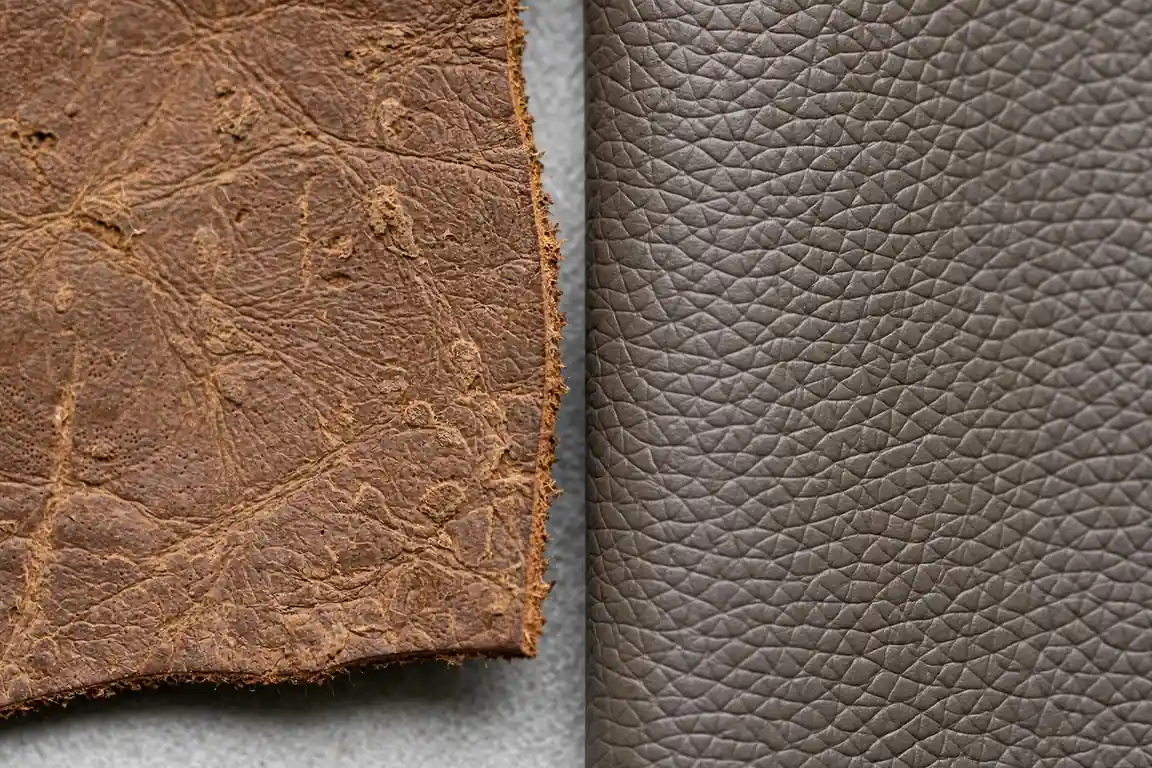
Real leather has small, irregular pores and a surface that varies slightly from spot to spot, because it came from an animal hide rather than a mold. Faux leather’s texture repeats in a pattern, because it’s stamped onto fabric or a polymer sheet. That’s the fastest tell, and there are a few more just as reliable once you know where to look.
Look at the Edge, Not the Surface
The cut edge of a piece is harder to fake than the front. Real leather has a fibrous, slightly rough edge that looks like compressed suede when you look closely. Faux leather’s edge is usually smooth, sometimes with a visible fabric backing peeking through, because the material is built in layers over a woven base. If a tag or a jacket seam lets you see the raw edge, that’s a more reliable check than the front surface.
The Smell Test Still Works
Genuine leather has an earthy, slightly smoky smell that comes from the tanning process. Faux leather smells like plastic or, in cheaper versions, like a strong chemical odor that doesn’t fade even after the item has been out of packaging for weeks. This is one of the more reliable checks precisely because it’s hard to manufacture around — a synthetic can be made to look like leather, but replicating the smell of tanned hide is a different problem entirely.
Press It and Watch What Happens
Press a finger into the material and release. Real leather has a slight give and then slowly returns to shape, sometimes leaving a faint temporary mark from body heat. Faux leather tends to bounce back immediately and uniformly, because it’s a consistent manufactured material rather than an organic one with natural variation. Temperature matters too: leather warms slightly to the touch after a few seconds of contact, while many synthetics stay cool longer.
Check the Price Against the Claim
A full-grain leather jacket has a production cost that puts a floor under its retail price; a $40 “genuine leather” jacket is very unlikely to be telling the truth about its material, whatever the tag says. Labeling rules exist around how “leather,” “genuine leather,” and “faux leather” can be used, and manufacturers who play loose with those terms are betting most shoppers won’t check. The Leather and Hide Council of America is a useful reference if you want to understand how the industry itself defines these terms.
When It’s Worth Trusting Your Eye Anyway
If you’re buying online and can’t touch the material, zoom into product photos for the pore pattern and edge detail rather than trusting the listing title. A close-up photo will usually reveal a repeating texture if it’s faux, even when the description says otherwise.
Neither material is automatically the better choice — faux leather is lighter, cheaper, and doesn’t require animal hide, while real leather ages and develops character over years of wear, which is part of why a genuine leather jacket or bag often earns a permanent spot in a small, durable wardrobe rather than getting replaced every few seasons. The mistake is paying leather prices for a material that won’t hold up the way leather does, which is exactly what these checks are for.
Real and faux leather can look strikingly similar on a store shelf, which is exactly why the distinction matters. Price, durability, care, and ethics all hinge on which one you are actually buying. A few reliable tests separate them in seconds, once you know what to check.
The quick visual checks
Start with your eyes. Several tells are visible immediately.
Grain pattern
Real leather has natural, irregular grain: pores and creases vary across the surface because it was once skin. Faux leather typically shows a repeating, uniform pattern stamped to imitate grain. Look closely at a large area. Perfect regularity is a red flag. That said, corrected-grain real leather is sanded and embossed with artificial pattern, so this test works best on full-grain products.
Edges
Cut edges reveal construction. Real leather shows a fibrous, suede-like edge, often burnished or dyed. Faux leather usually shows a fabric backing or foamy plastic layers at the edge, sometimes with visible separation. Check strap ends, pocket edges, and any unfinished seams. Edges do not lie the way surfaces can.
Color and finish consistency
Real leather varies subtly in color and texture across a hide; high-quality pieces embrace this. Faux leather is uniform to a degree nature never achieves. Suspicious perfection, identical color on every panel, is informative. Our guide to what vegan leather is made from explains the materials behind most faux options.
The touch and smell tests
Hands and nose catch what eyes miss.
Texture and temperature
Real leather feels warm quickly and has a supple, slightly uneven hand. Press it: real leather wrinkles naturally and the creases relax. Faux leather often feels cooler, plasticky, or unnaturally smooth, and pressed creases may look stamped rather than organic. Bend the material: real leather shows natural creasing; faux may show a whitish stress line where the plastic coating strains.
The smell
Real leather smells like leather: rich, organic, distinctive. Faux leather smells like chemicals, plastic, or nothing at all. Smell is one of the hardest things to fake and one of the most reliable tests. A strong chemical odor on a product sold as real leather is a serious warning sign.
The water drop test
A classic field test, useful with caveats.
How it works
Place a small drop of water on an inconspicuous spot. Real, unfinished leather absorbs it slowly, darkening temporarily. Most faux leather beads water on the plastic surface. The leatherworking community resources document this and other identification techniques used by craftspeople.
Limitations
Finished and coated real leathers, common in mass-market goods, may also bead water due to their topcoat. Do this test only where a tiny water mark will not matter, and treat beading as suggestive rather than conclusive on finished goods. Never soak a product to test it.
Price, labeling, and context clues
Sometimes the surroundings tell you before any test.
Price realism
Genuine leather costs real money to produce. A full-grain leather bag at fast-fashion prices is not a miracle; it is mislabeled or bonded leather, which is leather dust glued to fabric and barely qualifies. If the price seems impossible for real leather, trust that instinct. Our online shopping guide covers how to spot too-good-to-be-true listings generally.
Label language
Look for specific terms: full-grain, top-grain, genuine leather (the lowest real grade, despite the reassuring name). Terms like leather-like, leatherette, vegan leather, and PU all mean faux. No leather content claim at all on a leather-looking product means faux. In the EU and US, labeling laws require disclosure, though enforcement on imports varies.
Aging behavior
Real leather develops patina: it darkens, softens, and gains character with use. Faux leather does not patina; it wears, cracks, and peels. If you can see a used example of the same product, its aging tells the truth. Our fabric-structure article on what makes denim different explores a similar honest-aging concept in another material.
When it genuinely does not matter
For trend-driven pieces you will wear one season, the durability gap is irrelevant and faux makes economic sense. Nobody needs a thirty-year fast-fashion jacket. The identification skills matter most for investment pieces, where you are paying for longevity, and for situations where sellers misrepresent the material. Match your scrutiny to the stakes: high for expensive classics, low for disposable trends.
Frequently Asked Questions
What is the easiest way to tell real from faux leather?
Combine three quick checks: smell it (real leather has a distinctive organic smell), check the edges (real shows fibrous layers, faux shows fabric or plastic), and look for natural grain variation versus stamped uniformity. No single test is definitive, but together they are highly reliable.
Is genuine leather good quality?
Genuine leather is actually the lowest grade of real leather, made from the remaining layers after the top is split off. The quality ranking runs full-grain (best), top-grain, then genuine. Do not let the reassuring name fool you; genuine leather is real but not premium.
Can faux leather look exactly like real leather?
At a glance, high-quality PU can fool most people on new products. The differences emerge in hand feel, smell, edges, and especially aging. Faux never develops patina and eventually peels or cracks where real leather improves.
Does real leather always cost more?
Generally yes, often substantially. The price gap reflects real production costs. But quality faux from innovative makers can cost more than low-grade genuine leather. Compare specific products rather than assuming by category.
Which lasts longer?
Good real leather, maintained, lasts decades. Quality faux lasts years. Cheap faux lasts months to a couple of years before peeling. Longevity is real leather’s strongest practical advantage and the main reason it costs more.
Conclusion
Telling real from faux leather takes seconds once you know the checks: grain irregularity, fibrous edges, the distinctive smell, water behavior, and honest pricing. Use them together, because any single test can mislead on finished or unusual products. Buy with eyes open about which you are getting, and match your expectations and your wallet to the reality. More material guides on the Factblaze homepage.