What a Dog’s Body Language Actually Tells You Before a Bite
A stiff, still body and a tightly closed mouth are bigger warning signs than a growl, because by the time a dog growls, it has usually already tried several quieter signals first. Most bites that get called sudden or unprovoked were preceded by minutes of signals that people either didn’t recognize or didn’t take seriously.
The Quiet Signals That Come Before a Growl
- Lip licking or yawning when nothing is tired or food-related happening
- Whale eye — the whites of the eyes showing in a sideways glance
- A tail held stiff and low, or wagging in short, tight motions rather than loose sweeps
- Ears pinned flat back or, alternately, rigid and forward
- Freezing completely still, especially over a toy, food, or a resting spot
- Turning the head or body away while staying tense, rather than genuinely relaxing
Why These Get Missed
Freezing in particular looks like calm to most people, when it’s often the opposite: a dog holding very still is frequently the most escalated a dog gets before a bite, not the least. People tend to wait for a growl or bared teeth as the signal to back off, but a dog that’s already frozen or showing whale eye has moved past its early warnings and is closer to reacting than it looks.
What to Do When You See These Signals
Give the dog space and remove whatever is triggering the tension, whether that’s a hovering child, a hand reaching for a toy, or an unfamiliar person leaning in for a pet, rather than pushing forward to prove everything is fine. Let the dog choose to approach on its own terms once it’s had a moment to settle. Around kids specifically, never leave a dog showing these signals unsupervised, and teach children to recognize a still, stiff dog as one that wants distance rather than attention.
Never Punish a Growl
A growl is one of the last, clearest warnings a dog gives before escalating, and it exists precisely so a bite doesn’t have to happen. Scolding or correcting a dog for growling doesn’t make the underlying discomfort go away; it teaches the dog that warning isn’t safe, which can produce a dog that skips straight to biting the next time it feels the same way. Managing the situation that caused the growl matters more than reacting to the growl itself.
When to Bring in a Professional
A dog that shows these warning signs often, or whose tension seems to be increasing over time, benefits from a certified professional dog trainer or a veterinary behaviorist rather than home experimentation. Your veterinarian can also rule out pain or a medical cause behind sudden changes in tolerance, since a dog that’s newly guarding its body or resisting handling is sometimes hurting rather than being difficult. The American Kennel Club’s guidance on bite prevention is a solid starting point for understanding how these signals build toward a bite.
Reading a dog’s early signals well enough to intervene before a growl is a skill, and it’s one worth building deliberately rather than learning after something goes wrong.
Most dog bites do not come out of nowhere. Long before teeth are involved, a dog broadcasts discomfort through a sequence of small, readable signals. The problem is that people routinely miss them, misread them, or only notice the final warning. Learning to read this body language is not just useful for dog owners. It matters for joggers, delivery workers, parents, and anyone who shares public space with dogs.
The escalation ladder: how warnings build
Animal behaviorists often describe canine stress signals as a ladder. A dog starts at the bottom with subtle signs and climbs only if earlier signals are ignored. Understanding this sequence changes how you interpret what looks like a sudden snap.
Early, easy-to-miss signals
The first rungs are quiet. A dog that turns its head away, licks its lips when no food is present, or yawns repeatedly may be saying it is uncomfortable. Whale eye, where the whites of the eyes become visible as the dog looks sideways without turning its head, is another early indicator. These signals are easy to dismiss because the dog still looks calm to an untrained observer. In our guide to what makes a dog park safe to visit, we explain how these same subtle signals show up in off-leash play before conflicts start.
Middle warnings people misinterpret
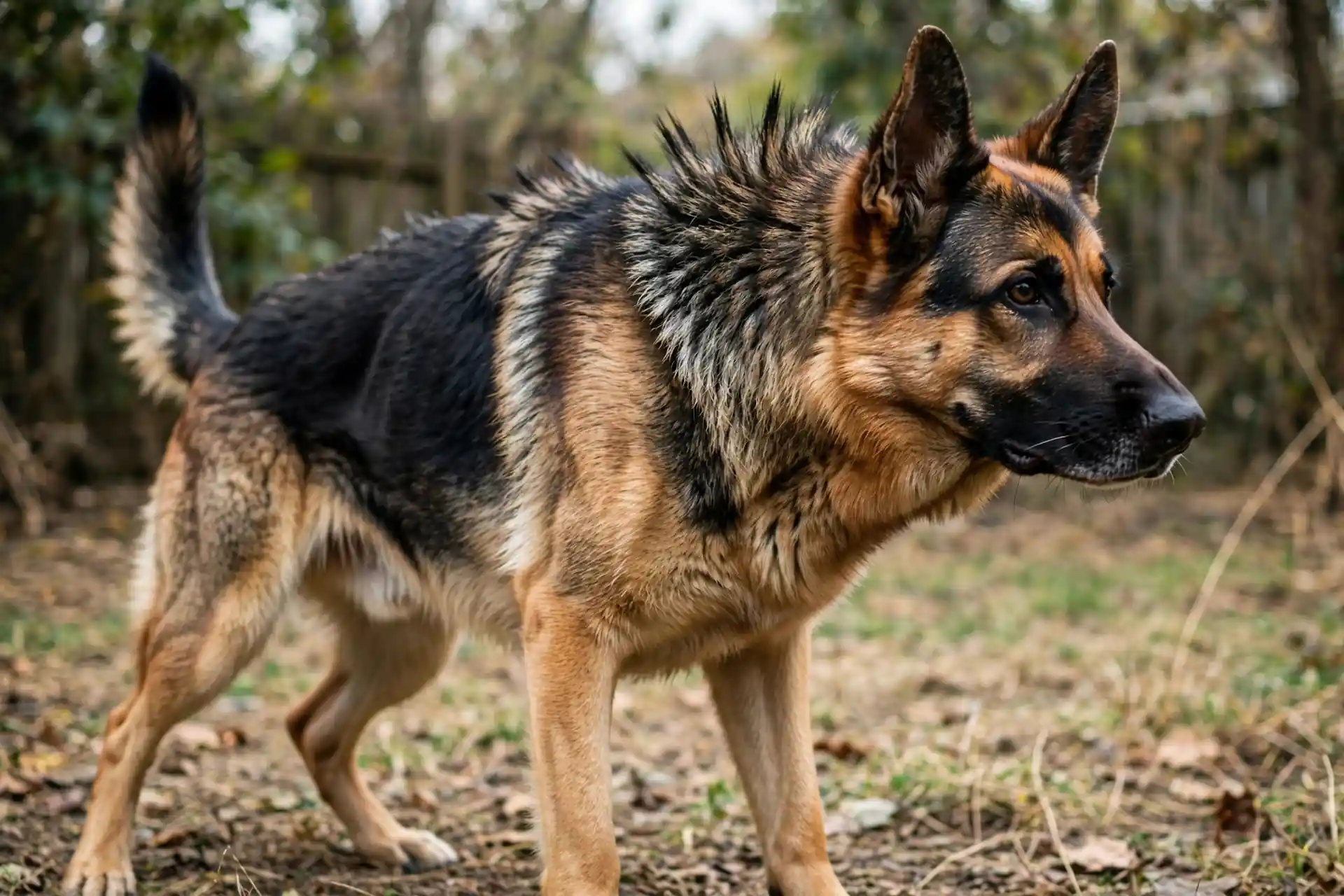
As stress rises, signals get louder. The dog may freeze and go very still, which many people mistake for calm. A frozen dog is often a dog making a decision. Growling is the most famous warning, yet it is the one people punish most, which is counterproductive: a dog taught never to growl may skip straight to biting. Raised hackles, a stiff wagging tail held high, and hard staring all belong in this middle zone. The American Kennel Club’s guide to dog body language has an excellent illustrated breakdown of these postures.
The final warnings
Snapping at the air, lunging, and baring teeth are last-resort communications. By this point the dog has been asking for space for a while. A bite that follows is rarely unprovoked in the dog’s mind, even if the human never registered the earlier requests.
Context changes everything
The same posture can mean different things in different situations. A wagging tail does not automatically mean happiness. Tail position, speed, and stiffness matter more than the wag itself. A low, loose wag usually signals friendliness, while a high, rapid, stiff wag can signal arousal or agitation.
Resource guarding
Many bites happen around food, toys, or sleeping spots. A dog that stiffens over its bowl, eats faster when approached, or positions its body between you and a valued object is resource guarding. This is normal canine behavior, not dominance or spite, but it needs management. Trading up, teaching the dog that your approach predicts better things, works far better than confrontation.
Fear-based reactions
Fear is behind a large share of bites. A frightened dog that cannot retreat may bite as a last option. Cornering a scared dog, looming over it, or reaching for its head are classic triggers. Giving the dog an escape route defuses most of these situations before they escalate.
Pain and startle responses
An older dog with arthritis, a dog with an undiagnosed injury, or any dog startled awake can bite reflexively. This is worth remembering with senior dogs in particular. If you want to understand age-related behavior changes, our article on how to tell if a senior dog’s slower pace is normal aging covers how pain reshapes behavior.
Reading the whole dog, not just one signal
Single signals mislead. Ears pinned back can mean fear, but in some breeds it is simply how they look when relaxed. The reliable approach is to read clusters: ears plus tail plus body posture plus mouth plus context. A dog with a loose body, soft eyes, and a relaxed open mouth is comfortable even if its ears happen to be back. A dog with a stiff body, closed mouth, hard eyes, and weight shifted forward deserves space regardless of what its tail is doing.
Breed and individual differences
Body language varies between individuals. Breeds with docked tails, cropped ears, or heavy facial wrinkles are harder to read because they have fewer signaling tools. Puppies are still learning the vocabulary themselves. Rescue dogs with unknown histories may have idiosyncratic triggers. When in doubt, assume less familiarity than you think you have.
What children need to know
Children are bitten more often than adults, partly because they are at face height and partly because they do things dogs find threatening: hugging around the neck, staring directly, squealing, and making sudden movements. Teaching kids to be a tree, standing still with arms at their sides and looking away, is one of the most effective bite prevention strategies that exists.
What to do when you see warning signs
Recognition only helps if it leads to better action. When a dog shows stress signals, the right response is almost always the same: create distance calmly.
De-escalation in the moment
Stop what you are doing. Turn your body slightly sideways rather than facing the dog head on. Avoid direct eye contact. Move away slowly without turning your back abruptly. Do not scream, run, or make sudden gestures, all of which can trigger a chase response. If you are working on handling skills generally, our piece on common mistakes people make with leash training a puppy covers how tension on the leash feeds into reactive behavior.
After an incident
If a bite or near bite happens, treat it as information. Note what was happening in the moments before: who was present, what the dog was doing, whether food or rest was involved. Patterns usually emerge. A single incident managed well rarely repeats; repeated incidents with no management changes almost always escalate.
Frequently Asked Questions
Do dogs always warn before they bite?
Almost always, but the warnings are not always ones humans recognize. Subtle signals like lip licking, yawning, and turning away precede most bites by seconds or minutes. True bites with zero warning are rare and usually involve extreme pain, neurological issues, or a dog that was previously punished for growling.
Does a wagging tail mean a dog is friendly?
Not necessarily. Tail wagging indicates arousal, not happiness specifically. A loose, low, wide wag usually means friendliness, but a high, stiff, fast wag can indicate tension or agitation. Always read the tail together with the rest of the body.
Should you punish a dog for growling?
No. Growling is communication, and punishing it removes an early warning without removing the underlying discomfort. A dog that learns growling brings punishment may skip the growl next time and go straight to a snap or bite.
Why do friendly dogs sometimes bite children?
Children’s behavior, hugging, face-to-face contact, sudden movements, loud noises, can overwhelm even tolerant dogs. The dog may have been signaling discomfort for a while before the child or supervising adult noticed. Close supervision and teaching kids calm interaction rules prevent most of these incidents.
Can body language tell you a bite is about to happen right now?
The most immediate pre-bite signs are freezing, a hard stare, and a sudden stillness in a previously active dog. If a dog goes rigid and locks eyes, give it space immediately. Do not reach toward it or try to soothe it by petting.
Conclusion
Dogs are remarkably clear communicators once you learn the vocabulary. The escalation from lip lick to growl to snap is a gift: each step is a chance to change course before anyone gets hurt. The people who get bitten are rarely the ones who read dogs well. They are the ones who missed the memo the dog had been sending all along. Pay attention to the quiet signals, respect the loud ones, and give dogs the space they ask for. If you spend time around dogs regularly, whether your own or other people’s, this literacy is one of the most practical safety skills you can build. You can explore more of our everyday knowledge guides on the Factblaze homepage.