What Whisker Fatigue Actually Is
A cat that paws food out of a bowl onto the floor before eating it, or hovers over a water dish without drinking, isn’t necessarily picky. It may be dealing with whisker fatigue, a real sensory response to a bowl that’s too narrow or too deep.
Whiskers, or vibrissae, are packed with nerve endings and constantly feed a cat information about the space around its face. A deep, narrow bowl forces those whiskers to press against the sides every time a cat lowers its head to eat or drink, and that steady pressure is uncomfortable in a way that has nothing to do with the food itself.
The signs look like a behavior problem but aren’t
Cats showing whisker fatigue often paw food onto the floor and eat it from there, dip a paw into water instead of drinking directly, stand back from a full bowl, or seem to hesitate before approaching a feeding station they’ve used for months. It’s easy to mistake this for finickiness or read it as a sign of illness, when the fix is usually about the dish rather than the cat or the food.
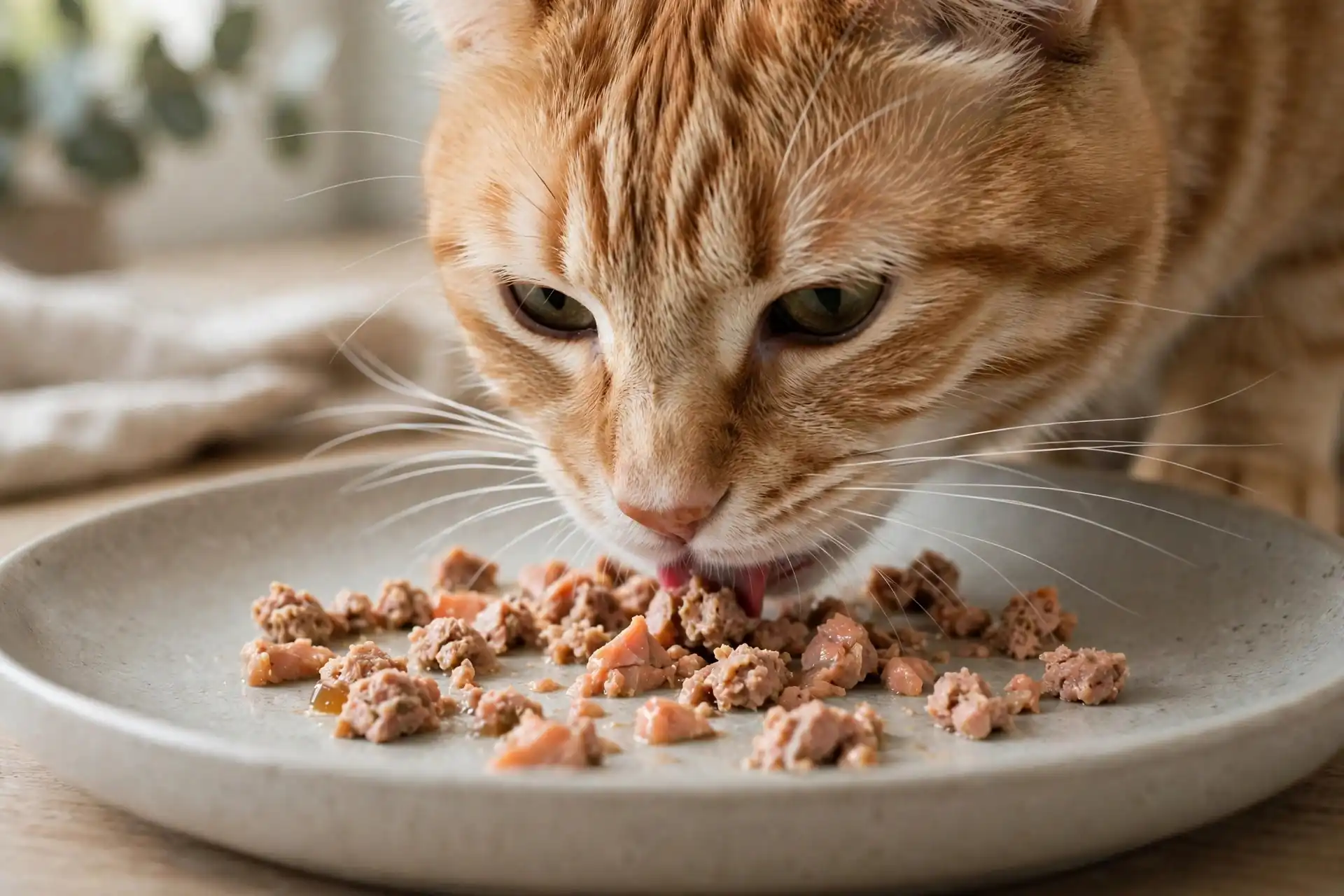
Wide, shallow bowls or flat plates solve the problem because a cat’s whiskers never make contact with the sides while it eats. Ceramic and stainless steel dishes designed specifically as “whisker-friendly” have become common for exactly this reason, but a wide dinner plate works just as well and costs far less.
- Switch to a shallow, wide bowl or a flat plate instead of a deep one
- Watch whether a cat starts eating directly from the new dish within a few days
- Rule out other causes if the behavior doesn’t improve, since dental pain can look similar
- Keep water in a wide bowl too, not just food, since the same pressure applies there
Not every cat that paws at food has whisker fatigue, and it’s worth ruling out other explanations before assuming that’s the cause. Dental pain, nausea, or simple pickiness about food placement near a busy walkway can all produce similar behavior. A cat that’s still avoiding food after switching to a shallow dish, or that shows other changes like reduced appetite or weight loss, needs a vet visit rather than another bowl swap. The kind of careful observation described in how to tell if a cat is in pain is a useful habit here too, since discomfort at mealtime can show up in body language before it shows up as a change in eating.
Whisker trimming is never an appropriate response to this, and it’s worth saying plainly: a cat’s whiskers should never be cut or trimmed for any reason. They’re a working sensory organ, not decoration, and trimming them disorients a cat’s sense of space and distance in a way that causes far more harm than a deep food bowl ever would.
Most owners who make the switch to a shallow dish see a change within a few days, sometimes immediately. General cat care guidance from the ASPCA covers feeding setup as part of everyday wellbeing, and a shallow dish is one of the cheapest changes on that list. It’s a small fix for a problem that often gets misread as attitude.
Whisker fatigue is one of those pet concepts that sounds scientific, gets repeated confidently online, and turns out to be more nuanced than the headlines suggest. The basic claim is that cats’ sensitive whiskers get overstimulated by deep food bowls, causing stress and food refusal. There is a grain of truth in it, surrounded by a fair amount of exaggeration.
What whiskers actually do
To evaluate the claim, start with the biology.
Whiskers as sensory instruments
Cat whiskers, vibrissae, are deeply rooted sensory organs connected to the nervous system. They detect air currents, judge whether openings are passable, and provide spatial awareness in the dark. They are exquisitely sensitive, far more so than regular fur. This sensitivity is real and well documented.
What sensitivity means
Sensitive does not automatically mean easily fatigued. Whiskers evolved to brush against things constantly as cats navigate the world. A cat pushing through grass, squeezing under furniture, or grooming its face subjects its whiskers to far more contact than a food bowl does. The idea that brief bowl contact overwhelms this robust system deserves skepticism. Veterinary behaviorists note that true whisker-related stress is plausible but likely rare and mild compared to other feeding issues. The American Animal Hospital Association owner resources cover feline sensory behavior in context.
Where the concept came from
Understanding the source helps calibrate the claim.
The origin story
Whisker fatigue as a popular concept traces largely to pet product marketing, particularly from sellers of wide flat cat dishes. The narrative is convenient: your cat’s problem has a simple cause and our product is the cure. That does not make it false, but it should lower your confidence in dramatic versions of the claim. Genuine veterinary literature on whisker fatigue as a distinct clinical condition is thin.
What vets actually say
Most veterinarians treat whisker sensitivity as a minor factor among many feeding considerations. When a cat eats reluctantly, vets look first at dental health, nausea, food palatability, stress, and illness, all far more common causes. Whisker-friendly bowls are a harmless experiment, not a diagnosis. If your cat is genuinely picky, our guide to wet versus dry food for picky eaters covers the factors that actually drive most food refusal.
When bowl shape genuinely matters
Dismissing the hype does not mean bowl design is irrelevant.
Shallow versus deep bowls
Wide, shallow dishes are better for cats regardless of whisker theories. They keep food accessible as the level drops, prevent the cat from having to push its face deep into a narrow container, and are easier to clean. Flat plates work well for wet food. These are practical advantages that need no fatigue theory to justify.
Whisker-friendly as harmless optimization
Switching to a wide shallow bowl costs little and might help a sensitive cat marginally. There is no downside. Just do not expect it to fix food refusal that has medical or behavioral roots. It is a refinement, not a remedy. For multi-pet households managing feeding dynamics, our article on introducing cats to resident dogs covers how feeding setup affects broader household harmony.
The real causes of mealtime reluctance
If your cat is eating poorly, these are the usual suspects, in rough order of likelihood.
Medical issues
Dental pain tops the list: cats with sore mouths eat gingerly or quit. Nausea from kidney disease, hyperthyroidism, or gastrointestinal issues suppresses appetite. Any sustained appetite change warrants a vet visit before any bowl experiments.
Food factors
Stale food, food served too cold from the refrigerator, unappealing texture, or sudden diet changes all cause refusal. Cats prefer food near body temperature and familiar textures. Warming refrigerated wet food for a few seconds often works better than any bowl swap.
Stress and environment
Noisy feeding locations, competition from other pets, dirty bowls, and household disruption all suppress appetite. A calm, consistent feeding station matters more than bowl geometry.
A balanced perspective
The whisker fatigue debate is a useful reminder of how pet advice spreads online. A plausible mechanism gets amplified by marketing, repeated as fact, and eventually treated as established science without the research to support it. The sensible response is not cynicism about everything, but proportion: try the easy fix, keep expectations modest, and prioritize the factors with real evidence behind them. Your cat benefits far more from fresh food, clean water, and a calm home than from any particular bowl shape.
How to Set Up a Whisker-Friendly Feeding Station
Start with the bowl: wide and shallow beats deep and narrow. Look for a plate or saucer-style dish at least five inches across with sides under an inch and a half high, so the cat eats without whiskers touching the sides. Choose ceramic or stainless steel — plastic develops scratches that harbor bacteria and can cause chin acne. Retire any bowl the cat must shove its face into.
Put a mat underneath. A silicone or rubber mat with a raised edge catches spills, stops the bowl sliding across the floor, and gives you one surface to wipe instead of a sticky floor. Wash the mat weekly; dried food residue smells and puts sensitive cats off their meals.
Location matters as much as equipment. Put the station in a quiet corner away from foot traffic, the washing machine, and the litter box — cats will not eat comfortably next to their toilet. Keep food and water bowls a few feet apart; many cats dislike drinking right beside their food. With a dog in the house, elevate the station or gate it so meals are never ambushed.
Set a cleaning routine and stick to it. Wash food bowls daily with hot soapy water — stale food film is a top reason cats walk away from full bowls. Refresh water daily and scrub the water bowl weekly to remove slimy biofilm. A clean station removes every excuse except the food itself.
Frequently Asked Questions
Is whisker fatigue a real condition?
Whisker sensitivity is real, but whisker fatigue as a distinct clinical syndrome causing significant food refusal is not well established in veterinary science. It is best understood as a minor possible factor, heavily promoted by marketers of specialty bowls, rather than a common diagnosis.
Should I buy whisker-friendly bowls?
Wide, shallow bowls are good for cats for practical reasons regardless of the fatigue theory. If you are buying bowls anyway, choose wide and shallow. But do not expect them to resolve appetite problems with medical or behavioral causes.
Why does my cat paw food out of the bowl?
Usually to eat from a flat surface, which many cats prefer, or because the bowl is too deep or narrow. It can also indicate whisker discomfort, vision issues in older cats, or simple preference. Trying a flat plate is a reasonable first step.
Can whiskers be damaged?
Whiskers can break or fall out naturally and regrow. Never trim a cat’s whiskers: it impairs their spatial awareness and causes genuine distress and disorientation. Broken whiskers from normal activity are not a concern.
What should I do if my cat stops eating?
See a vet promptly, especially if it lasts more than 24 hours. Appetite loss has many serious causes, and cats risk liver complications from prolonged fasting. Bowl changes can wait until medical causes are ruled out.
Conclusion
Whisker fatigue sits in that familiar zone between a real biological fact and a marketing story. Whiskers are sensitive; bowls that respect that are marginally nicer. But the dramatic version, where deep bowls stress cats into starvation, outruns the evidence by a wide margin. Feed on wide shallow dishes because they are practical, and look to health, food quality, and environment when appetite actually falters. More myth-busting pet guides on the Factblaze homepage.