
What Makes a Dog Park Safe to Visit
A dog park is safe to visit when the fencing is secure, the crowd is manageable, and the other owners are watching their dogs instead of their phones. It also has to suit your dog, because plenty of healthy, friendly dogs find a pack of strangers more stressful than fun.
Asking “is a dog park safe” has two halves: the place itself, and the dog you’re bringing into it. Spend five minutes outside the gate before you go in. That short look tells you most of what you need.
Check the space before the dogs
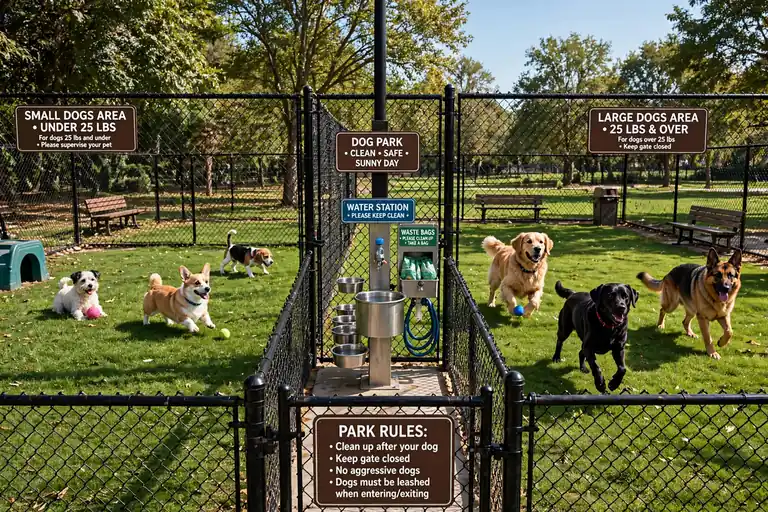
Walk the fence line if you can. Look for gaps near the ground, a latch that doesn’t catch, and a double-gated entry, which gives you a buffer zone to take the leash off without dogs crowding the opening. Separate areas for small and large dogs are a good sign. So are shade, fresh water, and ground that isn’t littered with glass, trash, or standing puddles.
On hot days the surface matters. Asphalt and artificial turf heat up fast, and a dog sprinting around in the sun can overheat quickly; the early warning signs in how to tell if a dog is overheating on a walk apply at the park too.
What to watch before letting your dog off leash
- How many dogs are inside, and whether one or two are getting ganged up on
- Play with pauses, role reversals, and loose, bouncy bodies
- Any dog that keeps chasing another dog that is clearly trying to get away
- Toys or food on the ground, which can spark guarding
- Owners who step in quickly when play gets too rough
If you see stiff bodies, hard stares, or one dog repeatedly pinning another, come back another time. Knowing the body language signals that come before a bite helps you spot trouble a few seconds earlier, and a few seconds is often all you need.
Is a dog park safe for your dog in particular?
Puppies that haven’t finished their vaccinations should stay home until your vet says they’re ready, since parks are shared by dogs of unknown health. Your vet can also tell you which vaccines and parasite prevention make sense where you live. The American Veterinary Medical Association’s pet owner resources are a solid starting point for questions to ask.
Temperament counts as much as health. A dog that doesn’t come back when called, guards toys, or gets overwhelmed and snappy in crowds is better served by walks and one-on-one playdates with dogs it knows. That isn’t a failure, just a preference.
Once you’re inside
Take the leash off in the entry area, because a leashed dog surrounded by loose ones can feel trapped. Keep early visits short, stay close enough to step in, and leave while your dog is still enjoying itself. After any scuffle, even one that looked minor, check for puncture wounds. Small bites can hide under fur and still need a vet visit, since they can become infected.
A busy park at 6 p.m. and a quiet one at 10 a.m. are two different places. Try off-peak hours first.
A good dog park can be a highlight of a dog’s week. A bad one can be the site of a frightening fight or a vet visit. The difference rarely comes down to luck. Safe dog parks share observable features, and risky ones broadcast their problems just as clearly if you know what to look for before you unclip the leash.
Evaluating the physical space
Start with the park itself. The layout and maintenance tell you how seriously the space is managed.
Fencing and entry design
Secure, tall fencing with no gaps is non-negotiable. Look for double-gated entries, the small airlock-style vestibules that let you unleash your dog safely before entering the main area. Single gates create chaos at entry and exit, which is when many incidents happen. Fencing should be tall enough that athletic dogs cannot clear it, and the ground along the fence line should be intact with no dug escape routes.
Size and zoning
Overcrowding is a top driver of park conflicts. A good park has enough space for dogs to disengage from each other, plus separate areas for large and small dogs. The small-dog section is not snobbery; size mismatches in rough play cause real injuries. If the park is one undifferentiated field and it is packed, consider coming back at a quieter hour. Water stations, shade, and waste bag dispensers that are actually stocked all signal active management.
Surface and cleanliness
Muddy, torn-up ground hides hazards and breeds conflict over the few good spots. Regularly maintained surfaces, picked-up waste, and intact equipment suggest someone is paying attention. Standing water, broken glass, or sharp fencing edges are reasons to leave. The American Kennel Club’s dog park safety guidance covers the physical checklist in more detail.
Reading the social environment
The dogs and humans present matter more than the infrastructure. A beautiful park full of unmanaged dogs is more dangerous than a modest park with attentive owners.
Owner attentiveness
Watch the humans before you enter. Are they watching their dogs or their phones? Engaged owners who move around, recall their dogs periodically, and intervene early in tense play are the single best safety feature a park can have. A cluster of owners socializing in one corner while their dogs roam unwatched is a warning sign. If you are still building your own handling skills, our guide to common leash training mistakes explains how handler awareness shapes dog behavior everywhere, not just at parks.
Dog body language at the gate
Stand outside for a few minutes and watch. Loose, bouncy play with frequent role reversals is healthy. One dog relentlessly pursuing another, pinning without release, or a pack ganging up on a single dog are all signs to skip this session. Learning to spot trouble early is a skill worth building; our article on dog body language warning signs teaches the escalation signals that precede most incidents.
Numbers and energy mix
A handful of calm dogs is ideal. A large pack of high-arousal dogs with no structure is where fights start. Puppies under four months, unvaccinated dogs, and dogs in heat should not be in the mix at all. If the energy feels frantic rather than playful, trust that feeling.
Your dog’s readiness
Not every dog belongs in a dog park, and the same dog may be ready on one day and not on another.
Temperament and training baseline
Dog parks suit social, resilient dogs with a reliable recall. Dogs that are fearful, reactive, resource guarders, or intact males in a mixed group tend to have bad experiences. A dog that guards toys at home will guard them at the park. Honest assessment of your own dog prevents most park problems before they start.
Health and vaccination
Core vaccinations should be current, plus whatever your vet recommends for social settings, often including bordetella and canine influenza. Flea and tick prevention matters because parks concentrate parasites. A dog recovering from illness or surgery should stay home regardless of how much it wants to go.
Age considerations
Very young puppies lack both immunity and social skills. Very old dogs may find the chaos stressful or painful. Senior dogs often do better with calm one-on-one playdates than with park mayhem.
Smart habits inside the park
Once you decide to enter, a few habits keep the visit safe.
Enter and exit with intention
Do not linger in the entry zone, where arriving dogs trigger excitement in the dogs already inside. Move into the park promptly and keep walking. Constant gentle movement prevents the static clusters where tension builds. Keep high-value toys and treats out of the equation; they are the most common spark for resource guarding fights.
Know when to leave
Leaving early is always an option and often the right one. If your dog is being bullied, is bullying, looks stressed, or the mix of dogs changes for the worse, go. There is no prize for staying. A short good visit beats a long bad one every time.
Red Flags That Mean You Should Leave the Dog Park
Leave when you see resource guarding: a dog standing stiff over a ball or water bowl, hard-staring any dog that approaches. That posture precedes most dog park fights. Bullying is another clear signal — one dog repeatedly pinning, body-slamming, or chasing a dog that is trying to get away, while the owner watches and laughs it off. A dog being ganged up on by two or more others needs intervention, not patience.
Watch the owners as much as the dogs. An owner on the phone ignoring their dog is a liability. Owners who bring small children into the off-leash area, or who bring intact unneutered males into a mixed park, are creating risks you did not sign up for. If no one is supervising the gate and dogs are rushing newcomers as they enter, the park has no functional order.
Your own dog’s behavior is a red flag too. A dog that stops playing, tucks its tail, hides behind you, or starts snapping is overwhelmed — advocate for it and leave before it escalates. Trust a sudden change more than a gradual one.
Leaving is always the right call when you feel uneasy, even if you cannot name the reason. You can come back tomorrow. One bad incident can undo months of good socialization, and no park visit is worth that trade.
Frequently Asked Questions
Are dog parks safe in general?
They can be, for the right dogs with attentive owners in well-managed spaces. They are not universally safe. Risk depends on the park’s design, the dogs present, owner attentiveness, and your own dog’s temperament and training. Assessing each visit individually is smarter than assuming any park is always fine or always dangerous.
What age should a puppy be before visiting a dog park?
Most vets and trainers suggest waiting until vaccinations are complete, usually around 16 weeks, and until the puppy has some basic training and recall. Even then, start with quiet times and short visits rather than peak-hour chaos.
Should small and large dogs be separated?
Yes, ideally. Size mismatches turn normal rough play into injury risk. Most well-designed parks have separate small-dog areas. If yours does not, be extra cautious about play between very differently sized dogs.
What should I do if a fight breaks out?
Do not reach in with your hands. Loud noise, like clapping or a sharp shout, sometimes interrupts. The wheelbarrow method, pulling the hind legs of the aggressor, is the standard physical intervention. Preventing fights through supervision and early exits matters far more than breaking them up well.
Are there alternatives to dog parks?
Plenty. Structured playdates with known dogs, sniff walks, training classes, and dog sports like nose work all provide exercise and enrichment with far less unpredictability. Many reactive or shy dogs thrive on these alternatives while hating parks.
Conclusion
A safe dog park is no accident. It has secure fencing, sensible zoning, and maintenance, but above all it has attentive owners and a healthy social mix on any given day. Your job is to assess all of that before committing, keep moving once inside, and leave at the first sign of trouble. The best park visit is the boring one where nothing happened. For more everyday guides on pets and practical life, explore the Factblaze homepage.
Related Articles
- How to Make Your Dog Comfortable Wearing a Muzzle
- What Makes a Dog Bed Worth the Cost
- How to Tell If a Senior Dog’s Slower Pace Is Normal Aging
And whatever treats you pack for the park, first check the foods that are genuinely dangerous for dogs so a well-meaning snack never becomes an emergency.