How to Find Legitimate Travel Reviews Instead of Fake Ones
Fake reviews tend to share a handful of patterns: vague praise, bursts of posts in a short window, and reviewer profiles with almost no history. Spotting fake travel reviews gets much easier once you stop reading reviews one at a time and start reading them as a group.
Look at the language, not the star rating
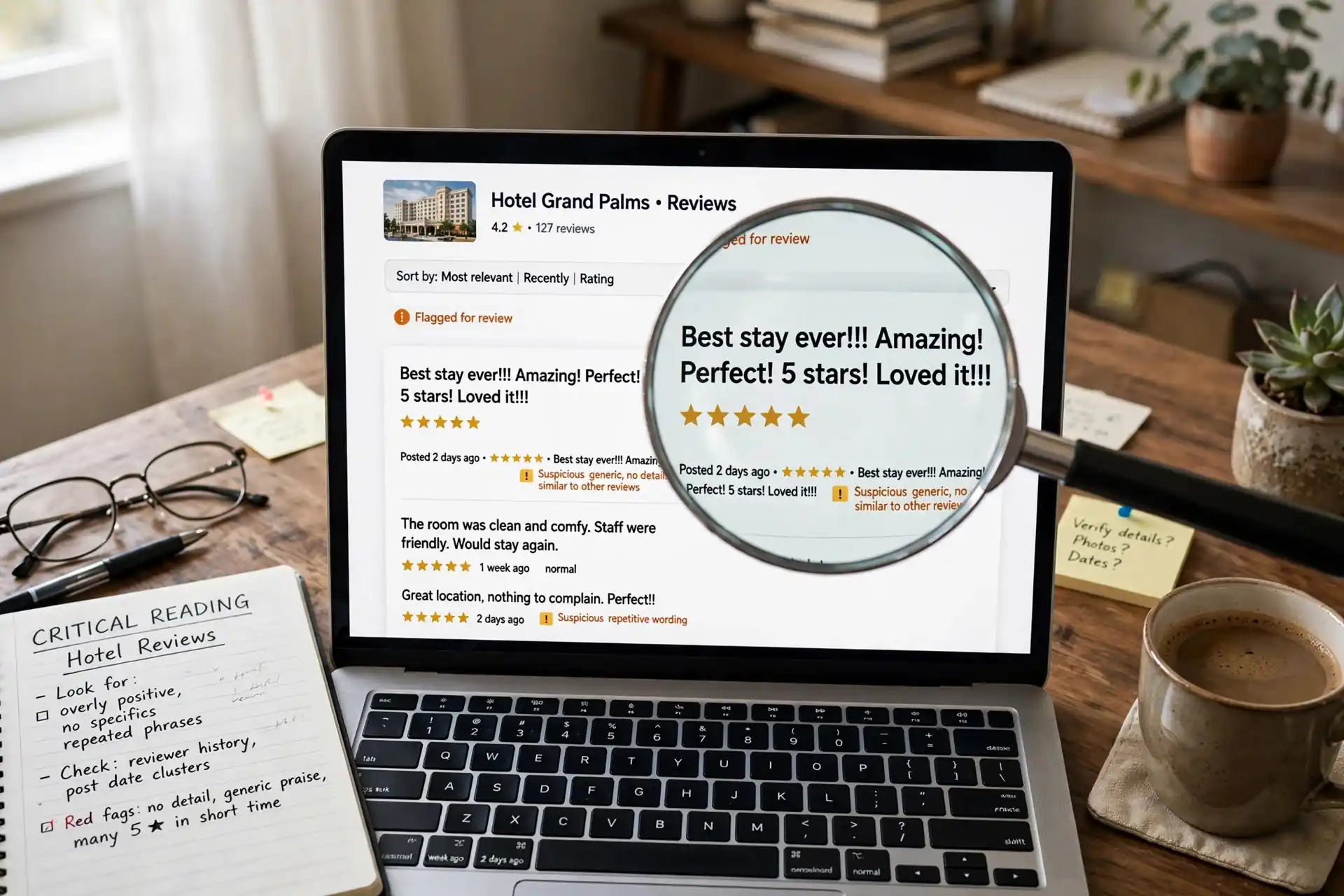
Genuine reviews usually mention specifics: the room number that faced the street, the breakfast that ran out by nine, the receptionist who helped with a taxi. Fake ones lean on general superlatives like “amazing,” “perfect,” and “best ever” without saying why.
Watch for the full name of the hotel or tour repeated several times in one review. Real guests rarely write that way. People writing for search engines do.
Check the reviewer, too
Click through to the profile. A reviewer with one review, or a string of five-star reviews for businesses in different cities on the same day, deserves less weight. So does a profile created recently with no photo and no other activity.
None of these signs proves a review is fake on its own. Plenty of honest travelers only ever write one review. It’s the combination that should make you skeptical.
Read the timeline
Sort reviews by date. A place with a steady trickle of mixed feedback over years looks like a real business. A sudden cluster of glowing reviews in one week, especially right after a run of complaints, often signals that someone paid for them or asked friends to help.
The reverse also happens. A burst of one-star reviews with similar wording can be a competitor or a coordinated campaign rather than a genuine problem.
Trust the middle
The most useful reviews are often the three-star ones. They tend to be written by people who weren’t trying to reward or punish anyone, and they usually explain trade-offs you care about, like a great location but thin walls.
When you read the mid-range reviews, look for complaints that repeat across different people and dates. A single mention of noise could be bad luck. Six mentions over two years is a fact about the building.
Spotting fake travel reviews across platforms
No single platform is immune, so compare across a few. A few quick checks help:
- Compare guest photos with the official photos. Big differences are a warning sign.
- Search the property name with words like “complaint” or “scam” and see what comes up outside the booking site.
- Check whether the business responds to negative reviews, and how. Calm, specific replies suggest a real operation.
- Look at reviews on a map-based platform, where reviewers often have longer histories.
Regulators take this seriously. The FTC’s guide to evaluating online reviews covers more warning signs and explains how businesses sometimes filter or incentivize feedback in ways you can’t see.
Be wary of reviews that mention an incentive, such as a free night or discount in exchange for posting. Even when the reviewer is honest, the reward skews the tone, and many platforms don’t allow it.
Finally, if a listing has almost no negative reviews at all, treat that as information too. Every hotel, tour, and restaurant has bad days. A perfect record over hundreds of stays is less likely to be excellent service than careful moderation.
A good rule: book on the pattern, never on a single review.
The Fake Review Economy
Travel reviews are compromised at industrial scale. Businesses buy positive reviews, competitors buy negative ones, and review farms produce convincing fakes by the thousand. Estimates of fake review prevalence vary, but studies consistently find significant percentages on major platforms, particularly for hotels and restaurants in competitive tourist markets. The fakes are no longer obvious. They are written by fluent humans or sophisticated AI, with specific details, plausible itineraries, and natural language patterns. Spotting them requires looking for structural tells rather than bad grammar.
The incentive structure explains the scale. A single star improvement on major platforms correlates with measurable revenue increases for hotels and restaurants. When one star is worth tens of thousands of dollars annually, spending hundreds on fake reviews is rational business behavior for the unscrupulous. Platforms fight back with detection algorithms and penalties, but it is an arms race the platforms are not decisively winning. Travelers need defensive reading skills. This matters because accommodation decisions based on misleading listing information compound when the reviews are also unreliable.
Patterns That Reveal Manipulation
Review velocity is the strongest signal. A property with a steady trickle of reviews for years that suddenly receives thirty five star reviews in two weeks is being boosted. Check the review dates, which most platforms display. Organic review patterns are roughly steady with seasonal variation. Spikes, especially of uniformly positive reviews, are artificial until proven otherwise. Similarly, a burst of one star reviews following no operational change suggests a competitor attack or extortion attempt.
Reviewer profile analysis is the second tool. Click through to reviewers leaving extreme ratings. If an account has only one review, or five reviews all for businesses in the same city posted on the same day, treat it skeptically. Genuine reviewers have varied histories across locations and time. Also watch for language patterns: multiple reviews using similar phrasing, identical specific details, or the same unusual adjectives suggest a single author behind multiple accounts.
Reading Reviews Like an Investigator
Weight the middle ratings heaviest. Three and four star reviews are the hardest to fake convincingly and the most informative. They contain the balanced detail that real experiences produce: what was good, what was not, who would enjoy it. Five star reviews may be genuine or purchased. One star reviews may be genuine or malicious. The threes and fours are where the truth lives. Read them first and in volume.
Look for specific, verifiable details over emotional superlatives. “The shower had great water pressure and the breakfast eggs were cooked to order” is credible. “Amazing incredible best ever” is not informative regardless of authenticity. Note what reviewers mention unprompted across multiple reviews. If six different reviewers mention thin walls, the walls are thin. Consensus on specifics is the most reliable signal in the entire review ecosystem.
Cross Platform Verification
Never rely on a single platform. Check the property across Google, TripAdvisor, Booking, and any regional platforms. Genuine quality shows consistently across sources. Manipulated ratings often show discrepancies: stellar on the platform where reviews were bought, mediocre where they were not. Also check the property’s responses to negative reviews. Professional, specific responses suggest real management. Generic defensive responses or no responses suggest indifference that often correlates with the complaints.
Tools and Techniques
Several third party tools analyze review authenticity using linguistic and pattern analysis. They are imperfect but useful as one input among many. Browser extensions that flag suspicious review patterns can speed up the profile analysis described above. But no tool replaces the fundamental skill of reading critically and cross referencing.
For high stakes bookings, go beyond reviews entirely. Check recent traveler photos, which are harder to fake at scale and reveal the property’s actual current condition. Look at the property on maps satellite view to verify location claims. Search for the property name plus words like scam, bedbugs, or construction to surface issues that reviews might miss. These independent checks catch what review manipulation hides. For the booking decision itself, choosing between accommodation types frames what you are actually evaluating. More travel planning resources are at Factblaze.
Frequently Asked Questions
What percentage of online reviews are fake?
Estimates vary widely by platform and category, with studies finding anywhere from single digits to over thirty percent in heavily manipulated categories like hotels in competitive markets. The exact number matters less than the assumption: treat reviews as a signal to be interpreted, not truth to be accepted.
Can I trust reviews with photos?
More than text alone, but not completely. Photos are harder to fake convincingly at scale, and traveler photos especially reveal real conditions. But stock photos get reused, and some fake reviewers attach plausible images. Photos raise credibility without guaranteeing it.
Should I only book places with hundreds of reviews?
High review counts provide more data for pattern analysis, which is valuable. But new legitimate properties have few reviews through no fault of their own. For newer places, weight the available reviews more carefully and supplement with the independent checks described above.
Do hotels really buy fake reviews?
Some do, and review farms openly advertise these services despite platform prohibitions. The economic incentive is clear and enforcement is imperfect. Assume the possibility exists for any property and read accordingly rather than assuming good faith.
What is the most reliable review platform?
None is categorically reliable, but platforms requiring verified stays, like Booking.com’s stayed guest reviews, have a structural advantage over open platforms where anyone can review anything. Combine verified stay platforms with open ones for the fullest picture.
Conclusion
Finding legitimate reviews means reading defensively: check review velocity for manipulation spikes, inspect reviewer profiles for authenticity, weight three and four star reviews heaviest, look for consensus on specifics, and verify across multiple platforms plus independent checks like traveler photos. The goal is not perfect certainty but a probabilistic picture built from multiple imperfect signals. Travelers who read this way book better and are surprised less. For research on review manipulation detection, the Federal Trade Commission publishes guidance on fake review practices and consumer protection.