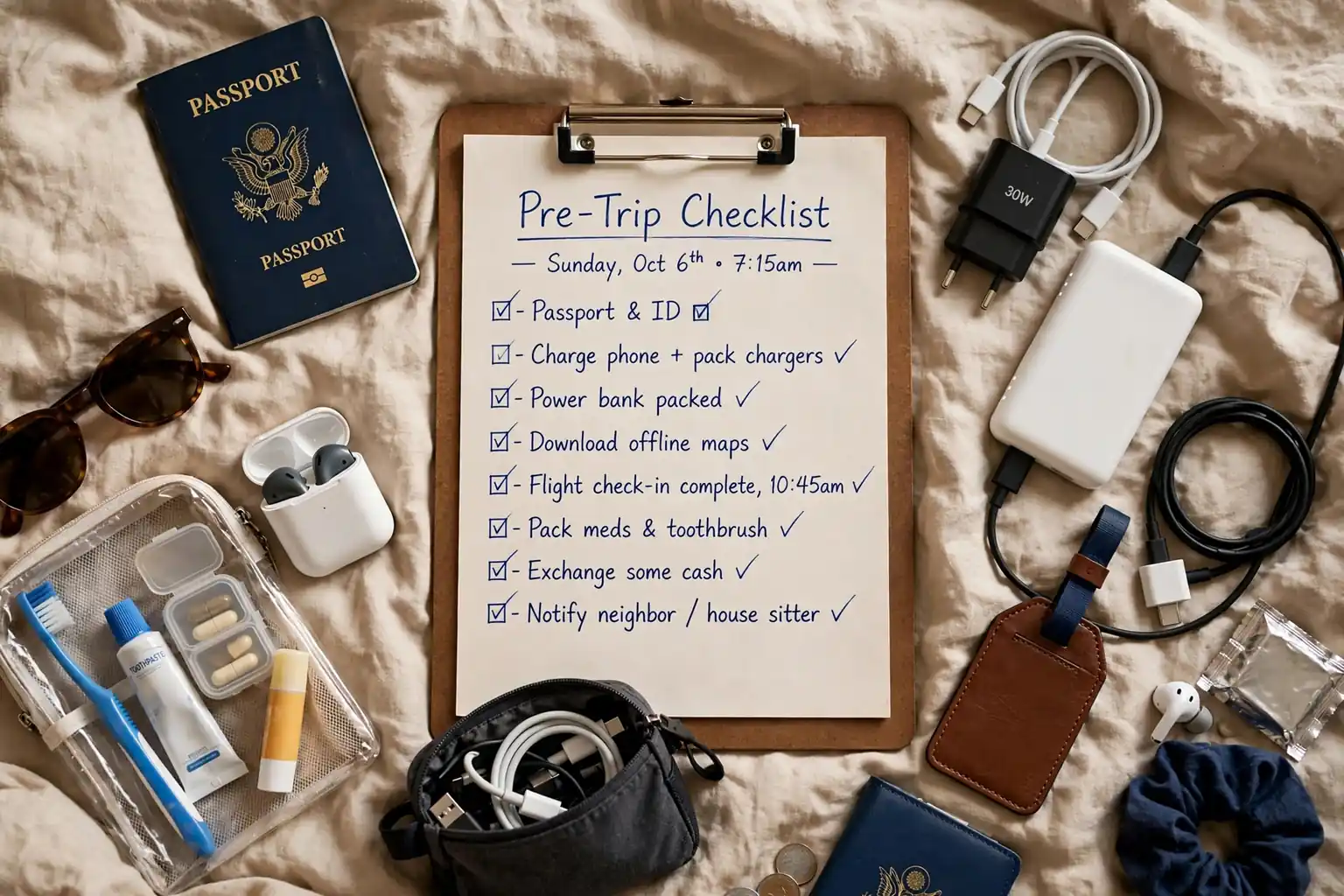
A Checklist for the Week Before an International Trip
International trips have failure points that domestic ones don’t — a passport that’s technically valid but not valid enough, a card that gets frozen the moment it’s used abroad, a phone with no way to reach anyone once you land. Clear these in the week before, while there’s still time to fix a problem.
Documents
- Check your passport’s expiration date against your destination’s entry rules, not just the calendar. Many countries require six months of validity beyond your travel dates, not just that the passport hasn’t technically expired. Requirements vary by country and change over time, so confirm the current rule for your specific destination on the relevant government’s official travel portal rather than assuming last year’s information still holds.
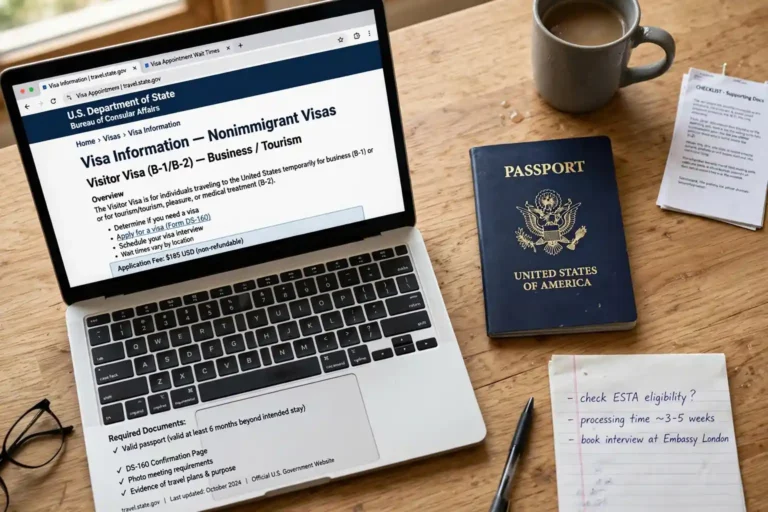
- Check visa requirements for your specific nationality and destination on an official government source. Rules here vary enough by passport and by country that a general travel article, including this one, shouldn’t be your final word on it.
- Make copies of your passport and itinerary, physical and digital. Email a copy to yourself and leave one with someone at home.
Money and Access
Call your bank and card issuer to flag your travel dates and destinations — an unflagged charge from abroad is one of the most common reasons a card gets frozen mid-trip. Check what your phone plan charges for data and calls where you’re going, and decide before you land whether you’re buying a local SIM, an eSIM, or an international plan add-on. Carrying a small amount of local currency for the first few hours after landing avoids being stuck at an airport exchange counter with no other option.
Health and Practical Prep
If your destination has any specific health guidance — altitude, water safety, required or recommended vaccinations — that’s a conversation for a doctor or travel clinic in the week before you leave, not a search engine the night before. Pack any prescription medication in your carry-on with enough supply to cover delays, along with copies of prescriptions if you’re carrying anything that might raise questions at customs.
Before You Walk Out the Door
Share your itinerary and accommodation details with someone who isn’t traveling with you. If you’re packing light, a carry-on-only approach works for longer international trips too, though it’s worth checking your destination’s customs rules on what you can bring in before you finalize what goes in the bag.
USA.gov’s travel section is a reliable starting point for passport, visa, and entry-requirement information straight from the source rather than secondhand.
Most international trip problems trace back to one skipped step in this list, not bad luck. Work through it a week out and the trip itself gets to be the part you actually remember.
The week before an international trip has a particular texture: excitement tangled up with a low hum of things you might be forgetting. The difference between a smooth departure and a stressful one is rarely luck — it’s a short list, worked through in order, with nothing left to the last night. This is that list, expanded into the details that actually trip people up.
Documents: The Non-Negotiable Foundation
Start here, because everything else is fixable except this. Check your passport’s expiration date against your destination’s entry requirements — many countries require six months of validity beyond your travel dates, and airlines can deny boarding if you don’t meet it. This is the single most common document failure, and it’s entirely preventable a week out.
Next, visas. Requirements vary wildly by nationality and destination, and processing times range from instant e-visas to multi-week consulate appointments. A week before departure is your last comfortable window to confirm you have what you need — or to discover you don’t, while there’s still time for expedited processing. For US travelers, travel.state.gov is the authoritative source for destination-specific entry requirements; for everyone else, your own foreign ministry’s travel site plus the destination country’s official immigration page. When in doubt about finding official visa information, go straight to government sources — third-party visa blogs go stale fast.
Copies and Digital Backups
Photograph or scan your passport’s photo page, your visa, your travel insurance policy, and your flight and hotel confirmations. Store them in cloud storage you can reach from any device, and email a set to yourself. Keep paper photocopies separate from the originals in your luggage. If your passport is lost or stolen abroad, having the number and a scan dramatically speeds up the replacement process at an embassy.
Also confirm how you’ll prove onward travel if your destination requires it — some countries want to see a return or onward ticket before they’ll let you board. A confirmation email on your phone usually suffices, but have it downloaded, not just in your inbox, in case airport Wi-Fi fails you.
Money: Cards, Cash, and Notifications
Call it old-fashioned, but notifying your bank of travel plans still prevents the special misery of a frozen card at a foreign ATM. Many banks let you set travel notices in their app — do it for every card you’re bringing, with the correct dates and countries. While you’re in the app, confirm your cards have no foreign transaction fees, or decide which card to use for what.
Get some local currency before you go — not a fortune, just enough for the taxi from the airport, a meal, and small emergencies before you find an ATM. Airport exchange counters have the worst rates in the business; a modest amount from your home bank or a reputable exchange service is cheaper. And check your daily ATM withdrawal limits; if you plan to rely on cash, you may want them raised temporarily.
Bring at least two different cards on two different networks (Visa and Mastercard, say), kept in separate places. If one is lost, skimmed, or declined, you have a backup. This redundancy is the cheapest travel insurance you’ll ever buy.
Health and Insurance: The Boring Stuff That Saves Trips
A week out, verify your travel insurance actually covers your trip — not just that you have a policy, but that the dates, destinations, and activities match. Adventure activities, cruises, and pre-existing conditions are the classic coverage gaps. Read the medical evacuation clause; it’s the part that matters in a real emergency.
Check whether your destination requires or recommends vaccinations, and whether you need proof — some countries ask for yellow fever certificates at the border. If you take prescription medication, confirm you have enough for the trip plus a buffer of several days, keep it in original labeled containers, and carry a copy of the prescription. Some medications that are routine at home are controlled substances abroad; a quick check of your destination’s rules avoids an ugly surprise at customs.
Assemble a small health kit: any personal prescriptions, basic pain relievers, anti-diarrhea medication, rehydration salts, bandages, and insect repellent appropriate to the region. Pharmacies abroad are fine, but explaining what you need through a language barrier at midnight is not how you want to spend your first evening.
Your Phone: Roaming, eSIMs, and Offline Access
Decide your connectivity plan now, not at the airport. Options: your carrier’s international roaming plan, a local SIM bought on arrival, or an eSIM installed before departure. eSIMs have become the easiest option for most travelers — buy before you fly, install at home on Wi-Fi, activate on landing. Whatever you choose, confirm your phone is unlocked if you’re going the local-SIM route.
Download what you’ll need offline: maps of your destinations, translation language packs, your airline’s app with boarding passes, and hotel confirmations. Screenshot or save anything with a QR code. Then tell someone your itinerary — a full copy to a trusted person at home, including flight numbers, hotel addresses, and your insurance policy number.
Home Logistics: The Part Everyone Forgets
An empty home needs a minimum of preparation. Stop mail or arrange for someone to collect it — a stuffed mailbox advertises absence. Set lights on timers. Unplug non-essential electronics. Take out the trash and clear perishables from the fridge; nothing ruins a homecoming like the smell of a forgotten bag of salad.
Arrange pet care, plant watering, and any bill payments that fall due while you’re away. Set up autopay or pay early for anything due during the trip. And leave a house key with someone you trust, with your contact details and return date written down — not just in a text message that gets buried.
The Final 48 Hours
Two days before, do a full document check: passport, visa, insurance, confirmations — physical and digital. Charge every device and pack chargers in your carry-on, never in checked luggage. Confirm your airport transfer or parking. Check in for your flight the moment it opens, and verify seat assignments and baggage allowances.
The night before deserves its own ritual, and it’s worth treating the night before a flight as a separate checklist: lay out travel clothes, pack the carry-on completely, set multiple alarms, and get to bed at a reasonable hour. Almost every departure-day disaster — the forgotten passport, the dead phone, the missed alarm — is a night-before failure, not a morning failure.
Frequently Asked Questions
How early should I arrive at the airport for an international flight?
The standard guidance is three hours for international departures. That covers check-in, security, and the longer document checks international flights require. During peak seasons or at large hubs, add a buffer.
Do I really need travel insurance?
For international travel, yes — medical care abroad can be shockingly expensive, and your domestic health insurance often covers little or nothing overseas. At minimum, get medical and evacuation coverage; trip cancellation is a sensible add-on for expensive bookings.
Should I get local currency before I leave?
A small amount, yes — enough for arrival-day essentials. For the rest of the trip, withdrawing from local ATMs with a no-fee debit card almost always beats exchange counters on rates.
What if my passport expires in five months?
Many countries will deny you entry under the six-month validity rule, and airlines may deny boarding. Renew before you travel — expedited services exist, but a week out you’re cutting it close, so check immediately.
Is an eSIM better than a local SIM card?
For most travelers, yes: you install it before departure, keep your home number active for calls and texts, and avoid hunting for a SIM vendor on arrival. Local SIMs can be cheaper for long stays or heavy data use.
Conclusion
A calm departure is just a checklist executed early. Documents first, money second, health and phone third, home last — and the final night reserved for packing, not panicking. Work through it in order and the week before your trip feels like anticipation instead of anxiety. For more travel preparation guides, visit Factblaze, and have a great trip.