
How to Choose a Travel Adapter That Works Everywhere You’re Going
Choosing a universal travel adapter comes down to two separate questions: will the plug fit the wall, and will your device survive the electricity coming out of it? An adapter only solves the first one, so you need to check both before you pack.
Most people shop for the shape and forget the voltage. That’s how hair straighteners end up smoking in hotel bathrooms.
Choosing a universal travel adapter starts with plug shape
A plug adapter is a passive piece of plastic and metal. It rearranges the prongs so your plug fits a foreign socket, and that’s all. It doesn’t change the voltage, the frequency, or anything else about the power.
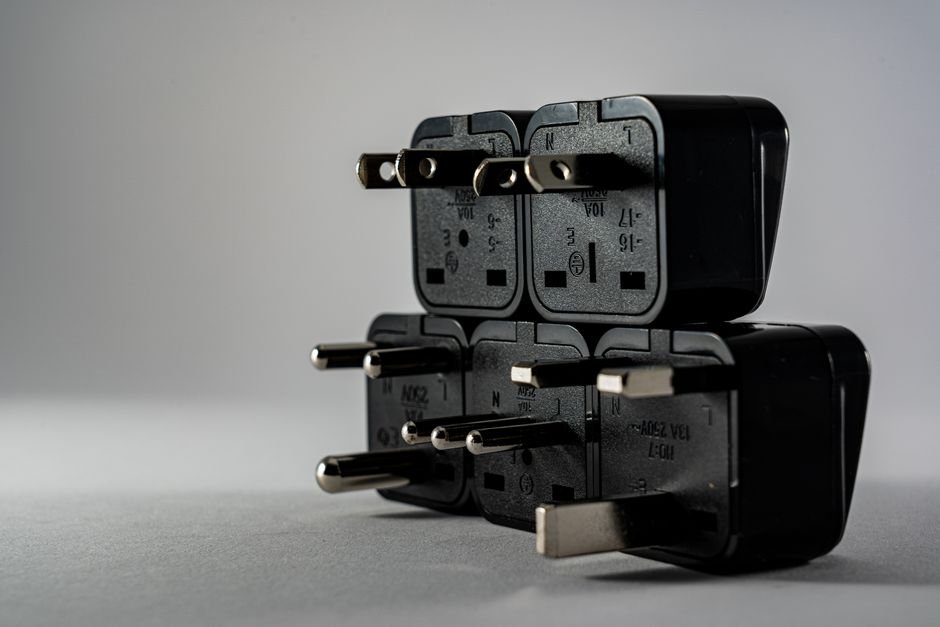
There are over a dozen socket types in use around the world, and some countries use more than one. A good universal adapter covers the common ones with sliding or folding prongs: the flat parallel pins used in North America, the round pins common across much of Europe, the three rectangular pins used in the UK and Ireland, and the angled pins used in Australia and New Zealand. Before you buy, look up the socket type for every country on your route, not just the first stop, and confirm the adapter lists each one.
Voltage: the part that can ruin a device
Household power runs at roughly 100 to 127 volts in some regions and 220 to 240 volts in others. Plug a device built only for the lower range into the higher one and you can burn it out in seconds.
The fix is reading the label on your charger or power brick. Look for the input line. If it says something like “100–240V, 50/60Hz,” the device is dual voltage and only needs a plug adapter. Most phone chargers, laptop bricks, and camera chargers are built this way.
If the label shows a single voltage, you need a voltage converter or a dual-voltage replacement. Heat-producing appliances are the usual problem: hair dryers, curling irons, straighteners, and travel kettles often draw more power than small converters can handle. Buying a dual-voltage version of the tool is usually safer and simpler than converting.
Features worth paying for
- Built-in USB ports, ideally including USB-C with enough output to charge a laptop, so one adapter handles several devices.
- A fuse or surge protection, and a safety certification mark from a recognized testing body such as UL or an equivalent regional lab.
- Grounding support if you’re charging a laptop with a three-prong plug.
- A compact, sturdy body that doesn’t sag out of loose hotel sockets.
Skip the cheapest no-name cubes. Poorly built adapters overheat, lose contact, and occasionally fail in ways that damage what’s plugged in. A well-made universal adapter isn’t expensive relative to the phone or laptop it protects.
Pack it where you can reach it on arrival, because a dead phone after a long flight is when you’ll want it most. Adding it to your night-before-a-flight checklist keeps it from being left on the kitchen counter, and if you’re heading abroad, the week-before international trip checklist is a good moment to check every charger’s label.
Read the tiny print on your chargers before you buy anything. That one line of text tells you whether a basic adapter is enough or whether you need to rethink what you’re bringing.