How to Choose a Travel Adapter That Works Everywhere
Choosing a universal travel adapter comes down to two separate questions: will the plug fit the wall, and will your device survive the electricity coming out of it? An adapter only solves the first one, so you need to check both before you pack.
Most people shop for the shape and forget the voltage. That’s how hair straighteners end up smoking in hotel bathrooms.
Choosing a universal travel adapter starts with plug shape
A plug adapter is a passive piece of plastic and metal. It rearranges the prongs so your plug fits a foreign socket, and that’s all. It doesn’t change the voltage, the frequency, or anything else about the power.
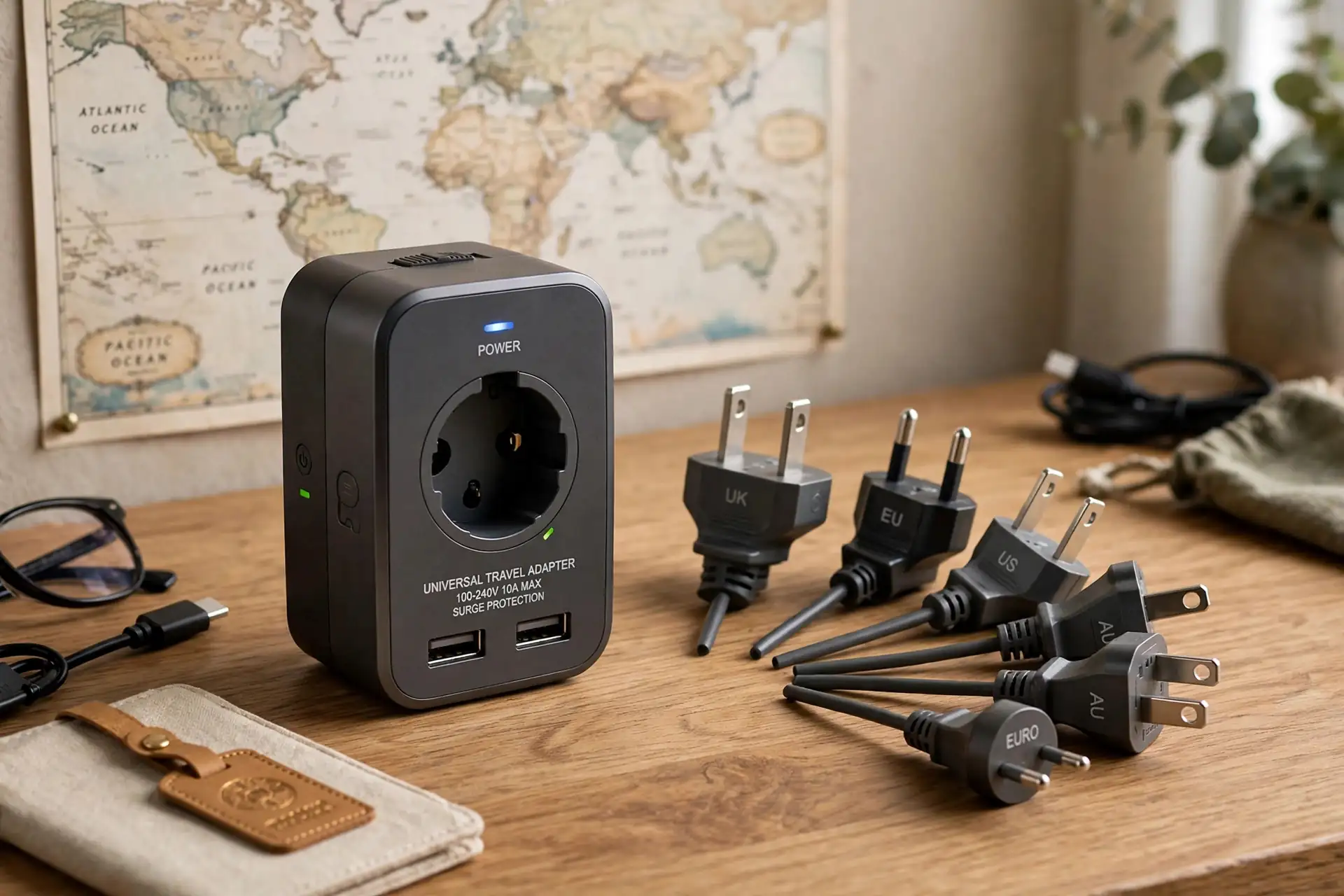
There are over a dozen socket types in use around the world, and some countries use more than one. A good universal adapter covers the common ones with sliding or folding prongs: the flat parallel pins used in North America, the round pins common across much of Europe, the three rectangular pins used in the UK and Ireland, and the angled pins used in Australia and New Zealand. Before you buy, look up the socket type for every country on your route, not just the first stop, and confirm the adapter lists each one.
Voltage: the part that can ruin a device
Household power runs at roughly 100 to 127 volts in some regions and 220 to 240 volts in others. Plug a device built only for the lower range into the higher one and you can burn it out in seconds.
The fix is reading the label on your charger or power brick. Look for the input line. If it says something like “100–240V, 50/60Hz,” the device is dual voltage and only needs a plug adapter. Most phone chargers, laptop bricks, and camera chargers are built this way.
If the label shows a single voltage, you need a voltage converter or a dual-voltage replacement. Heat-producing appliances are the usual problem: hair dryers, curling irons, straighteners, and travel kettles often draw more power than small converters can handle. Buying a dual-voltage version of the tool is usually safer and simpler than converting.
Features worth paying for
- Built-in USB ports, ideally including USB-C with enough output to charge a laptop, so one adapter handles several devices.
- A fuse or surge protection, and a safety certification mark from a recognized testing body such as UL or an equivalent regional lab.
- Grounding support if you’re charging a laptop with a three-prong plug.
- A compact, sturdy body that doesn’t sag out of loose hotel sockets.
Skip the cheapest no-name cubes. Poorly built adapters overheat, lose contact, and occasionally fail in ways that damage what’s plugged in. A well-made universal adapter isn’t expensive relative to the phone or laptop it protects.
Pack it where you can reach it on arrival, because a dead phone after a long flight is when you’ll want it most. Adding it to your night-before-a-flight checklist keeps it from being left on the kitchen counter, and if you’re heading abroad, the week-before international trip checklist is a good moment to check every charger’s label.
Read the tiny print on your chargers before you buy anything. That one line of text tells you whether a basic adapter is enough or whether you need to rethink what you’re bringing.
Why One Adapter Does Not Fit Every Trip
The phrase universal travel adapter is optimistic marketing. No single adapter handles every plug type, voltage, and frequency combination on earth, because the world’s electrical systems were never standardized. What you actually need depends on three separate questions: what plug shape your destination uses, what voltage it runs, and what your devices require. Confusing these three is how travelers fry electronics or sit phoneless in hotel rooms.
Start with plug shape, which is purely mechanical. There are fifteen recognized plug types lettered A through O. North America uses A and B. Most of Europe uses C, E, and F. The UK uses G. Australia uses I. Parts of Asia and Africa use D, M, and N. A good adapter covers the types for your specific destinations, not all fifteen. Buying a massive cube that handles everything is heavier and bulkier than a compact adapter matched to your route. Check each country’s plug type before you go, since neighbors often differ. This kind of destination specific preparation is part of preparing in the week before an international trip.
Adapters vs Converters: The Critical Distinction
An adapter changes plug shape. A converter changes voltage. These are completely different functions, and confusing them destroys devices. Most modern electronics, phones, laptops, camera chargers, are dual voltage, marked 100-240V, and need only an adapter for the plug shape. The device handles the voltage difference internally. But high wattage heating appliances, hair dryers, curling irons, kettles, are often single voltage. Plugging a 120V hair dryer into 240V European current with only a plug adapter will kill it spectacularly, possibly with smoke.
Check every device’s label before traveling. If it says 100-240V, you need only an adapter. If it says 120V only, you need a voltage converter rated for the device’s wattage, or better, leave it home and buy a dual voltage travel version. For most travelers, the practical answer is to travel only with dual voltage electronics and skip the converter entirely.
What to Look for in an Adapter
Prioritize compactness and the specific plug types you need. The best travel adapters are small cubes or sliding designs that cover four to six common types. Avoid the giant all in one bricks unless you genuinely travel across many plug regions. Weight and pocket space matter when the adapter lives in your daypack for weeks.
USB ports are now essential. An adapter with two or more USB ports, ideally including USB-C with decent wattage, lets you charge multiple devices from one outlet. This matters because many hotel rooms have frustratingly few accessible outlets. Check the USB power output: cheap adapters provide slow 1A charging that barely maintains a modern phone. Look for at least 2.4A per port or USB-C PD for laptops. Surge protection is a meaningful bonus in regions with unstable power grids.
Safety Certifications Matter
Buy adapters with recognized safety certifications: CE, FCC, RoHS at minimum. Uncertified cheap adapters are a genuine fire risk, with undersized internal contacts that overheat under load. This is not theoretical. Hotel fires started by cheap adapters are documented. Spend the extra ten dollars. Also check that the adapter’s maximum wattage rating exceeds your highest draw device, and never daisy chain adapters or plug power strips into adapters in ways that exceed ratings.
Destination Specific Notes
The UK and Ireland use the bulky Type G plug with a built in fuse. Adapters for the UK are necessarily chunky. Much of Europe is straightforward with Type C, the simple two round pin Europlug that fits most continental sockets. Switzerland uses its own Type J, which looks similar but is not identical. Italy mixes types L with varying pin spacing. Japan uses Type A like North America but runs 100V, which is fine for dual voltage devices but worth noting.
Parts of Africa and Asia are the trickiest, with multiple plug types sometimes within one country due to colonial era infrastructure mixing. South Africa’s Type M, India’s Type D, and Brazil’s Type N each require specific adapter support. When visiting these regions, verify at the city level if possible, not just the country level. For keeping all your travel gear organized alongside power solutions, packing electronics properly prevents the tangled mess most travelers accept as inevitable. More travel gear guides are at Factblaze.
Frequently Asked Questions
Do I need a voltage converter for my phone?
No. Virtually all modern phone chargers are dual voltage (100-240V). You need only a plug adapter for the shape. Check the tiny print on your charger to confirm, but phone charging has been universally dual voltage for over a decade.
Can I use my CPAP machine abroad with just an adapter?
Most modern CPAP machines are dual voltage, needing only a plug adapter. Verify on your specific model’s label. Bring a backup power option and check with your airline about in flight use policies. Medical devices deserve extra verification before you rely on them abroad.
Why does my adapter feel hot?
Mild warmth is normal under load. Genuine heat, too hot to touch comfortably, indicates overloading, poor contact, or a defective unit. Unplug immediately and reassess. Never ignore a hot adapter, and never cover adapters with fabric that traps heat.
Should I buy the adapter at home or at my destination?
Buy at home. Destination purchased adapters are often lower quality tourist trap products at inflated prices, and you need the adapter working from the moment you arrive, ideally for the airport transfer. Research and buy a certified adapter before departure.
Can I charge my laptop through a USB port on the adapter?
Only if the USB-C port supports Power Delivery at sufficient wattage for your laptop, typically 45W or more. Standard USB-A ports cannot charge laptops meaningfully. For laptop charging, either use the laptop’s own power brick with a plug adapter or verify the travel adapter’s USB-C PD specifications match your laptop’s requirements.
Conclusion
Choosing a travel adapter means answering three questions: which plug types your destinations use, which of your devices are dual voltage, and how many USB ports you need. Buy a compact certified adapter matched to your route, travel only with dual voltage electronics, and respect wattage limits. The universal adapter does not exist, but the right adapter for your specific trip does, and it weighs almost nothing. For official plug and voltage data by country, the International Electrotechnical Commission maintains world plug type references worth consulting before any trip.