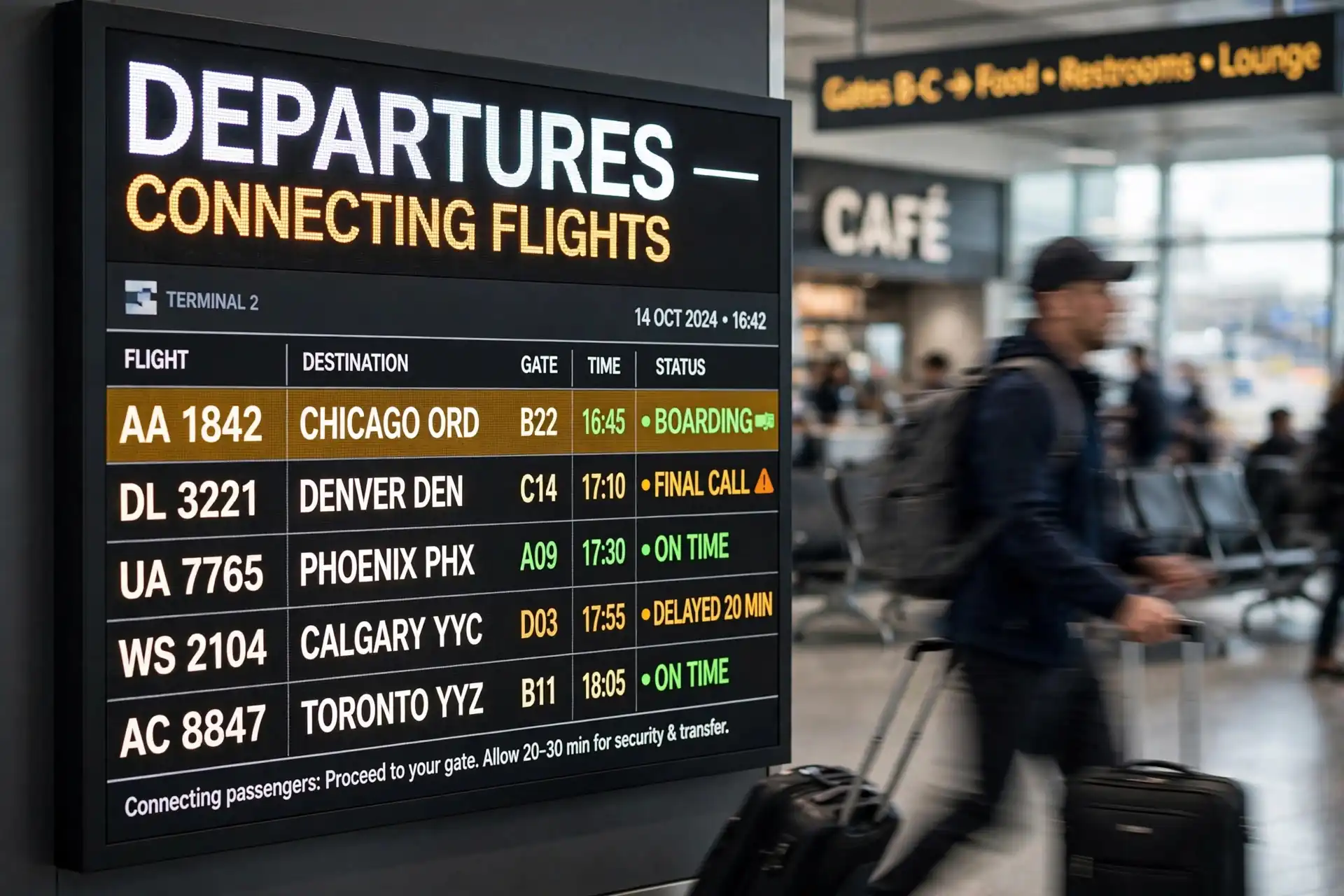
Common Mistakes People Make Booking Connecting Flights
Most connecting-flight problems start at booking, not at the airport. By the time you’re jogging between gates, the mistake was already made weeks earlier by whoever picked the layover time.
Cutting the Layover Too Close
A 45-minute connection looks fine on a booking site, but it doesn’t account for a late inbound flight, a gate on the opposite end of a large airport, or a security recheck at an international transfer. As a rough floor, an hour is tight for a small domestic airport and can be genuinely risky for a large hub or any connection that involves clearing customs again. When a layover looks short, check the airport’s own minimum connection time before assuming the airline’s booking system already protected you from it.
Booking Separate Tickets to Save Money
Splitting a trip into two separate tickets with two different airlines is sometimes cheaper, but it removes the safety net that comes with a single itinerary. If the first flight is delayed and the two bookings aren’t linked, the second airline has no obligation to rebook you, hold the flight, or move your checked bag — you’re simply treated as a no-show. That risk is worth taking for a long layover in one city on a trip you’re not in a rush to finish, and a bad trade for anything tight.
Assuming Checked Bags Transfer Automatically
Bags usually transfer automatically only when both flights are on the same ticket, often within the same airline alliance. Separate tickets frequently mean claiming your bag and rechecking it yourself, which eats into whatever connection time you had. This is one more reason a carry-on-only approach is worth considering for shorter trips with a connection — it removes bag transfer entirely from the list of things that can go wrong.
Not Checking the Terminal Change
Some connections require moving between terminals that aren’t a short walk apart, sometimes involving a shuttle, train, or a full re-entry through security. That detail is usually visible on the booking confirmation but easy to skim past. Knowing before you land whether you’re dealing with a five-minute walk or a fifteen-minute shuttle ride changes how nervous you should be about a short connection.
Ignoring Time Zones When Judging Layover Length
A layover that reads as three hours can actually be much shorter once you account for a time zone change on the connecting leg, and the reverse is also true. Always check both flight times against the same clock before deciding a connection feels comfortable.
The FAA’s traveler resources cover more of the operational side of flight delays and airport logistics if you want to understand what drives connection risk on a given route.
None of these mistakes are exotic — they’re all decisions made in the ten seconds it takes to pick a flight time on a booking page. Slow down on that one screen and most of the risk goes away.
Connecting flights look simple on a booking screen: pick a departure, pick an arrival, done. The mistakes hide in everything the screen does not show you, from minimum connection times to whose responsibility your bags become. The overview above names the traps. Below is how each one actually works and how to avoid it.
Booking Layovers That Are Too Short
The forty-five-minute connection is the classic self-inflicted wound of air travel. It looks efficient on paper and falls apart at the first gust of reality. A slightly late inbound flight, a gate at the far end of the terminal, a slow deplaning process, and suddenly you are sprinting through an airport you have never seen while your next flight boards without you.
Every airport publishes minimum connection times, the shortest interval the airport considers workable, and they vary enormously. A domestic-to-domestic connection at a compact airport might be officially fine at forty-five minutes. An international-to-domestic connection at a sprawling hub can require two hours or more once immigration, baggage claim, customs, and rechecking are factored in. These minimums are floors, not recommendations. They assume everything goes right, and things rarely go right on every leg of a travel day.
A practical rule: give yourself at least ninety minutes for domestic connections and three hours when switching from international to domestic. Longer is not wasted time. It is insurance you can spend on coffee instead of panic.
Stitching Together Separate Tickets
This is the mistake that turns a missed connection from an inconvenience into a financial disaster. When both flights are on one ticket, the airline that sold it is responsible for getting you to your destination. If you miss the connection because the first flight was late, they rebook you, usually at no charge, and duty-of-care rules in many regions cover meals and hotels during long delays.
When the flights are on separate tickets, even with the same airline, none of that applies. The second airline sees you as a no-show, not a misconnected passenger. Your onward ticket may be canceled automatically, and buying a replacement at walk-up prices on the day of travel is brutally expensive. The first airline owes you nothing for the missed connection because, as far as its contract goes, it delivered you to the airport on its ticket, late or not.
People end up with separate tickets by chasing cheap fares: a budget carrier for the first leg, a different airline for the long haul. Sometimes the savings are real, but price the risk honestly. If you must fly separate tickets, build in an overnight buffer between them and know before you book what a last-minute replacement ticket would cost. The U.S. Department of Transportation’s air travel consumer pages at transportation.gov spell out what airlines actually owe you in delay and cancellation scenarios, and the protections are thinner than most travelers assume.
Overlooking Terminal Changes and Airport Layouts
Not all connections at the same airport are equal. Some airports make terminal changes painless, with airside trains every few minutes. Others require exiting security, riding a shuttle bus across the airfield, and reclearing security, a process that can eat an hour before you have even walked anywhere.
Terminal changes on one ticket
Before booking, check which terminals your flights use. Airline websites and airport maps show this, and a quick search for the airport’s terminal transfer guide tells you whether the move is airside or landside. A connection that requires reclearing security needs at least an extra hour compared to one that does not. This detail is invisible on most booking screens, which is exactly why it catches people.
International-to-domestic transfers
In the United States, arriving internationally usually means clearing immigration, collecting your bags, passing customs, and rechecking them, even when both flights are on one ticket. Some airports have streamlined this, but many have not. Add the possibility of long immigration lines during peak arrival banks. Three hours is the sane minimum here, and during busy seasons even that can feel tight.
The multi-airport city trap
A few cities have multiple airports, and booking sites occasionally offer itineraries that arrive at one and depart from another. London, New York, Tokyo, and Paris are the usual suspects. Unless you specifically want a city stopover, treat these as different cities. The transfer between airports is a separate journey with its own traffic risk, and no airline will protect the connection.
Not Thinking About the Long Day as a Whole
Travelers optimize each flight in isolation and forget they are buying a ten-hour day, not two pleasant flights. Seat strategy is the overlooked piece. On a single short hop, any seat is tolerable. Across three legs with layovers, the seat you pick compounds: easy bathroom access on every leg, or a window view you stop noticing by leg two. Our breakdown of the aisle versus window seat debate is worth a read before you select seats, because the right answer changes when the trip gets long.
The same whole-day thinking applies to departure times. The 6 a.m. first leg that saves fifty dollars costs you a 3:30 a.m. alarm and a groggy connection decision later. The last flight of the day as your final leg means a missed connection strands you overnight with no later option. Midday departures give you the most recovery options if anything goes wrong, because there are still later flights to be rebooked onto.
Food and comfort deserve a line in the plan too. Long connection days with tight turnarounds leave no time for real meals, and airport food at a sprint is expensive and miserable. Pack snacks, carry an empty water bottle through security, and download entertainment before you leave. Small preparations, large difference in how the day feels.
Skipping the “Should I Even Connect?” Question
Sometimes the best connection is no connection. For short routes, travelers default to flying without checking the alternatives, and the math often favors the train. A one-hour flight with a connection can easily become a five-hour door-to-door journey once you count airport arrival time, the layover, and baggage claim. On many corridors, rail is genuinely competitive. Our comparison of overnight train versus short flight walks through the real door-to-door numbers, and on some routes the train wins outright while letting you sleep through the journey.
Even when flying is the right call, question the routing. A direct flight that costs a little more is often cheaper than a connection once you value your time and risk. And if you must connect, consider connecting through the airline’s main hub rather than a small outstation. Hubs have more frequent onward flights, which means more rebooking options when things go wrong, plus better facilities for killing a long layover comfortably.
Frequently Asked Questions
What is the minimum safe layover for a domestic connection?
Ninety minutes is a sensible minimum for domestic-to-domestic connections at most airports. Go longer at large hubs, during winter weather season, or if the connection requires a terminal change. Forty-five minutes is the airline’s minimum, not yours.
Will the airline wait for me if my first flight is late?
Occasionally for a few minutes, but never count on it. Airlines hold flights only in rare operational circumstances. Assume the second flight leaves on time and plan your connection so that a modest delay on the first leg does not strand you.
Do I need to recheck my bags on every connection?
On a single ticket, bags are usually checked through to your final destination, except on international-to-domestic transfers in countries like the United States, where you must collect and recheck them after customs. On separate tickets, always confirm with the first airline whether the bags can be tagged through.
What happens if I miss my connection?
On a single ticket, the airline rebooks you on the next available flight at no charge. On separate tickets, you are on your own and may need to buy a new onward ticket at last-minute prices. Travel insurance with missed-connection coverage can help, but only if the policy was bought before the disruption.
Are longer layovers ever a good thing?
Yes. A four-to-six-hour layover at an interesting hub can become a mini city visit, and even a boring long layover beats a missed connection. Some airlines formalize this with free stopover programs. The stress you avoid is worth more than the time you spend.
Conclusion
Good connecting itineraries are built, not found. Give yourself real buffer time, keep everything on one ticket whenever possible, check the terminals before you book, plan for the whole travel day instead of each leg, and question whether the connection should exist at all. Most missed-connection horror stories trace back to one of these five decisions. For more travel planning guides that save you from learning the hard way, browse the travel section here on Factblaze.